

The AER also specified that much of the planned generation from 2023-24 had been delayed, with 2.1GW of large-scale generation and energy storage commissioned throughout that year. Much of the commissioned capacity set to enter the market during the year will now come online a year later in 2024-25, providing 6.4GW to the NEM at full output. For reference, the NEM often seeks peak demand spikes of around 34GW, supplied by 48GW of generating capacity.
Consumers have become an ‘integral part of the energy transition’
This grants an opportunity for rooftop solar PV, which is set to overtake coal-fired power by the end of this year and by the end of the decade and is forecast to reach 49.4GW. According to the AER’s report, consumers have become an “integral part of the energy transition” due to their investment in rooftop solar PV, home batteries, and electric vehicles (EVs).
Consumer investment in rooftop solar PV has meant that it has become the highest registered capacity fuel source on the NEM, the AER has said, standing at over 20GW. This is the equivalent of 25% of the registered generation capacity on the NEM and is an increase of 2.9GW year-on-year.
This is a remarkable feat for clean technology and could lead to it playing a major role in the market under plans being explored by the Australian Energy Market Commission (AEMC). The organisation introduced a new draft determination proposing to enable virtual power plants (VPPs) to compete directly with large-scale generators in the energy market. This would be achieved by enabling aggregated consumer energy resources (CERs) to be scheduled and dispatchable in the NEM.
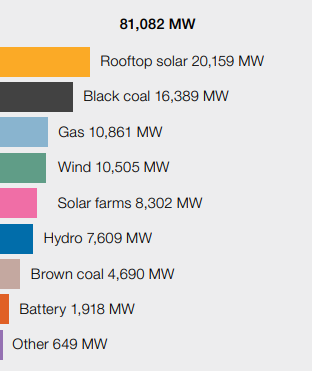 The NEM’s generation mix from 2023-24. Image: AER.
The AEMC cited that price-responsive small resources, such as backup generators and solar PV, could, therefore, respond to changes in spot prices. This would also contribute to a decentralised energy system. The amount of rooftops on the NEM could provide key services in the energy transition as coal-fired power is withdrawn from the grid.
It is worth noting that New South Wales and Queensland have the most installed capacity. However, South Australia has the highest relative rooftop solar capacity, making up 40% of its total capacity. Queensland, however, has the highest percentage installed on its rooftops with it standing at just over 50%.
The AER stated that the rapid uptake of rooftop solar PV has “dramatically changed the shape of daily spot price and grid demand” in the NEM. Before the mass adoption of the technology, the peak of both prices and demand in the summer typically occurred in the middle of the day. The ARE claims that the “opposite is now true”.
Grid-scale solar PV leads to negative price intervals
The AER’s report also highlights the importance of grid-scale solar PV power plants. The organisation states that Australia has the highest solar radiation per square metre of any continent, thus showcasing the opportunity the technology could play in Australia’s energy transition.