

In the days after wildfire ripped through a rural neighborhood in the Maui mountain town of Kula, residents were determined to do what they could to prevent a repeat. With donated hoses and some impromptu training, some even learned how to open a standpipe to attack flames themselves if needed.
It’s part of a self-reliance mindset that took hold after the blaze last August, when the Upcountry fire destroyed 19 homes. Since that blaze, which had firefighters trucking in water from elsewhere because of a loss in system pressure, the people of Kula are determined to do all they can to be ready for next time.
“Anyone around who sees something, you’re on duty,” said Mark Ross, who lost a rental property where he had planned to retire with his wife. Ross, who is among residents who learned how to tap the standpipe from a retired fireman using donated hoses to stamp out hot spots for months after the fire, called the training “kind of a lifeline for everybody who still lives in that neighborhood.”
The fire that hit Kula was far smaller than the one that devastated the historic town of Lahaina, about 24 miles (about 38 kilometers) away. At least 102 people died in Lahaina, the deadliest U.S. wildfire in a century, and thousands of homes burned.
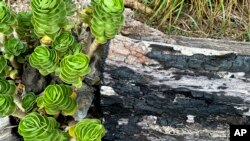
Succulent plants sprout through a charred log outside Chris Cole’s home, July 18, 2024, in Kula, Hawaii.
But what’s happened in Kula in the year since has been a lesson in community-led recovery. Residents stood watch for months to protect their homes from flare-ups as roots smoldered underground. They cleared debris. They installed cameras to watch for signs of future fires. And they’re working to restore burned forests, including launching a nursery for native plants aimed at reintroducing a native ecosystem to an area that had been overtaken by thirsty invasive trees.
“They’re building infrastructure, but the beautiful thing is at the same time, they’re building social infrastructure,” said Rebecca Solnit, author of several books on post-disaster cities. “They’re deepening community and that is a major source of safety in a disaster.”
Kyle Ellison started a nonprofit after the fire, Malama Kula, that organizes volunteers to meet Kula fire victims’ immediate needs like clearing debris. It also bought and installed two advanced smoke detection cameras to watch over the town — a tool that Hawaiian Electric began installing across the entire island around the same time, and is widely used in California.
“We’re not going to wait for people to say it’s OK for us to do things,” said Ellison, who watched flames last year come within 10 feet of the home he was renting. “The community is just going to take action to protect ourselves.”
Residents are also urging officials to safeguard their water system and its pressure. Kula’s pipes ran dry last year because key pumps had no backup power when they lost electricity — a common vulnerability for towns across the United States.