


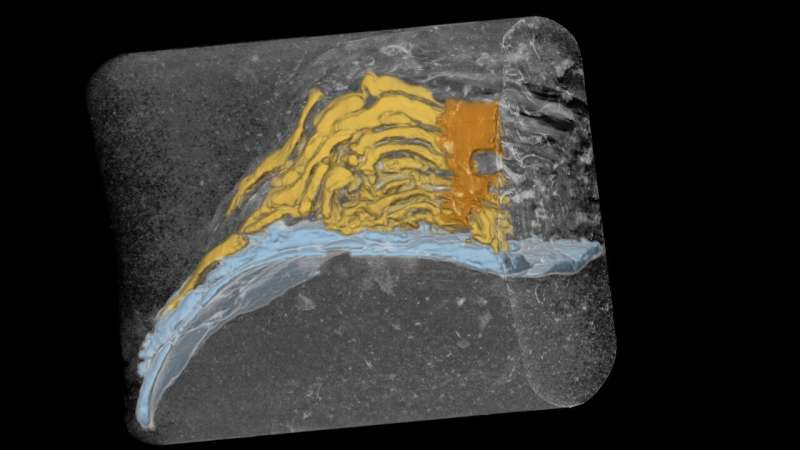
An X-ray reconstruction of a 32-million-year-old fossil kelp holdfast colored to show the base (orange), holdfast (yellow) and the bivalve shell to which it attached (blue). Credit: Dula Parkinson/Advanced Light Source, Lawrence Berkeley National Laboratory
The unique underwater kelp forests that line the Pacific Coast have been enriching a diverse ecosystem for far longer than previously thought.
Contrary to what was previously believed, a new study indicates that kelp has been flourishing off the Northwest Coast for more than 32 million years. This is long before the appearance of modern groups of marine mammals, sea urchins, birds and bivalves that now inhabit the kelp forests.
At an age much greater than previously determined, these coastal kelp forests have been supporting sea otters, sea lions, seals, birds, fish and crustaceans. This means they were likely a major source of food for an ancient, now-extinct mammal known as a desmostylian.
The paleobotanist Cindy Looy, professor of integrative biology at the University of California, Berkeley said, “People initially said, ‘We don’t think the kelps were there before 14 million years ago because the organisms associated with the modern kelp forest were not there yet.’ Now, we show the kelps were there, it’s just that all the organisms that you expect to be associated with them were not.”
Reported in the journal Proceedings of the National Academy of Sciences, the evidence for the greater antiquity of kelp forests comes from newly discovered fossils of the kelp’s holdfast. These fossils rate back to 32.1 million years ago and challenge the original belief that kelp evolved with the appearance of modern marine mammals.
“Our holdfasts provide good evidence for kelp being the food source for an enigmatic group of marine mammals, the desmostylia,” said Steffen Kiel, lead author of the paper and a senior curator at the Swedish Museum of Natural History in Stockholm.
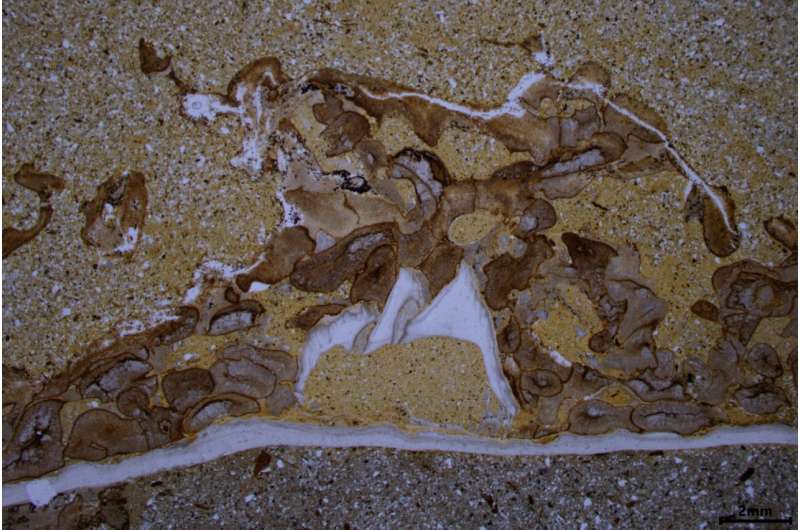
A slice through a 32-million-year-old fossil holdfast showing the finger-like haptera overgrowing a barnacle. Credit: Steffen Kiel
“This is the only order of Cenozoic mammals that actually went extinct during the Cenozoic. The fact that kelp had long been suggested as a food source for these hippo-sized marine mammals constitutes a major find,” Kiel added. Read more rnrn