

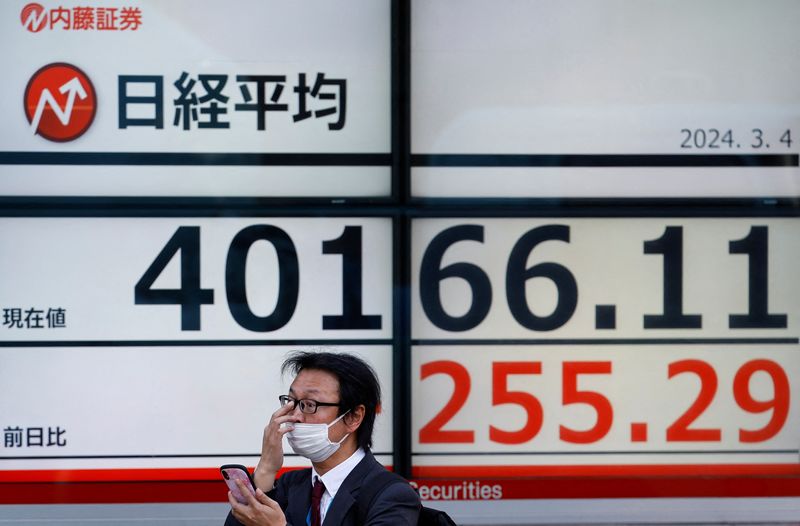

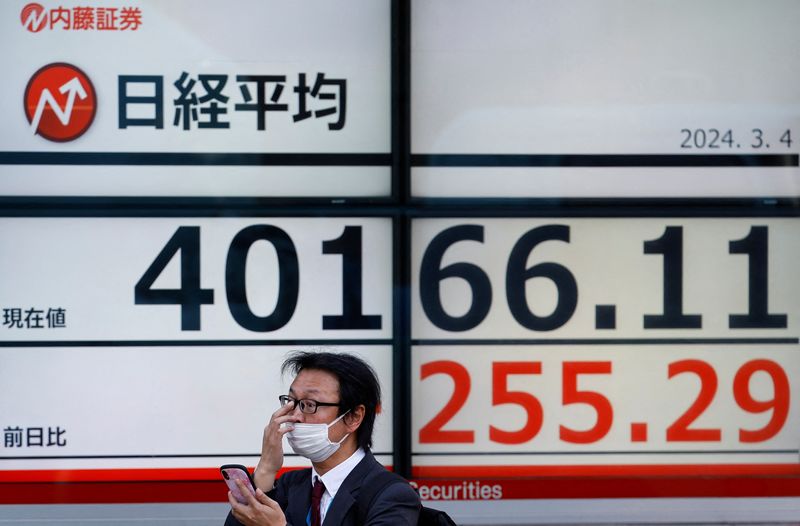
© Reuters. FILE PHOTO: An individual using a mobile device in front of a screen displaying Japan’s Nikkei share average outside a brokerage in Tokyo, Japan on March 4, 2024. REUTERS/Kim Kyung-Hoon/File Photo
By Rae Wee
SINGAPORE (Reuters) – The Asian stock market has reached a seven-month peak on Friday, with the potential of major central banks leading an upcoming cycle of interest rate reductions contributing to this rise. This has subsequently put pressure on the dollar and Treasury yields, making it a mixed picture for investors to evaluate.
Japan is currently standing out from the crowd, with growing expectations that the Bank of Japan (BOJ) might step away from negative interest rates this month. This speculation has bolstered the yen and caused domestic bond yields to climb.
During the early trading hours in Asia, MSCI’s broadest index of Asia-Pacific shares, excluding Japan, hit 538.47 points, its highest level since August. The index was up by 1.15%, indicating a potential weekly gain of around 2%.
Recently, global stock indexes achieved record highs following signals from the European Central Bank (ECB) about a probable rate cut in June, and statements from Federal Reserve Chair Jerome Powell suggesting similar moves regarding U.S. interest rates.
EUROSTOXX 50 futures saw an increase of 0.16%, with adding 0.09%. Meanwhile, showed a slight gain of 0.02%, as Nasdaq futures dropped by 0.17%.
Vishnu Varathan, the chief economist for Asia ex-Japan at Mizuho Bank, noted that the Fed Chair’s remarks have been enticing to investors, particularly due to the confidence projected in initiating rate cuts. Market responses have been positive, interpreting this as an opportunity for significant market shifts.
The two-year U.S. Treasury yield, reflecting short-term rate expectations, hit a one-month low of 4.4940% on Friday due to heightened bets on impending Fed rate cuts.
The 10-year benchmark yield was recorded at 4.0827%. Following this, all eyes are now on the upcoming nonfarm payrolls report, expected later on Friday, to provide more insights into the U.S. rate trajectory.
Market participants are also awaiting the U.S. inflation data next week, particularly after the surprising jobs report in January.
“Should tonight’s nonfarm payrolls data show strong numbers, coupled with higher-than-anticipated CPI data next week, it could lead to significant shifts across different asset classes, including equities, gold, bitcoin, and foreign exchange,” said Tony Sycamore, a market analyst at IG.
While this scenario is not the base case, it remains a potential risk to consider, given the current climate. The continuous speculation about an upcoming Fed easing cycle has kept the dollar on a weaker footing, hitting a roughly two-month low against the euro on Friday.
The euro was last seen at $1.0947, after hitting $1.0956 earlier in the session, while the pound rose to a more than two-month high of $1.2820.
THE SHIFT IN BOJ STRATEGY
The yen soared to a one-month peak against the dollar on Friday, standing at 147.54 per dollar,