



Rystad Energy
Rystad Energy is an independent energy consulting services and business intelligence provider offering global databases, strategic advisory and research products for energy companies and suppliers,…
More Info
Premium Content
By Rystad Energy – Aug 28, 2025, 3:00 PM CDT
- The Bolivian presidential election, with a runoff scheduled for 19 October, is expected to bring a new era in the country’s energy policy and impact its natural gas relationships with Argentina and Brazil.
- Both leading presidential candidates, Jorge Quiroga and Rodrigo Paz, acknowledge the critical decline in Bolivia’s natural gas production and propose distinct strategies to boost output and exports.
- The future Bolivian government faces the challenge of attracting foreign investment to reverse the nationalization of the energy sector and increase gas production, which will have significant implications for regional energy markets.
The Bolivian presidential election is poised to have a profound impact on the country’s natural gas sector, with significant implications for its commercial relationships with neighboring Argentina and Brazil. As both leading presidential candidates, former president Jorge Quiroga and Senator Rodrigo Paz, acknowledge the looming threat of declining gas production, they are under pressure to devise strategies to boost output and prevent a potentially devastating decline in exports over the next decade.
The first round of the Bolivian presidential election took place on 17 August, with the leftwing Movimiento al Socialismo (MAS) suffering a historic defeat after nearly two decades in power. MAS nominee, Eduardo del Castillo, managed only about 3% of the vote, while right-leaning Quiroga secured 27% and the more centrist Paz garnered 32%. The runoff is scheduled for 19 October, and the shift away from MAS’s long dominance is likely to bring about a new era in the country’s energy policy. It could potentially alter the course of the gas industry and its relationships with neighboring countries, such as Argentina and Brazil.
Bolivia’s upstream sector, once open to private investment in the 1990s, where major oil and gas companies participated in the gas production increase in the country. Future country actions led to the resources nationalization in 2006, with YPFB being responsible for the reserves and gas commercialization. Bolivia’s natural gas production has been declining since 2014, threatening to turn the country into a net importer within the next decade. Despite recent discoveries like the Mayaya field, the long-term outlook remains bleak. In 2014, gas exports accounted for 46.5% of Bolivia’s total exports, amounting to $6.01 billion out of $12.90 billion. However, by 2024, this share had plummeted to 18.1% ($1.61 billion out of $8.92 billion).
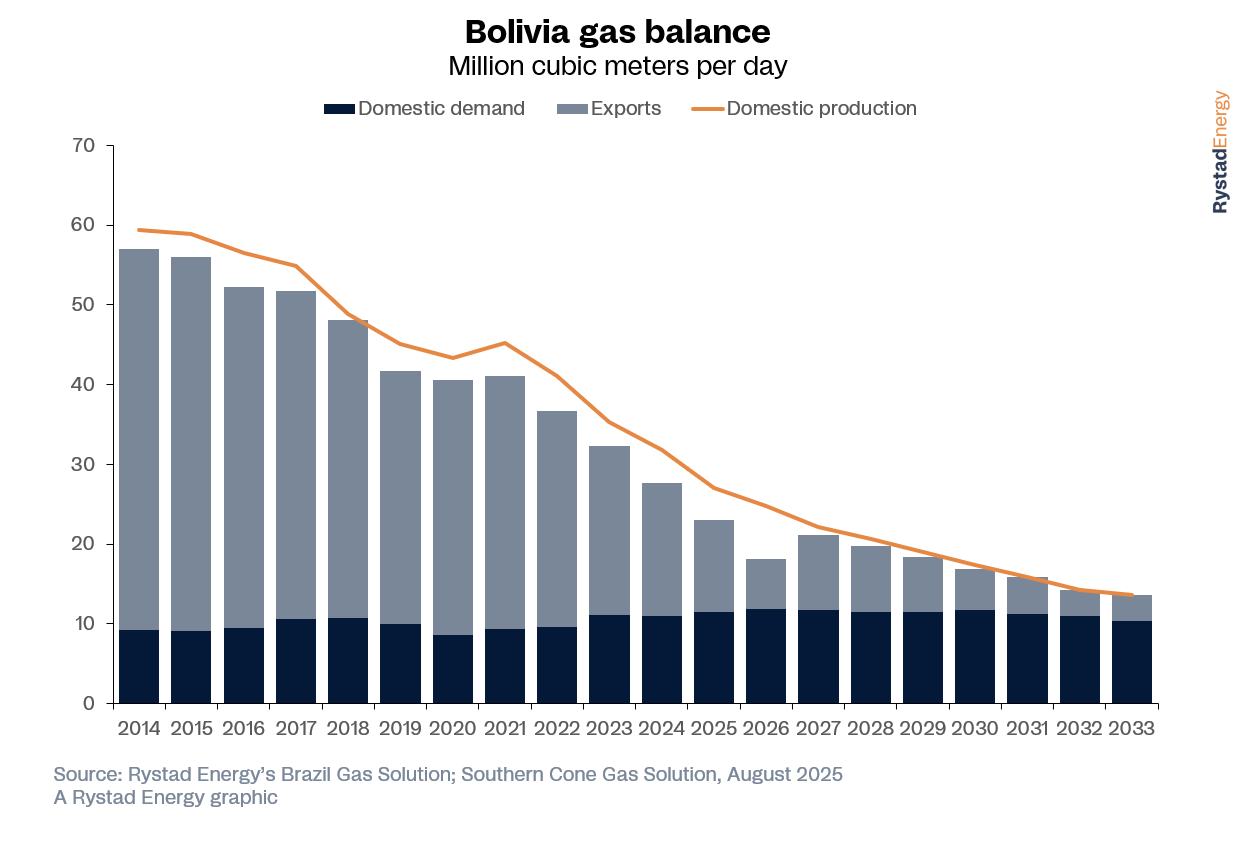
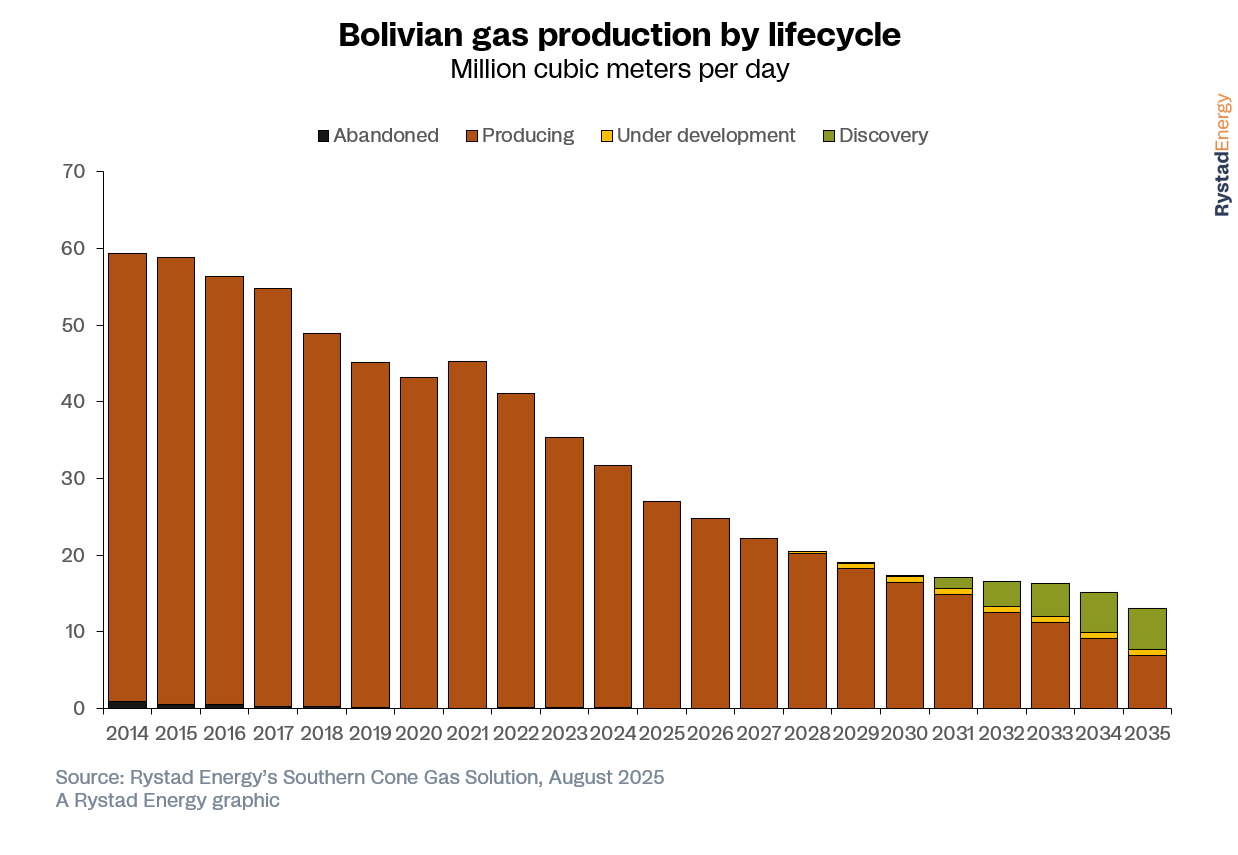
Quiroga and Paz have both acknowledged the concern surrounding the country’s declining natural gas production in their campaign proposals. While both candidates aim to boost gas output, they have distinct approaches to achieving this goal. Quiroga’s proposal involves providing subsidies to producers to encourage increased production,