




Rystad Energy
Rystad Energy is an independent energy consulting services and business intelligence provider offering global databases, strategic advisory and research products for energy companies and suppliers,…
More Info
Premium Content
By Rystad Energy – Oct 03, 2025, 4:00 PM CDT
- Curtailment, the forced reduction of renewable generation, has become a critical issue in Brazil, doubling in 2025 to an estimated 20 terawatt hours due to insufficient transmission infrastructure and localized oversupply.
- The Northeast region, particularly Bahia for solar and Ceará for wind, is most affected by curtailment, which has reached 27% for solar and 16% for wind, leading to significant revenue losses and increased risks for project developers.
- Addressing curtailment requires coordinated actions, including expanding transmission infrastructure, enhancing pricing mechanisms to incentivize demand, and developing a regulatory framework for battery storage, while developers can mitigate risks through careful site selection and portfolio diversification.

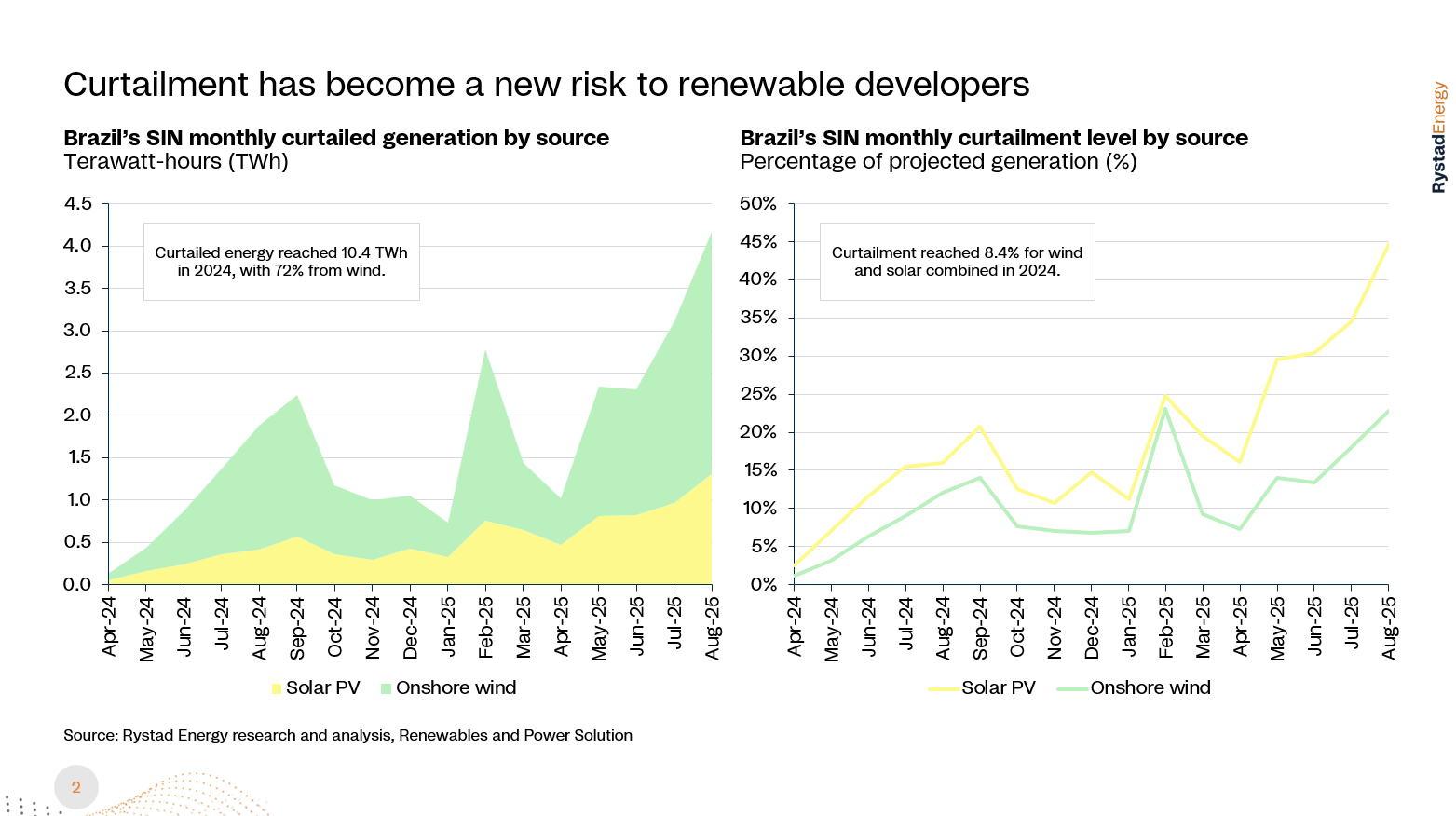
Curtailment has become a very relevant issue in Brazil as renewable penetration grows. In short, curtailment is the forced reduction of renewable generation, which typically occurs when there is too much intermittent generation on the grid and insufficient transmission infrastructure. Operators are then required to shut down units to balance the system. The main drivers are transmission bottlenecks, operational restrictions related to grid stability and reliability and localized oversupply. We can split these into two major categories: infrastructure and demand. As of this year, non-hydro renewables already make up about one-third of Brazil’s power matrix, and curtailment has increased to very concerning levels. By August alone, we estimate nearly 20 terawatt hours of curtailed generation, double the total observed in 2024. Roughly half of this is linked to demand issues, while the other half stems from infrastructure constraints.
Although wind makes up most of the curtailed generation in absolute terms, solar is proportionally the most affected. Curtailment has reached about 27% for solar in 2025, compared to 16% for wind, both much higher than last year.
Which regions of Brazil are most exposed to renewable curtailment?
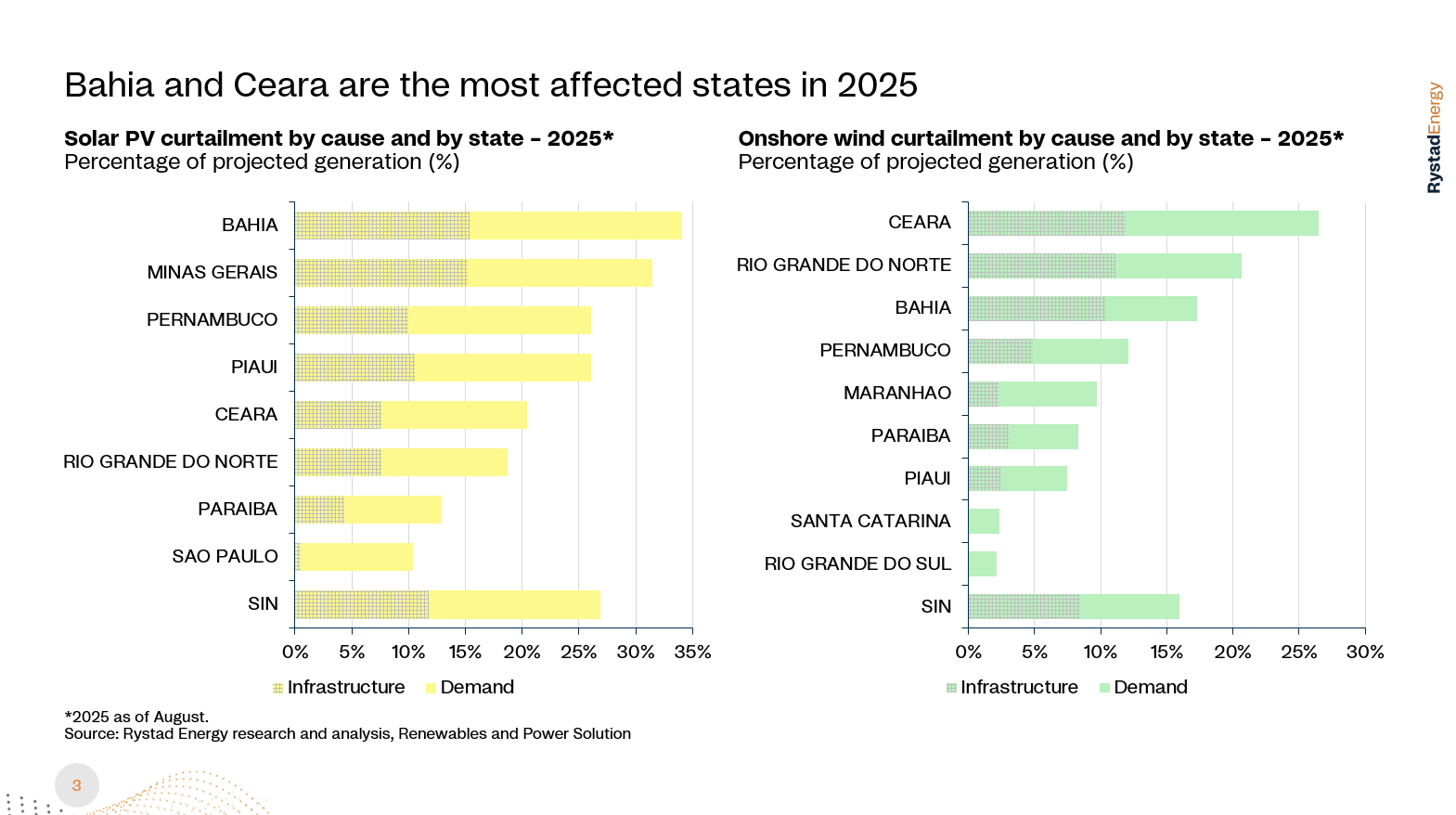
Most of Brazil’s solar and wind resources are concentrated in the northeast, and this is the region most affected by curtailment. Transmission bottlenecks in the area limit the ability to export surplus generation to the main load centers in the southeast, leading to congestion and forced shutdowns.
Looking more closely, Bahia is the most affected state for solar generation, with curtailment surpassing 30%. For wind, Ceará is the most exposed, already exceeding 25%. Other states in the northeast are also impacted, along with Minas Gerais in the southeast. Overall, the northeast stands out as the most vulnerable region, making new transmission lines critical for alleviating the issue.
What risks does curtailment pose for project developers?
For operational projects, curtailment leads directly to revenue losses,