

SAN JACINTO, Calif. — A paradox has settled across California’s velvet green fields and orchards. California farmers, who are some of the most ardent supporters of Donald Trump, would seem to be on a collision course with one of the president-elect’s most important campaign promises.
Trump has pledged to carry out mass deportations of undocumented immigrants across the country, including, he has said in recent days, rounding up people and putting them in newly built detention camps.
If any such effort penetrated California’s heartland — where half the fruits and vegetables consumed in the U.S. are grown — it almost surely would decimate the workforce that farmers rely on to plant and harvest their crops. At least half of the state’s 162,000 farmworkers are undocumented, according to estimates from the federal Department of Labor and research conducted by UC Merced. Without sufficient workers, food would rot in the fields, sending grocery prices skyrocketing.
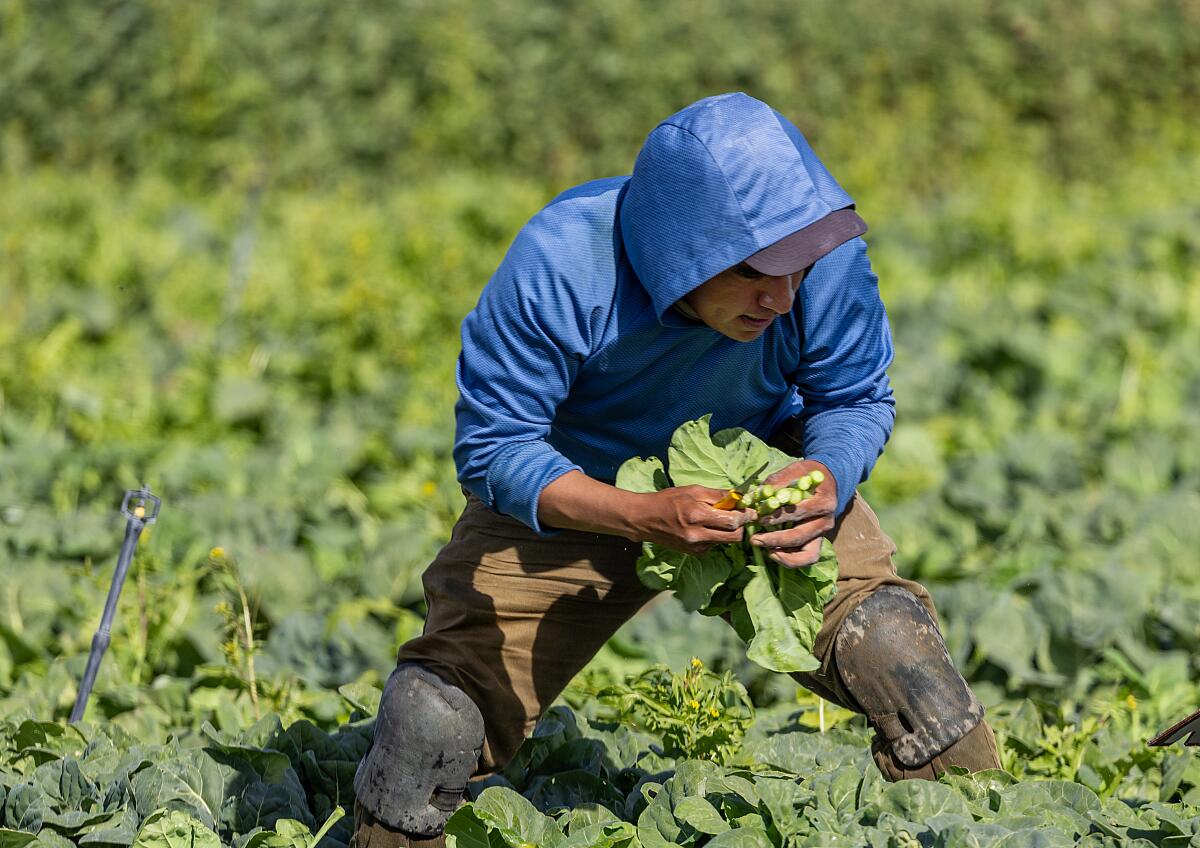
If the Trump administration conducts mass deportation efforts in California’s heartland, farm contractors and other experts said it would decimate the workforce
(Allen J. Schaben / Los Angeles Times)
And yet, farmers are not railing in protest. Many say they expect the president will support their workforce needs, either through a robust legalization program for workers already here or by leaving farms be and focusing enforcement elsewhere.
Some are also pushing the government to make it easier for them to import temporary guest workers under the H-2A visa program, which allows farms to hire seasonal agricultural workers when the domestic labor supply falls short.
Karoline Leavitt, a spokesperson for the Trump-Vance transition team, did not respond to questions about agricultural workers specifically, but said: “The American people reelected President Trump by a resounding margin, giving him a mandate to implement the promises he made on the campaign trail, like deporting migrant criminals and restoring our economic greatness. He will deliver.”
In that context, Steve Scaroni, the founder one of the largest guest-worker companies in the country, Fresh Harvest, predicted an increased demand for the thousands of workers his company brings in each year from Mexico, Honduras, Guatemala and El Salvador for three- to 10-month stints picking lettuce, strawberries and other crops.
“Most farmers are realizing that they’re going to need to implement the H-2A program at some level to assure that they have labor,” Scaroni said. “Because we just don’t know what the deportation is going to look like.”
Farmworkers and their advocates are anxious — both at the prospect of mass deportations and a huge expansion of guest worker programs that in the past have spawned complaints about shorted paychecks, unpaid travel time and unsafe housing.
Sara, a farmworker living in Riverside County who asked to be identified by only her first name because she is undocumented, said she and fellow workers harvesting cilantro in the eastern Coachella Valley share a pervasive sense of dread.