

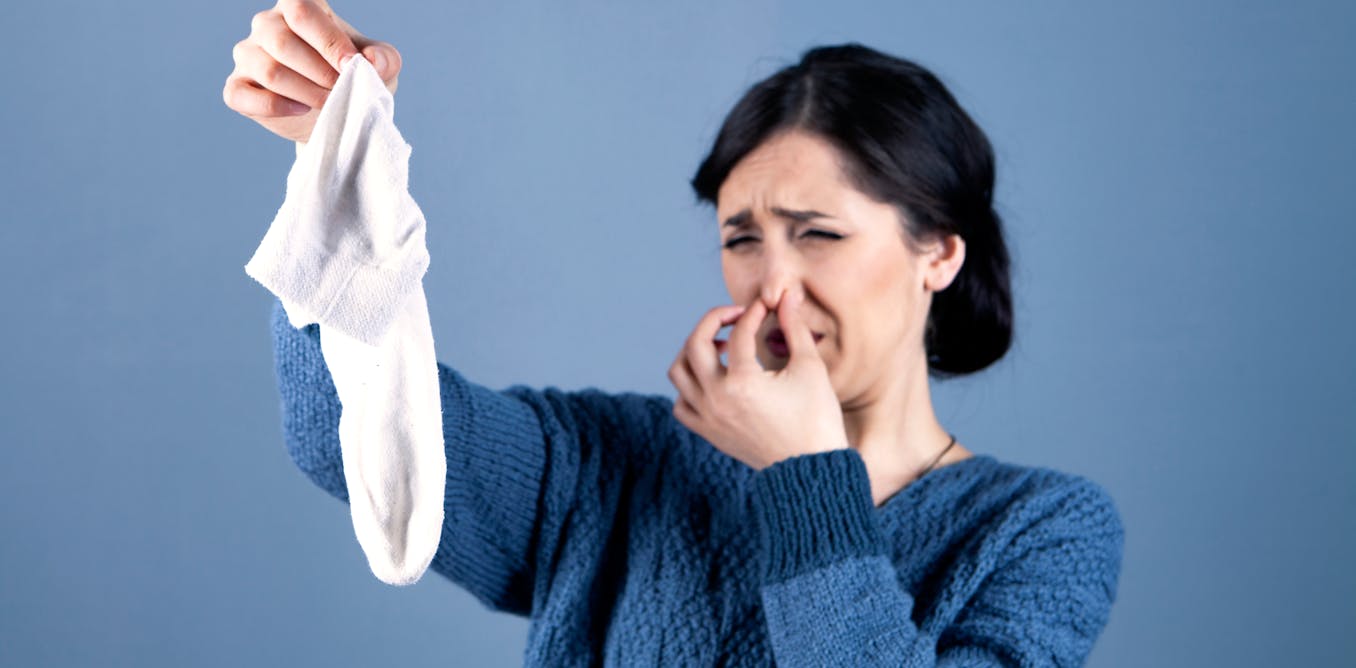

It’s pretty normal to wear the same pair of jeans, a jumper or even a t-shirt more than once. But what about your socks?
If you knew what really lived in your socks after even one day of wearing, you might just think twice about doing it.
Our feet are home to a microscopic rainforest of bacteria and fungi – typically containing up to 1,000 different bacterial and fungal species. The foot also has a more diverse range of fungi living on it than any other region of the human body.
The foot skin also contains one of the highest amount of sweat glands in the human body.
Most foot bacteria and fungi prefer to live in the warm, moist areas between your toes where they dine on the nutrients within your sweat and dead skin cells. The waste products produced by these microbes are the reason why feet, socks and shoes can become smelly.
For instance, the bacteria Staphylococcal hominis produces an alcohol from the sweat it consumes that makes a rotten onion smell. Staphylococcus epidermis, on the other hand, produces a compound that has a cheese smell. Corynebacterium, another member of the foot microbiome, creates an acid which is described as having a goat-like smell.
The more our feet sweat, the more nutrients available for the foot’s bacteria to eat and the stronger the odour will be. As socks can trap sweat in, this creates an even more optimal environment for odour-producing bacteria. And, these bacteria can survive on fabric for months. For instance, bacteria can survive on cotton for up to 90 days. So if you re-wear unwashed socks, you’re only allowing more bacteria to grow and thrive.
The types of microbes resident in your socks don’t just include those that normally call the foot microbiome home. They also include microbes that come from the surrounding environment – such as your floors at home or in the gym or even the ground outside.
In a study which looked at the microbial content of clothing which had only been worn once, socks had the highest microbial count compared to other types of clothing. Socks had between 8-9 million bacteria per sample, while t-shirts only had around 83,000 bacteria per sample.
Species profiling of socks shows they harbour both harmless skin bacteria, as well as potential pathogens such as Aspergillus, Candida and Cryptococcus which can cause respiratory and gut infections.
The microbes living in your socks can also transfer to any surface they come in contact with – including your shoes, bed, couch or floor. This means dirty socks could spread the fungus which causes Athlete’s foot, a contagious infection that affects the skin on and around the toes.
This is why it’s especially key that those with Athlete’s foot don’t share socks or shoes with other people,