

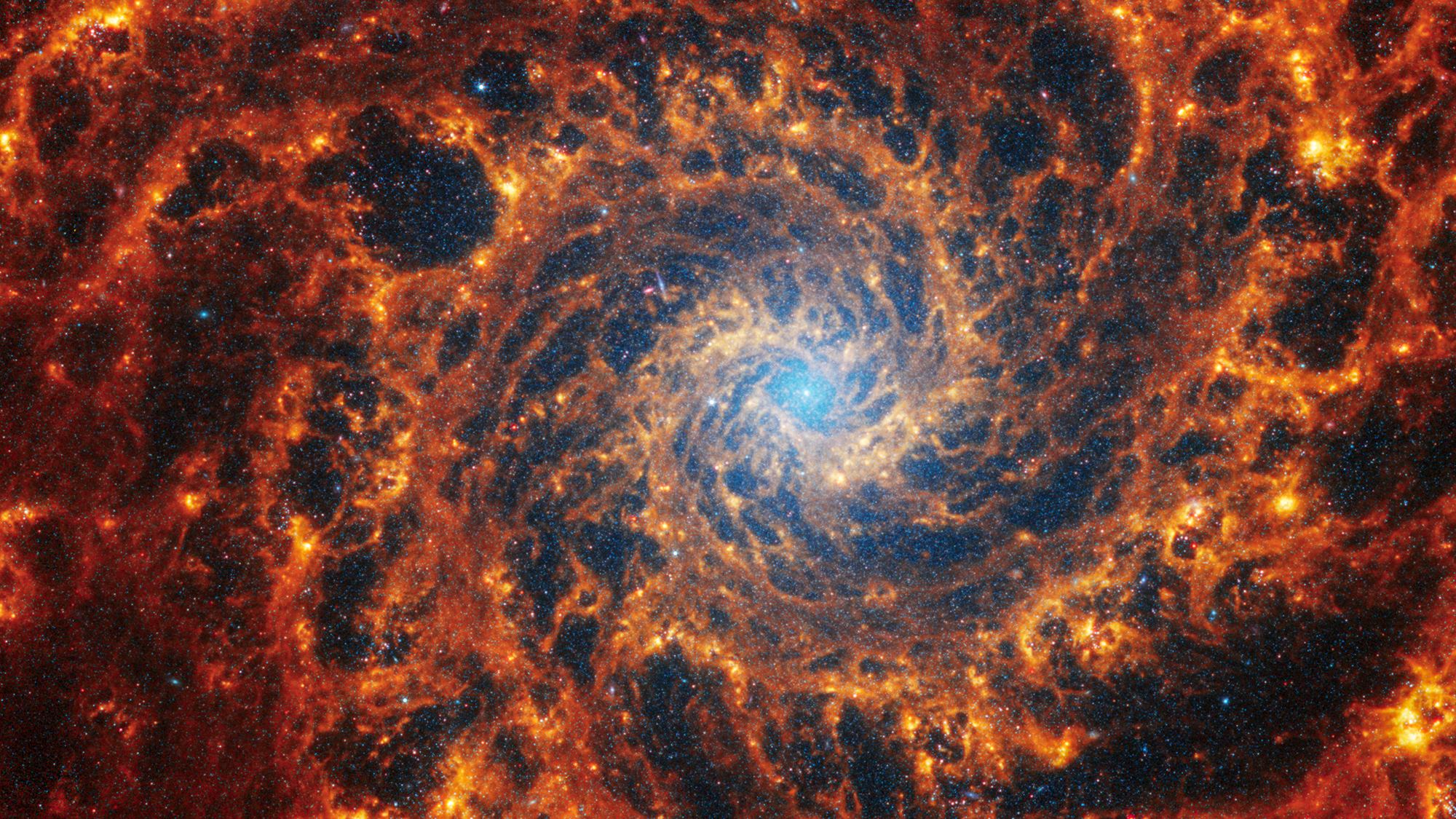

Black holes are incredible phenomena in our universe, and swirling stars, dust, and gas around them could reveal more about the formation of some of the most intricate structures in the cosmos.
By
Laura Baisas
|
Published Jan 29, 2024 2:15 PM EST
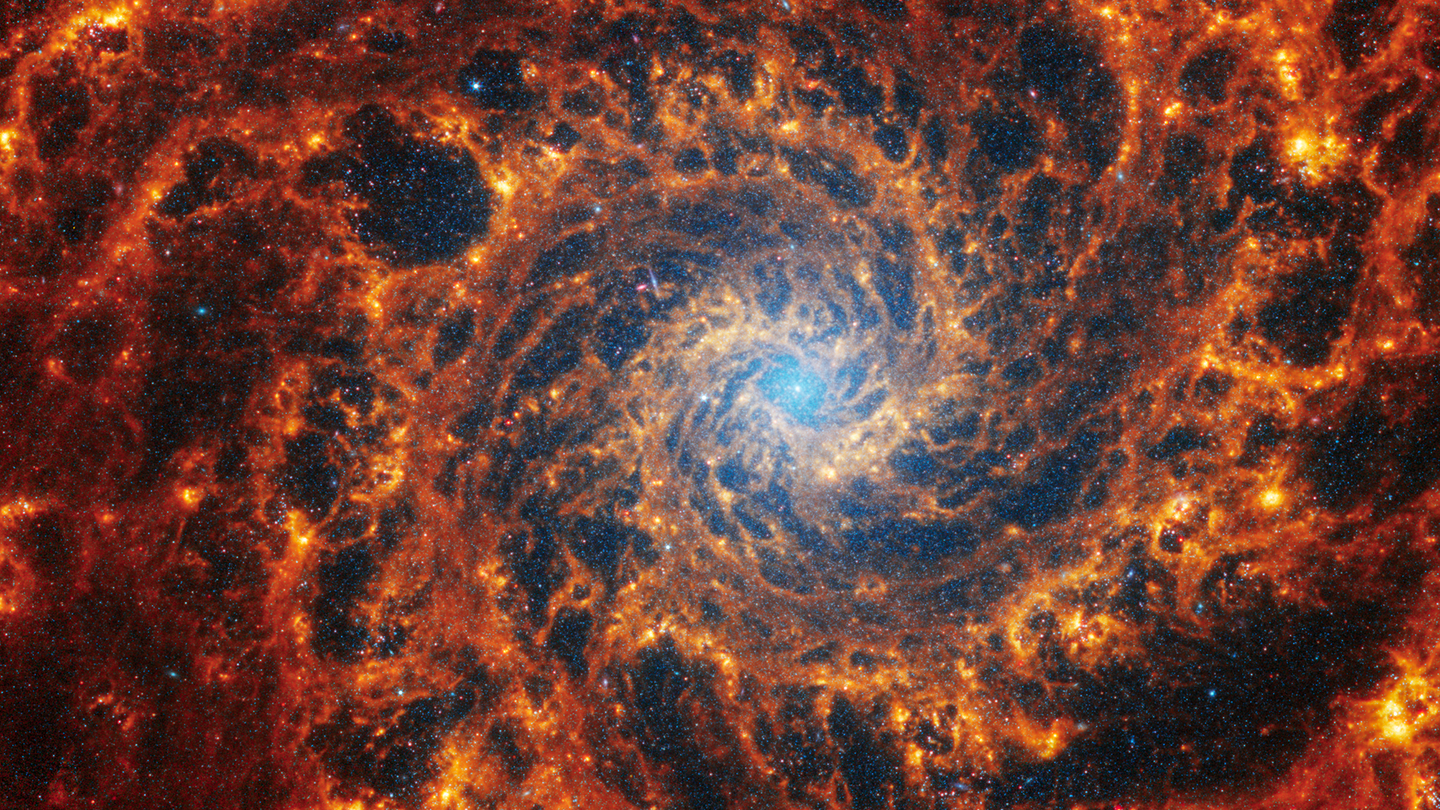 infrared light and Hubble’s showcase visible light. Dust absorbs ultraviolet and visible light, and then re-emits it in the infrared. In JWST’s images, we see dust glowing in infrared light. In Hubble’s images, dark regions are where starlight is absorbed by dust.” decoding=”async” data-dimension=”landscape” />
Face-on spiral galaxy, NGC 628, is split diagonally in this image: The James Webb Space Telescope’s observations appear at top left, and the Hubble Space Telescope’s on bottom right. JWST’s observations combine near- and mid-infrared light and Hubble’s showcase visible light. Dust absorbs ultraviolet and visible light, and then re-emits it in the infrared. In JWST’s images, we see dust glowing in infrared light. In Hubble’s images, dark regions are where starlight is absorbed by dust. NASA, ESA, CSA, STScI, Janice Lee (STScI), Thomas Williams (Oxford), PHANGS Team
Astronomers have released new images of 19 nearby face-on spiral galaxies, seen using a combination of near- and mid-infrared light, captured by the James Webb Space Telescope (JWST). Spiral galaxies have a breathtaking visual appeal, with their presence of buff and wavy arms filled with stars arranged in a whirlpool pattern with vibrant colors and light. According to the European Space Agency (ESA), the most visually spectacular spiral galaxies are considered “face-on,” meaning that their spiral arms and bulge are clearly visible.
[Related: Elliptical galaxies may just be spiral galaxies with their arms lobbed off.]
These new images are a composite of years of data collected from multiple telescopes to provide a comprehensive view of these mesmerizing spiral galaxies and how they are formed.
“I feel like our team lives in a constant state of being overwhelmed–in a positive way–by the amount of detail in these images,” Thomas Williams, a postdoctoral researcher from the University of Oxford in the United Kingdom, said in a statement.
Tracing spiral arms
JWST’s Near-Infrared Camera (NIR-Cam) captured millions of stars that appear in blue tones in the new images. Some of the stars are seen clustered tightly together in groups, while others are spread down the spiral arms.
The telescope’s Mid-Infrared Instrument (MIRI) data reveals glowing space dust around and between the stars, as well as some stars that have not fully formed, still encased in the dust and gas that fuel their growth.
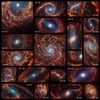 A collection of 19 face-on spiral galaxies from the James Webb Space Telescope in near- and mid-infrared light. CREDIT: Image NASA, ESA, CSA, STScI, Janice Lee (STScI), Thomas Williams (Oxford), PHANGS Team. Designer: Elizabeth Wheatley (STScI)
“These are where we can find the newest, most massive stars in the galaxies,” Erik Rosolowsky, a physicist from the University of Alberta in Canada, said in a statement.
The JWST images also display large, spherical shells in the gas and dust. » …
Read More rnrn