

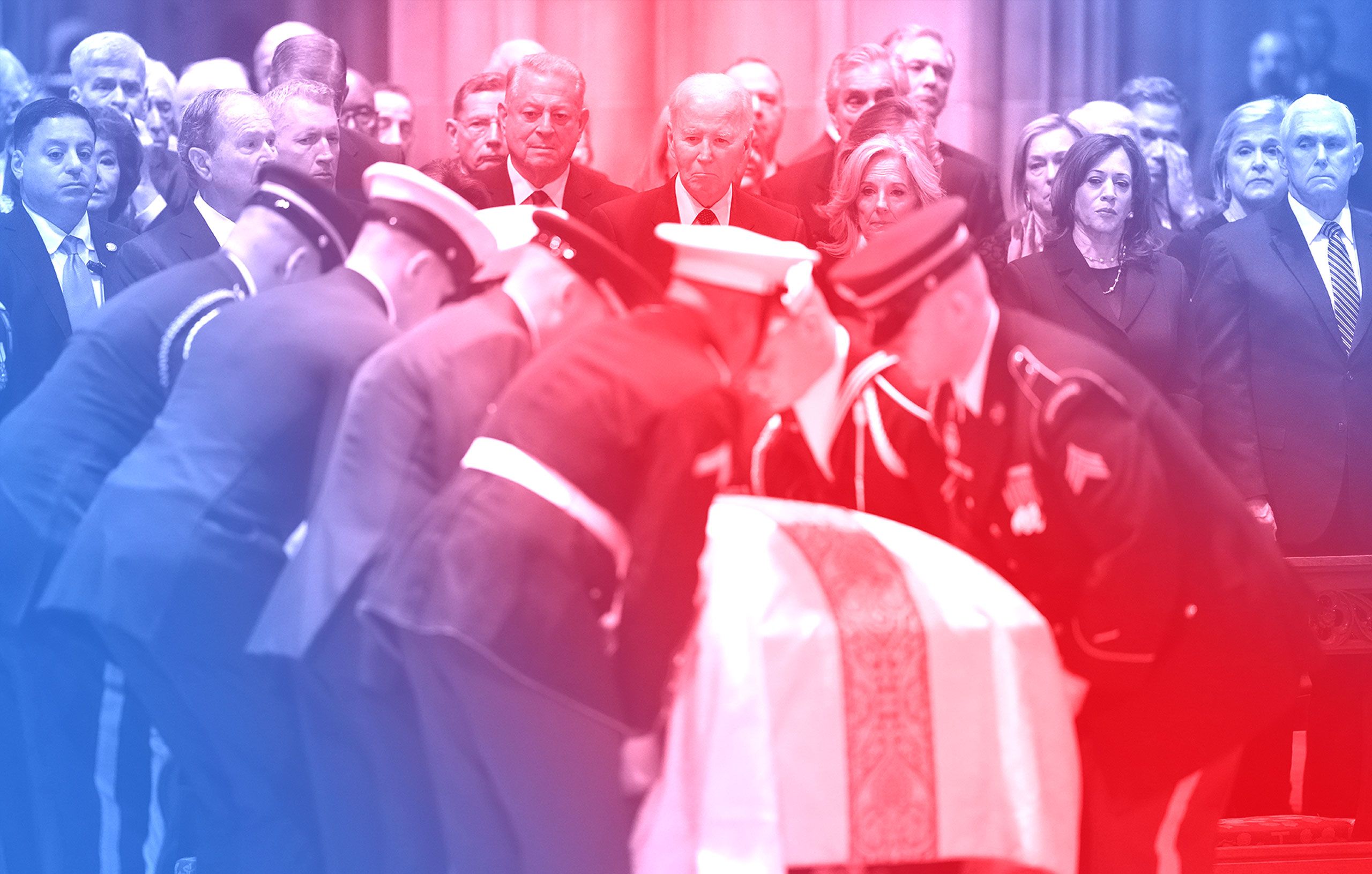

On Thursday morning, not long after entering Washington National Cathedral for the funeral of Dick Cheney, I ran into Rachel Maddow. She gave me a hug. A couple of minutes earlier, a starstruck usher had told me that the iconic liberal TV host was in attendance, though I hadn’t quite believed it. But then, yes, there she was. I got a hug from Rachel Maddow at Dick Cheney’s funeral. Cue the pigs flying. Hell may not yet have frozen over, but on an overcast November morning in Donald Trump’s besieged capital, there were moments when it seemed like it might have.
Trump’s takeover of the Republican Party—the Party that Cheney had loved and served until Trump, finally, caused him to walk away from it—has been a decade in the making. But there can be no better summing up of the reordering of our politics in this era than the scene on Thursday in that lovely church where Washington marks the passing of its giants. On hand to say goodbye to the former Vice-President, who shaped the post-9/11 world with a belief in the unchecked exercise of American power, making him perhaps the most divisive figure in public life until Trump himself, were Nancy Pelosi and Dan Quayle, Mitch McConnell and Adam Schiff, James Carville and Karl Rove. Joe Biden took the Amtrak down from Delaware, even though it was his eighty-third birthday. Kamala Harris sat in the front row next to Mike Pence. Waiting for the service to begin, I exchanged pleasantries with Al Gore and Margaret Tutwiler and Elliott Abrams and a lot of other people whose names one used to read in the newspaper back when people read newspapers.
Absent entirely was Trump or any senior members from his Administration. The sitting Vice-President, J. D. Vance, was not invited. The Republican Speaker of the House, where Cheney served for ten years as a congressman from Wyoming, did not show. This was how Cheney would have wanted it to be. He could not have been prouder in his final years to have followed his daughter Liz out the door of the Party that chose Trump’s lies about the election of 2020 over the plain truth of his defeat. As a result, the cathedral was not completely full, the way it would have been if our city and our country were not so riven by discord, but it was not anywhere near empty, either. Politics moves on; alliances shift. You can fill a very large room with people who have not forgiven Cheney for the Iraq War but who were nonetheless sad to see the passing of a man who dared to speak out about Trump. So many of the former Vice-President’s fellow-Republicans agreed with him privately and said nothing publicly.
“I can’t believe we got Dick Cheney in the national divorce,” someone said as I was walking in. Why were they—we—all there? To see who else was, for sure. It’s still Washington. To remember?