

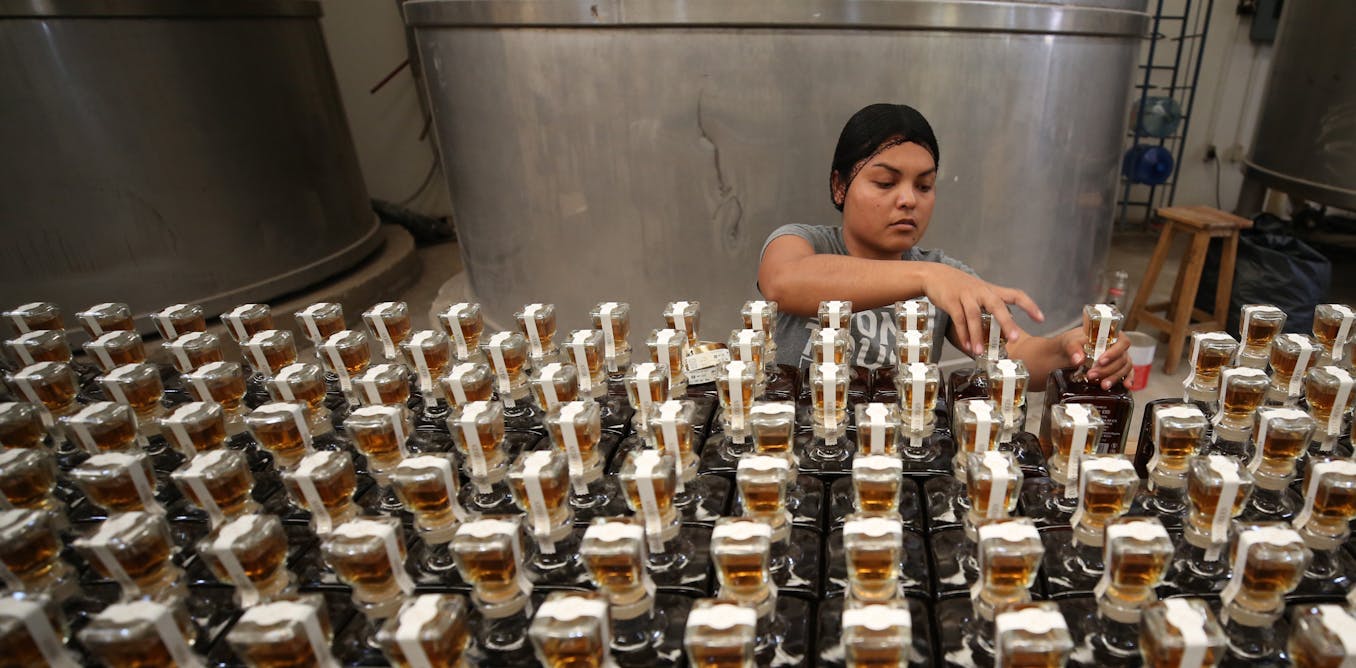

Bottles of tequila now command premium prices in trendy bars. On Instagram, celebrity-backed brands of the agave-based Mexican spirit jostle for attention. And debates over cultural appropriation and agave sustainability swirl alongside booming tourism in Jalisco, the western Mexican state that serves as the world’s tequila distillation hub.
But behind the spirit’s flash of marketing and growing popularity lies a rarely asked question: Where did the knowledge to distill agave come from in the first place?
In recent years, scholars studying how Indigenous communities responded to colonialism and global trade networks have begun to look more closely at the Pacific world. One key focus is the Manila-Acapulco galleon trade route, which linked Asia and the Americas for 250 years, from 1565 to 1815.
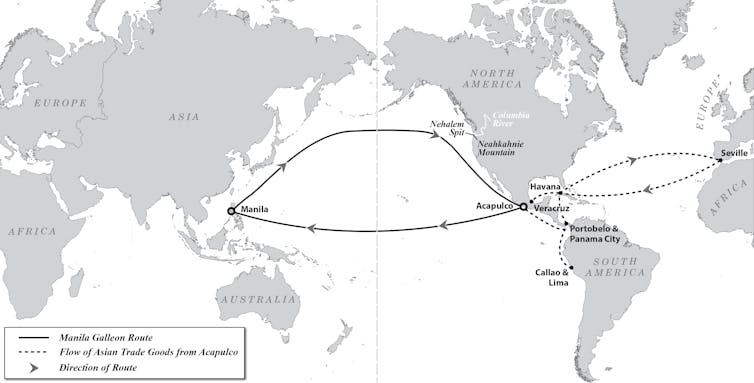
The Manila-Acapulco galleon trade route.
Jesse Nett/Oregon Encylopedia
After Spain colonized the Philippines in 1565, Spanish galleons – towering, multidecked sailing ships – carried Chinese silk and Mexican silver across the ocean. But far more than goods traveled aboard those ships. They moved people, ideas and technologies.
Among them was the craft of distillation.
This overlooked connection may help explain how distilled agave spirits such as tequila came into being. While tequila is unmistakably a Mexican creation, the techniques used to produce it may owe something to Filipino sailors, who brought with them deep knowledge of transforming coconut sap into a potent spirit known as lambanog.
3 competing theories
For centuries, the rise of tequila has been credited to the Spanish. After the conquest of Mexico in the 16th century, colonizers introduced alembic stills, which are based on Moorish and Arabic technology. Unlike simple boiling, distillation requires managing heat and capturing purified vapor. These stills represented a major technological leap, allowing people to transform fermented drinks into distilled spirits.
Agave, long used to make the fermented drink pulque, soon became the base for something new: tequila and mezcal.
Colonial records, including the “Relaciones Geográficas,” a massive data-gathering project initiated by the Spanish Crown in the late 16th century, describe local Mesoamerican communities learning distillation from Spanish settlers. This version is well documented. But it assumes that technology moved in only one direction, from Europe to the Americas.
A second idea suggests that Mesoamerican communities already had some understanding of vapor condensation. Archaeologists have found ceramic vessels in western Mexico that may have been used to capture steam. While distillation requires additional steps, this prior knowledge may have primed Indigenous groups to more readily adopt new techniques.
As Mexican ethnobotanists Patricia Colunga-GarcíaMarín and Daniel Zizumbo-Villarreal have argued, “The adoption of distillation was likely not simply imposed, but creatively adapted to local knowledge systems.”
A third perspective, which other researchers and I are exploring, traces a potential Filipino influence. The galleon trade brought thousands of Filipino sailors and laborers to Mexico, particularly along the Pacific coast. In places such as Guerrero, Colima and Jalisco,