


Erin Patterson, having been convicted in the Supreme Court of Victoria two months ago on three counts of murder and one count of attempted murder, has today received a life sentence from the trial judge, Justice Christopher Beale.
He ordered a non-parole period of 33 years. Given her age (50) and the 676 days she’s already spent in detention, this means Patterson will not be eligible to apply for parole until 2056, when she is in her 80s.
Erin Patterson’s story is now one of the most well-known true crime cases in Australia. Nine weeks ago, a jury found her guilty of poisoning her lunch guests in July 2023 at her home in Leongatha with foraged death-cap mushrooms she had baked into individual servings of Beef Wellington.
In sentencing, Justice Beale said he had no hesitation in finding Patterson’s offending falls into the “worst category” of murder and attempted murder.
So after months of media frenzy and myriad headlines, the sentencing now bookends the case, pending any appeal. Here’s how the judge reached his decision and what happens now.
The life sentence was as expected, given Patterson’s lawyer, Colin Mandy, did not oppose the prosecution’s bid for the maximum sentence for murder in Victoria.
The matter that exercised the judge’s mind, principally, in considering the sentence was the length of the non-parole period. The standard such period for murder in Victoria is 20 years.
If there’s more than one victim, however, the minimum non-parole period increases to 25 years.
While it’s possible to sentence a murderer to life without parole, it is very unusual.
In 2019, the judge who gave a life sentence to James Gargasoulas, the man who drove down Bourke Street Mall in Melbourne, killing six people, set a non-parole period of 46 years.
What did the judge consider?
The factors taken into account in sentencing relate to the nature of the crime and the personal circumstances of the person convicted.
The final outcome is informed by principles that vary only slightly across Australia’s states and territories.
The main one here, arguably, was denunciation: the sentence needs to reinforce in the public mind the abhorrence of her conduct.
Indeed, there was no plea of guilty, and no remorse from Patterson at any time.
Moreover, when considering a non-parole period, a judge takes into account what is referred to as “proportionality”. This can be a limiting feature where there is lesser culpability, but an exacerbating feature where there are multiple deaths.
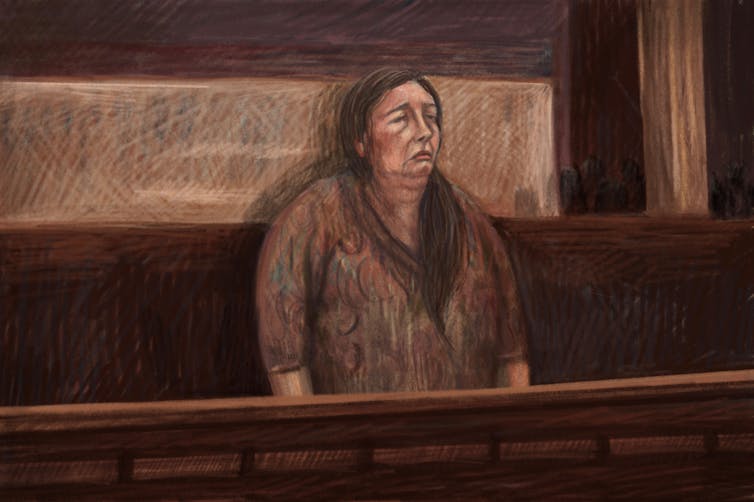
Patterson was not remorseful at any stage of the trial.
Anita Lester/AAP
One might refer to it colloquially as a person receiving their “just deserts”.
In this instance, the judge was mindful of the fact there were four victims.
He was also mindful of Patterson’s “harsh” prison conditions,