


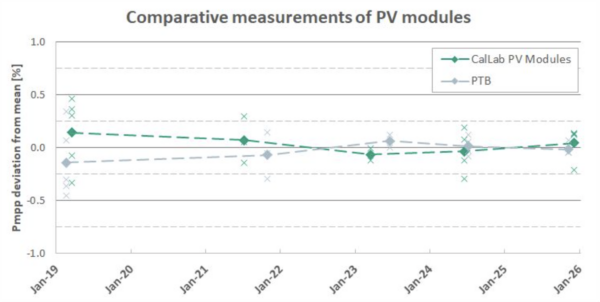
An interlaboratory comparison between the CalLab PV Modules of Fraunhofer Institute for Solar Energy Systems ISE and Physikalisch-Technische Bundesanstalt finds the two organizations deviate by less than 0.15% when measuring the performance of photovoltaic modules. The Fraunhofer team says this is one of the most important indications as to whether their analysis is on the right track.
February 12, 2026
Patrick Jowett
Image: Fraunhofer ISE
The CalLab PV Modules of Fraunhofer Institute for Solar Energy Systems ISE and Physikalisch-Technische Bundesanstalt (PTB), Germany’s leading authority for various measurement variables, have found their power measurements of photovoltaic modules deviate by less than 0.15% on average from the reference value.
The two organizations have been conducting interlaboratory measurement programs for many years at both the solar cell and module levels to validate calibration levels.
This work involves both institutes assessing the same PV modules and solar cells independently under different test settings and then comparing the results. Their latest measurement comparison, finalized in December, achieved a deviation of less than 0.15% on the determined power.
Martin Kaiser, head of CalLab PV Modules at Fraunhofer ISE, said the annual ring comparison with PTB is “one of the most important indicators for us as to whether we are on the right track here.”
The discrepancy between the power ratings of many PV module manufacturers and the measurement results of Fraunhofer ISE has been growing, according to a statement published by the institute, rising to a median negative deviation of 1.4% in 2025.
Last March, Fraunhofer released the results of a longitudinal research project that involved testing over 70,000 solar modules which found a negative trend emerging since 2017 between performance data from PV module manufacturers and the institute’s performance measurement of the modules.
Kaiser explained that engineering, procurement, and construction service providers rely on the most accurate, independent power measurements available when selecting PV modules. “A stable, traceable calibration level at our accredited calibration laboratory serves as the absolute foundation for a reliable assessment of module quality as well as the power and energy efficiency of purchased modules,” he added.
This content is protected by copyright and may not be reused. If you want to cooperate with us and would like to reuse some of our content, please contact: editors@pv-magazine.com.
Popular content
