


Armed Conflicts, Asia-Pacific, Democracy, Editors’ Choice, Featured, Gender, Headlines, Human Rights, Humanitarian Emergencies, Inequality, TerraViva United Nations
Human Rights

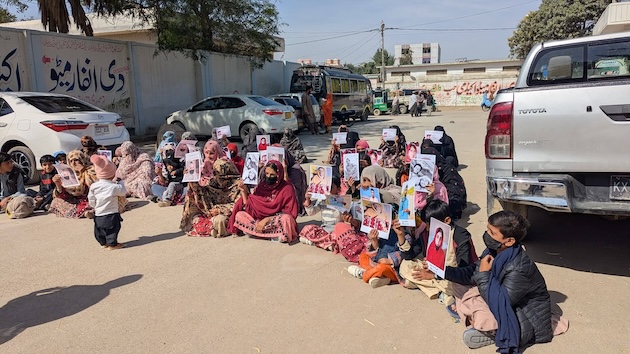
Refusing to relent, Baloch women protest the abduction of their family members outside the Lasbela Press Club in Hub Chowki on January 24, 2026. Courtesy: Fozia Shashani
KARACHI, Pakistan, Feb 18 2026 (IPS) – Fozia Shashani, 26, a member of the Baloch Yakjehti Committee, said it was “most painful” to hear reports that two Baloch women – Hawa Baloch, 20, and Asifa Mengal, 24 – had taken part in active combat as suicide bombers. The path, she said, was in complete contrast to her belief in peaceful resistance. Yet, she added, such extreme choices were the result of a state that had “failed its people.”
Her comments come in the aftermath of a series of coordinated gun and bomb attacks on January 31 across mineral-rich Balochistan—including Quetta, Mastung, Nushki, Dalbandin, Kharan, Panjgur, Tump, Gwadar, and Pasni – during which attackers stormed security installations, set government buildings ablaze, and looted banks.
The Baloch Liberation Army (BLA), a separatist group, claimed responsibility for the attacks, which killed 31 civilians – including five women – and 17 security personnel. The military’s media wing reported the killing of 145 militants in a 40-hour gun battle.
According to the Pakistan Security Report 2025 by the Pakistan Institute of Peace Studies, militant violence surged nationwide with 699 attacks — a 34 percent increase from 2024.
 press conference on December 4, 2025 against the abduction of Nasreen and Mahjabeen Baloch, was blocked by the police. Credit: Zofeen T. Ebrahim/IPS” width=”630″ height=”352″/>
Road leading to the Karachi Press Club, where the Aurat Foundation was holding a press conference on December 4, 2025 against the abduction of Nasreen and Mahjabeen Baloch, was blocked by the police. Credit: Zofeen T. Ebrahim/IPS
This escalation was most pronounced in Balochistan, which recorded 254 attacks, killing 419 people and injuring 607, up from 322 fatalities in 2024, in the province.
A video of Hawa, who joined the BLA’s Majeed Brigade (the suicide squad), shows her looking straight at the camera and laughingly saying, “Pakistan cannot face us,” “Today is a day of joy,” and “War is fun.” Taken before the attack, it signals a person who is defiant and fearless.
While previously rare, the recruitment of Baloch women by separatist groups is now more common, said security analyst Muhammad Amir Rana, director of PIPS. Already, a dozen women have died carrying out suicide bombings in the last four years.
He links it to the rise in enforced disappearances, a reality that he said “has pushed some women toward armed resistance.”
Despite thousands being disappeared or killed, more young people — women included — are drawn to the resistance.

Announcement poster circulated by the Aurat Foundation. Courtesy: Aurat Foundation
According to Amnesty International, enforced disappearances in Pakistan began in the 1980s but increased in the aftermath of 2001 followed by the US-led ‘war on terror’.