


- Environment
The Land of Geothermal Wonders
Published February 2, 2024
LARDERELLO, ITALY – On a chilly autumn morning in the Italian countryside near Larderello, Tuscany, the misty landscape reminded me why the area is nicknamed Valle del Diavolo, or the Devil’s Valley. Supposedly the inspiration for Dante Alighieri’s Inferno, the land here is a web of natural cracks in the rock that let a mix of steam and gasses reach the surface. Volcanic vents called fumaroles and geysers sprayed white clouds into the air.
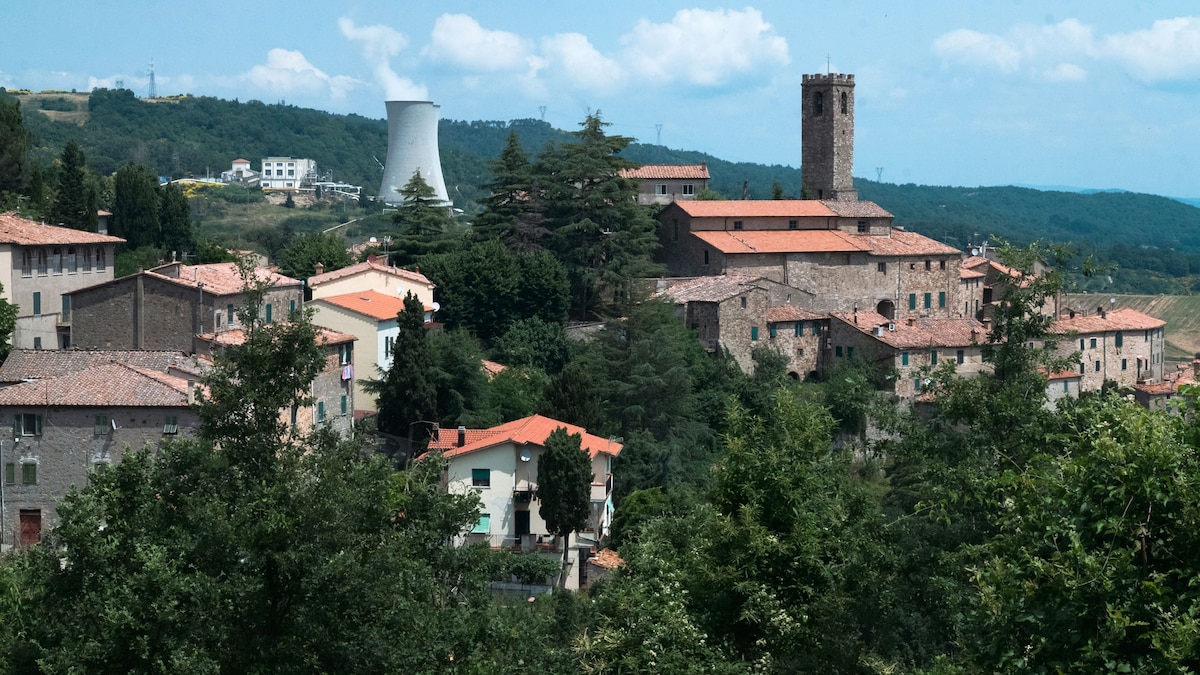
Unlike the rolling hills, vineyards, and cypress-lined roads of other parts of Tuscany, the landscape here is studded with dozens of gray cooling towers puffing white vapors. The deafening roar of a car-sized turbine at the Valle Secolo geothermal plant stamps out any sense of tranquility, but its violent spinning transforms steam rising from 3,300 feet below ground into energy for 150,000 families in the region.
“The more steam we manage to extract, the fewer oil tankers will travel,” said Geoffrey Giudetti, a geologist working for Enel Green Power, Europe’s largest geothermal operator, which runs Valle Secolo and 33 other Tuscan geothermal plants. About 30 percent of Tuscany’s electricity comes from this underground energy source. After the electricity production is done, the leftover steam heats water for nearby districts.
This energy harnessed from underground has recently proved a vital resource. Russia’s invasion of Ukraine underscored Italy’s dependence on Russian fossil fuels, and as the war raged on, Italian electricity prices skyrocketed. In 2022 Italians bore some of the world’s highest household electricity bills. Factories scaled down production, and households resorted to turning down their heaters.
But residents of the Larderello area spent the winter in warm homes, Giudetti says, thanks to the local geothermal plants harnessing boiling vapors 24/7.
Bruno Della Vedova, president of the Italian Geothermal Union, is convinced that other Italian regions could benefit from such a resource. According to a 2015 Italian government report, much of the country could run on energy converted from underground heat sources.
As the world looks to transition to renewable energy, Tuscany’s century-long history of harnessing geothermal resources stands as a beacon of hope for the country’s energy strategy.
Pulling energy from the Earth
While countries like Iceland and Kenya are taking advantage of their geothermal resources, the industry’s growth has stagnated in Italy. High set-up costs and difficulties in extraction—which, done incorrectly, can result in heavy economic and environmental loss—present significant barriers. And new plants often run into opposition from nearby communities over health concerns.
According to Della Vedova, Italy sits on a geothermal sweet spot. Situated where the African tectonic plate meets the Eurasian one,