

As U.S. diplomats arrived in Damascus on Friday, Syria’s de facto new leader Ahmed al-Sharaa will likely have greeted them with a clear message: Under his rule, there will be no threat to the West.
Sharaa, who has dropped his nom de guerre of Abu Mohammad al-Jolani, has been pushing this line in meetings with Western diplomats and the media since rebel forces, led by his Hayat Tahrir al-Sham group, or HTS, toppled the regime of President Bashar al-Assad. As his new administration takes charge, he has also called for the United States and other countries to drop sanctions against Syria.
“Now, after all that has happened, sanctions must be lifted because they were targeted at the old regime,” Sharaa, dressed in a smart suit and a white shirt, told the BBC in an interview earlier this week, having abandoned the camouflage military fatigues and turban he once wore as a jihadist leader.
“The victim and the oppressor should not be treated in the same way,” he added.
He has also attempted to move away from his past as a jihadist leader with links to both the Islamic State terrorist group and Al Qaeda.
Striking a more moderate tone, Sharaa has vowed to usher in an era of change driven by a vision of an inclusive Syria in which the country’s many religious and ethnic groups will be represented.
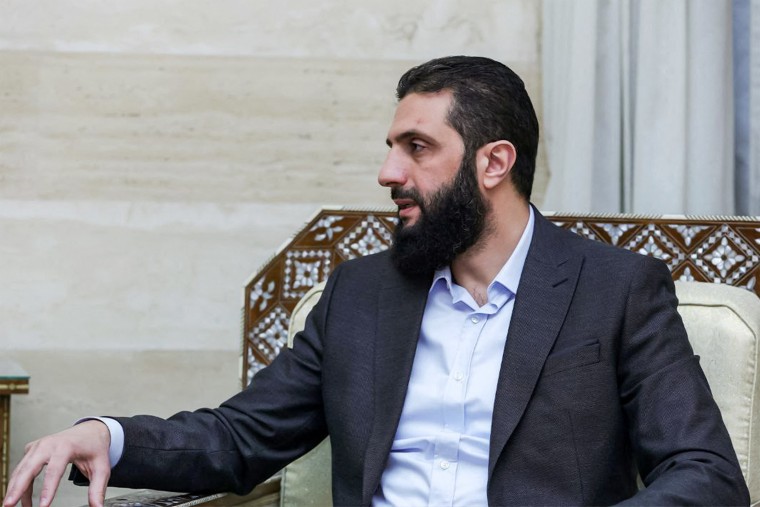 Ahmed al-Sharaa, formerly known as Abu Mohammad al-Jolani and the head of the Hayat Tahrir al-Sham rebel group.SANA / AFP – Getty Images
But with a $10 million U.S. bounty on his head and as the current leader of a group that has been designated a terrorist organization by Washington and others, he faces an uphill battle to convince people that he is a changed man.
Sharaa has “been embracing a more conventional image,” Joze Pelayo, an associate director at the Atlantic Council’s Scowcroft Middle East Security Initiative, told NBC News. “But I think he needs to walk the talk for that recognition and for that approval to remain sustainable.”
Sharaa has also attempted to present HTS as more moderate, insisting in his BBC interview that it should not be considered a terrorist group because it does not target civilians or civilian areas.
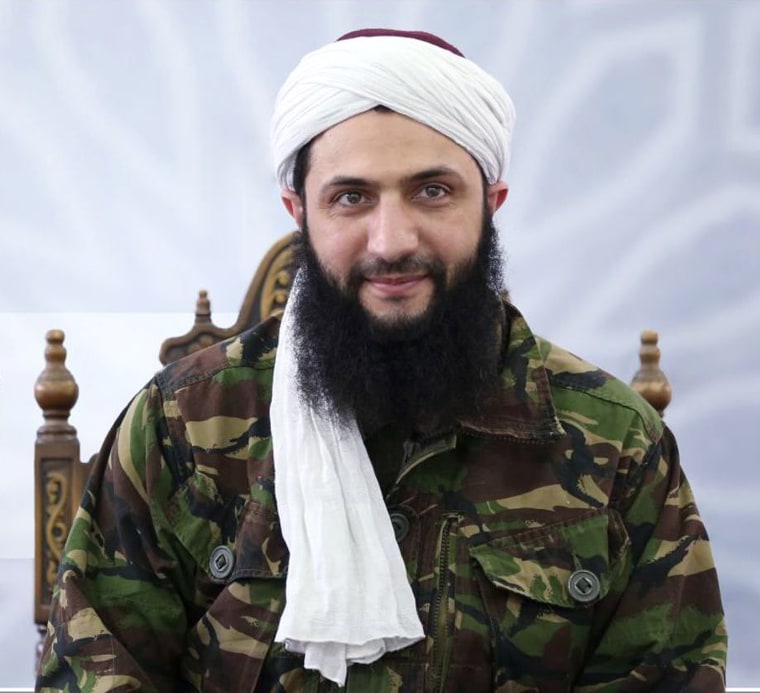 Sharaa, then known as Abu Mohammad al-Jolani, in a media appearance in July 2016.Balkis Press / Sipa via AP file
Unlike the Taliban in Afghanistan, which barred women from higher education, public spaces like parks and most jobs, the BBC reported that Sharaa said he would be much more inclusive and had pointed to HTS’ record in regions it has governed in recent years, particularly in the city of Idlib in Syria’s northwest.
There, he said, universities had been teaching “for more than eight years,” adding, “I think the percentage of women in universities is more than 60%.”
Sharaa also promised that a Syrian committee of legal experts would be formed to write a new constitution for the country.