


The recent FBI search of the Fulton County, Georgia, elections facility and the seizure of election-related materials pursuant to a warrant has attracted concern for what it might mean for future elections.
What if a determined executive branch used federal law enforcement to seize election materials to sow distrust in the results of the 2026 midterm congressional elections?
Courts and states should be wary when an investigation risks commandeering the evidence needed to ascertain election results. That is where a largely forgotten Supreme Court case from the 1970s matters, a case about an Indiana recount that sets important guardrails to prevent post-election chaos in federal elections.
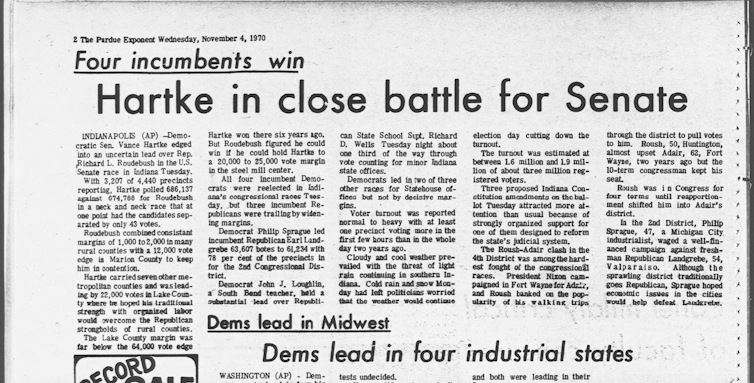
The day after Election Day in 1970, votes were very close in the Indiana election for U.S. Senate. A challenge to the outcome would lead to an important U.S. Supreme Court case.
The Purdue Exponent, Nov. 4, 1970
Congress’s constitutionally-delegated role
The case known as Roudebush v. Hartke arose from a razor-thin U.S. Senate race in Indiana in 1970. The ballots were cast on Election Day, and the state counted and verified the results, a process known as the “canvass.” The state certified R. Vance Hartke as the winner. Typically, the certified winner presents himself to Congress, which accepts his certificate of election and seats the member to Congress.
The losing candidate, Richard L. Roudebush, invoked Indiana’s recount procedures. Hartke then sued to stop the recount. He argued that a state recount would intrude on the power of each chamber, the Senate or the House of Representatives, to judge its own elections under Article I, Section 5 of the U.S. Constitution. That clause gives each chamber the sole right to judge elections. No one else can interfere with that power.
Hartke worried that a recount might result in ballots that could be altered or destroyed, which would diminish the ability of the Senate to engage in a meaningful examination of the ballots if an election contest arose.
But the Supreme Court rejected that argument.
It held that a state recount does not “usurp” the Senate’s authority because the Senate remains free to make the ultimate judgment of who won the election. The recount can be understood as producing new information – in this case, an additional set of tabulated results – without stripping the Senate of its final say.
Furthermore, there was no evidence that a recount board would be “less honest or conscientious in the performance of its duties” than the original precinct boards that tabulated the election results the first time around, the court said.
A state recount, then, is perfectly acceptable, as long as it does not impair the power of Congress.
In the Roudebush decision, the court recognized that states run the mechanics of congressional elections as part of their power under Article I, Section 4 of the U.S. Constitution to set the “Times, Places and Manner of holding Elections for Senators and Representatives,” subject to Congress’s own regulation.