

Wide Angle
Where have all the relatable male role models gone?
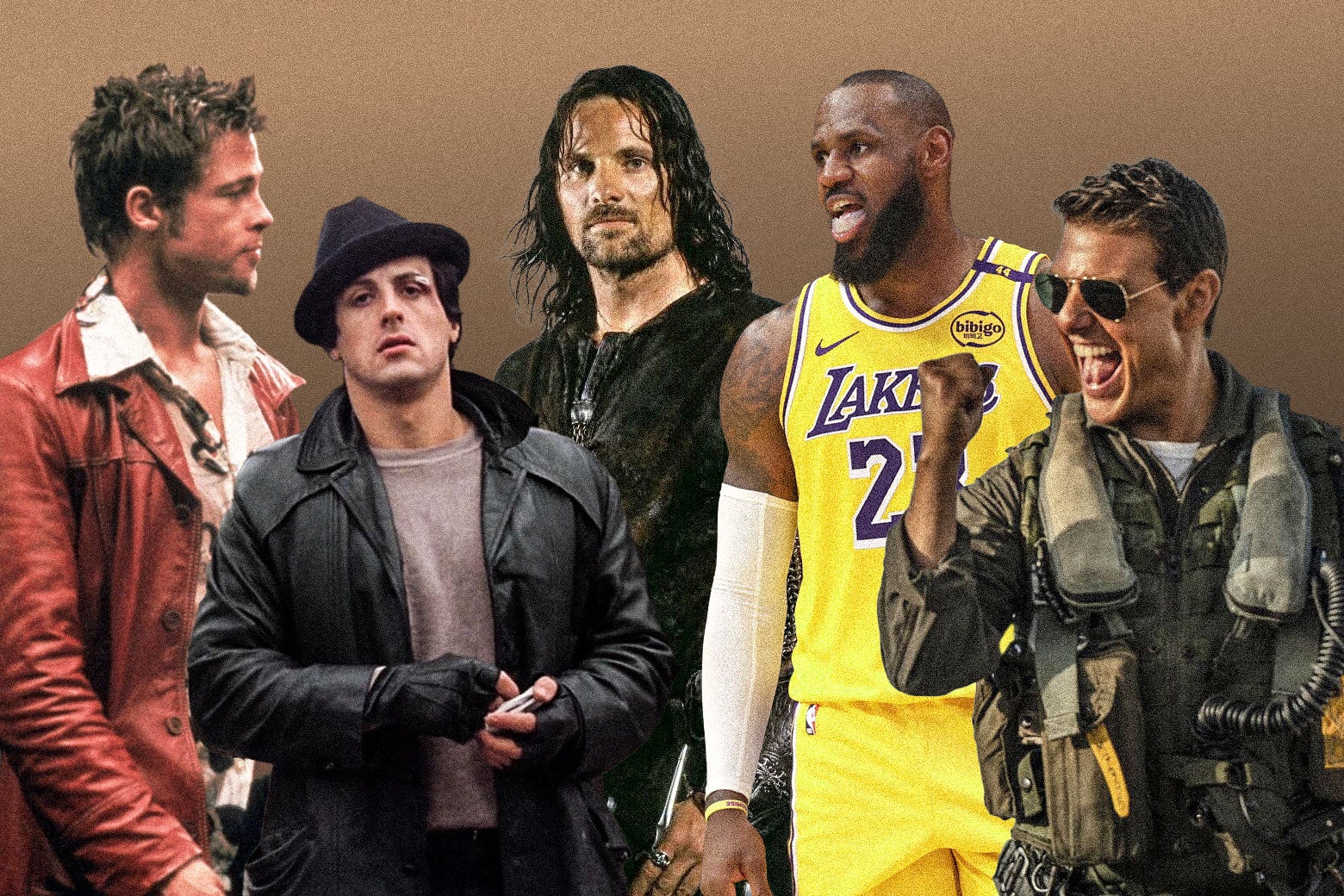
Photo illustration by Slate. Photos by Harry How/Getty Images, New Line Cinema, 20th Century Studios, and MGM.
Are young men … OK? That’s a question that seems to be on many a mind these days as conversations about gender, sexuality, and what it means to be a “man” reach a fever pitch in the media and beyond. A large part of that discourse revolves around an apparent dearth of relatable, inspiring, and adequate male role models (fictional and otherwise) for young men to aspire to. But what even is an adequate male role model? According to the National Research Group—an international strategy firm that conducts studies relating to the entertainment and technology industries—we’re facing a “masculinity crisis” in which “today’s boys and young men are being fed contradictory cultural signals about masculinity.” NRG raises and explores this cultural siren in a recent study titled “Hero Complex,” for which the organization polled 1,250 young men, ages 8 to 30, on where they look for male role models and how they feel about what they find there. One finding? Only 52 percent of the young men polled claimed to have real people in their lives to act as their role models, while 26 percent said they found role models in fictional characters, and 21 percent in public figures and celebrities. This is just one sign that media plays a massive role in the coming-of-age of young men—an insight that 84 percent of parents polled agreed with.
Slate spoke with Fergus Navaratnam-Blair, a research director at NRG, to learn about the most popular fictional and real-life male role models, how masculinity is perceived across the political divide, how depictions of masculinity have changed over the decades, and the growing role the internet plays in young men’s sense of self. This conversation has been edited and condensed for clarity.
Slate: It’s clear that investigating media’s presentation of masculinity is important, but you wouldn’t have necessarily known how important it is before doing the research. So what made you want to conduct this study?
Fergus Navaratnam-Blair: We at NRG work very closely with most of the big Hollywood studios and a lot of the big streaming companies, and they’re increasingly thinking about this question of: How do we create characters that resonate with male audiences, particularly young male audiences right now? Particularly in a time period when so many of these audiences are spending more and more of their time on online content platforms like YouTube and TikTok.
The other reason was the broader cultural and social backdrop we’re in right now. We’ve been seeing, increasingly both here in the U.K. and over in the U.S., discourse within the media around this notion of: “Are we in a crisis of masculinity? What does that mean in terms of its impact on boys and young men growing up in today’s environment?” We felt we have something of a responsibility to be grappling with this question of: “What’s our role in this conversation?”
There’s a lot of conversation about the dissolution of monoculture now.