

This article is part of TPM Cafe, TPM’s home for opinion and news analysis. It was originally published at The Conversation.
Many Americans will find on their November 2024 ballot a space to vote for an important office: local sheriff. While there are exceptions, sheriffs have a long history of using their power to maintain a particular, unequal balance of power in society, often along racial and class lines.
A recent example of this arose on Sept. 13, 2024, when Bruce Zuchowski, sheriff of Portage County, Ohio, posted a message on a Facebook page headed by a graphic that included his official portrait and which was labeled with his official title. Zuchowski called for the public to write down the addresses of people who have campaign signs supporting Democratic nominee Vice President Kamala Harris in their yards.
That way, he said, when immigrants arrive and need housing, “We’ll already have the addresses of the … families … who supported their arrival.”
The post, which Zuchowski later claimed appeared on his “personal Facebook page,” used derogatory terms for immigrants and for Harris. It also included screenshots of two Fox News stories about migrants in Aurora, Colorado, and Springfield, Ohio, which are both places that former President Donald Trump, the Republican nominee, and his running mate JD Vance have falsely claimed to be sites of dangerous activity by immigrants.
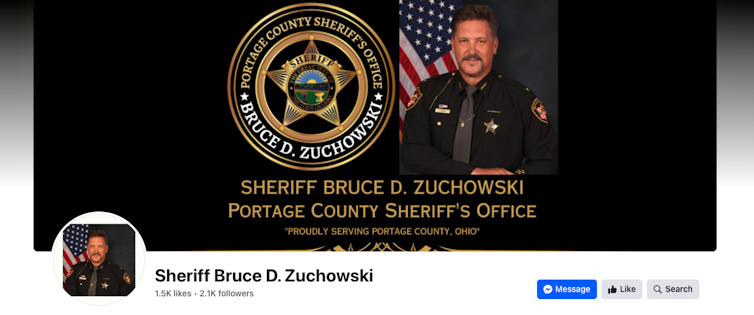 The header of a page Sheriff Bruce Zuchowski claimed is a ‘personal’ Facebook page shows him in uniform and carries his full title. Screenshot of a Facebook page
Sheriffs in the U.S. don’t often get national news attention, but Zuchowski’s request was covered in The Washington Post, NBC News and The Guardian, among others.
There are more than 3,000 sheriffs elected at the county level in the United States, each of whom has authority and autonomy to both set and enforce law enforcement policy. For example, sheriffs in many states can decide whether their deputies will wear body cameras and what happens to the footage recorded during routine stops.
In our book, “The Power of the Badge: Sheriffs and Inequality in the United States,” we provide a comprehensive look at this office and detail the history of sheriffs enforcing inequality both by using formal powers of their office, such as cooperating with federal immigration officers, and with informal powers, such as communicating about who belongs in their community.
Zuchowski’s post, which vilifies immigrants and targets people who support immigrant rights, is just part of that long history of sheriffs using their power as a tool of social control, as we document in our book.
Various sheriffs have participated in social control throughout American history. For instance, in the 18th century, an Alabama sheriff ran slave auctions and Georgia sheriffs played a central role in enforcing slave codes. In the 19th century, a Pennsylvania sheriff quashed union efforts to protect workers’ rights against exploitative businesses.