


As DeFi has evolved recently, the battle for dominance in the derivatives space has intensified. With the surge in on-chain perpetual trading, platforms like dYdX, Aevo, and GMX have carved out niches—but none have reshaped the market as aggressively as Hyperliquid. Since its mainnet debut in 2023 and the launch of HyperEVM in early 2025, Hyperliquid has emerged as the new standard for on-chain performance, transparency, and user alignment.
Architectural Differences: The Battle Between Speed and Decentralization
Hyperliquid operates a custom Layer-1 blockchain, designed from scratch for high-frequency trading. At its core is the HyperBFT, a Byzantine Fault Tolerant PoS consensus mechanism enabling sub-second block finality and ~100,000 TPS throughput. Combined with its native HyperCore and HyperEVM, it delivers fully on-chain execution for all trades, orders, and liquidations.
With its custom L1 capable of ~100k+ orders per second, it significantly outpaces competitors. For context, most decentralized perps protocols can handle on the order of only a few thousand operations per second or less. For example, GMX (an AMM-based perps DEX on Arbitrum) and Vertex (orderbook on Arbitrum) are constrained by Ethereum L2 speeds – they can process perhaps ~2,000 orders per second at best.
Hyperliquid’s purpose-built chain, in contrast, doesn’t have to share blockspace or throughput with other dApps, allowing it to scale much higher. Even dYdX v4, which launched its own app-chain on Cosmos blockchain in late 2023, has lower throughput on paper; dYdX relies on the Cosmos SDK and Tendermint consensus, typically yielding block times ~1–2 seconds.
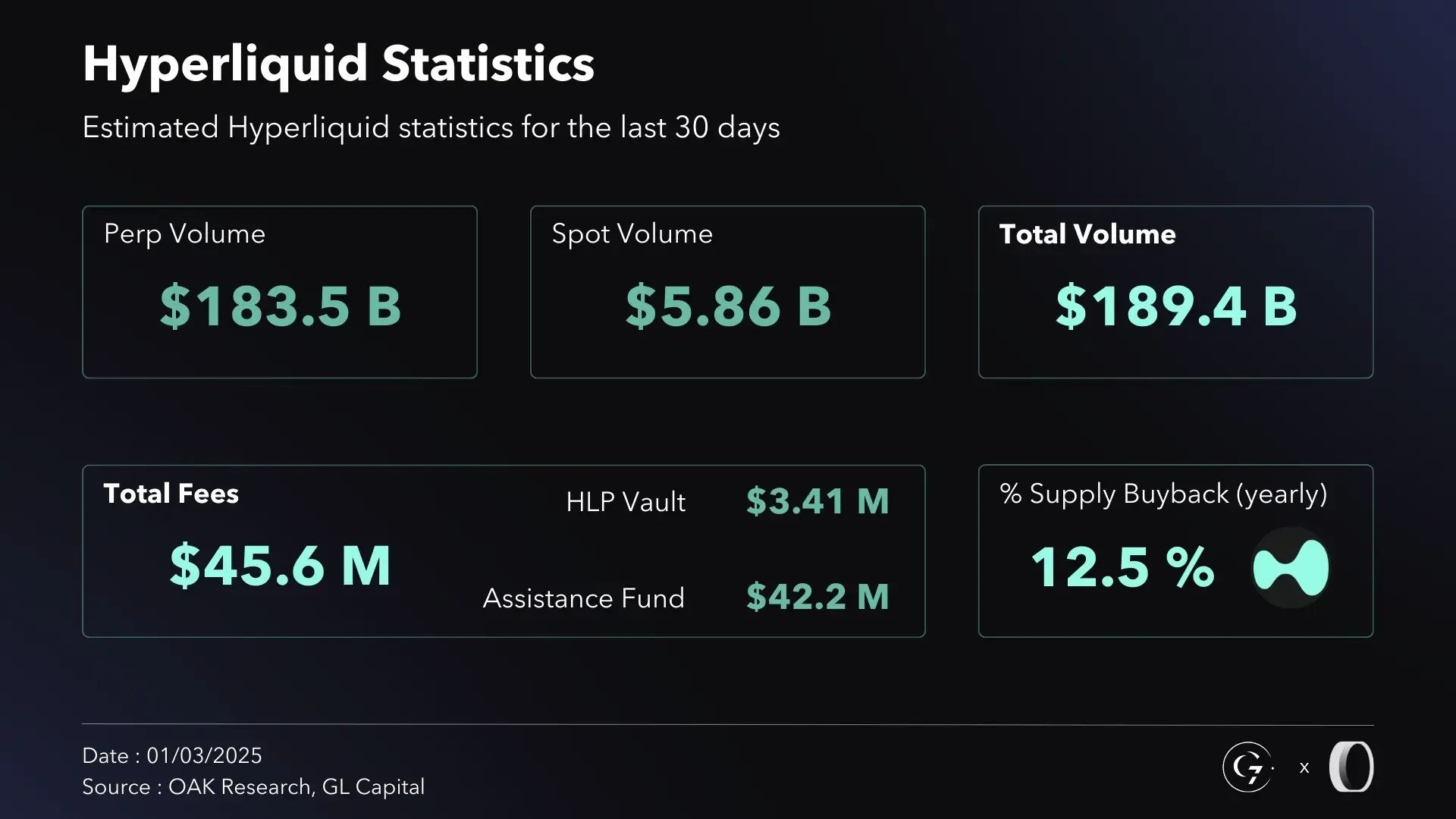
While fast, that’s still slower than Hyperliquid’s sub-second finality, and dYdX’s throughput is limited by its need for global blockchain consensus on each batch of trades. Hyperliquid’s pipelined HotStuff consensus and optimized networking give it an edge in pure speed. This shows in volumes: by Q4 2024, Hyperliquid was already handling 5× the trading volume of its nearest on-chain competitor (dYdX and GMX).
Source: OAK Research & GL Research
In December 2024 alone, Hyperliquid facilitated ~$160B of perp trading volume, whereas dYdX (used to be the leader) was far behind in market share. Hyperliquid also boasts higher leverage (up to 50× vs dYdX’s 20× and GMX’s ~50× on major pairs but effectively less liquid at extremes) and more markets (130+ vs ~30–40 on dYdX at the time and a similar range on GMX/Aevo). Aevo, which is built as an Optimism-based L2, also targets high throughput, but as an optimistic rollup its latency is tied to Ethereum’s pace and it currently allows up to 20× leverage.
In short, Hyperliquid offers the closest performance to a centralized exchange, which has been a decisive advantage in attracting active traders from slower platforms.
For more: Hyperliquid Deep Dive: Understand HYPE and HLP Model
Trading Experience and Liquidity Depth
When it comes to trading experience, Hyperliquid and dYdX both strive to emulate top-tier CEX platforms. Both exchanges offer professional web interfaces with TradingView charts, advanced order types,