

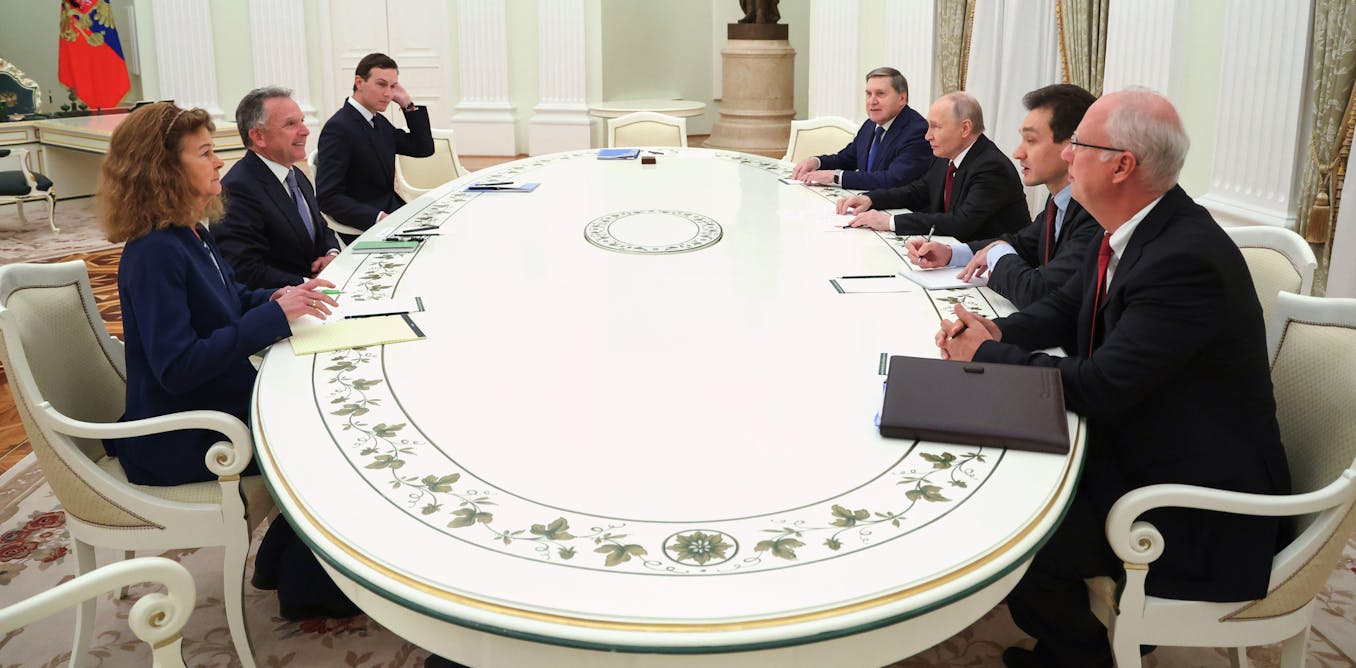

Once again there is an impasse in the attempts to bring an end to the war in Ukraine. A five-hour meeting in the Kremlin between the Russian president, Vladimir Putin, and the US team led by Donald Trump’s envoys, businessmen Steve Witkoff and Jared Kushner, has failed to make any significant progress.
Putin’s aide Yuri Ushakov described the talks, held on December 2, as “constructive”. But, tellingly, he added that “some American proposals appear more or less acceptable”. This was clearly a reference to the 28-point plan drawn up in late November by Witkoff and Kirill Dmitriev, the head of Russia’s direct investment fund.
This plan drew strong criticism from both Ukrainian and European leaders as it appeared to favour Russia, calling for Ukraine to give up territory, banning it from ever joining Nato and restricting the size of its armed forces.
The UK, France and Germany met in Geneva on November 22 and developed a counterproposal providing for a larger Ukrainian military and deferring the questions of Ukrainian territory and Nato membership for further negotiation. The plan was revised the following day by US and Ukrainian officials in Geneva and then again at Witkoff’s private members’ club in south Florida on November 30.
Washington and Kyiv announced a new “refined peace framework”, which they said represented “meaningful progress toward aligning positions and identifying clear next steps”. Any future agreement, a White House statement said, “must fully uphold Ukraine’s sovereignty and deliver a sustainable and just peace”.
But, predictably, progress towards any kind of peace, just or not, has run into a brick wall at the Kremlin. At the core of the stalemate is the question of territory. Putin insists on securing the whole of the Donetsk and Luhansk oblasts, including territory Russia has been unable, to date, to secure by force of arms. Kyiv and its European allies have made it clear that this outcome is unacceptable.
This highlights an important point of difference from some US statements, particularly Donald Trump, who has warned that: “The way it’s going, if you look, it’s just moving in one direction. So eventually that’s land that over the next couple of months might be gotten by Russia anyway.”
Putin has worked hard to reinforce this perception. In the days leading up to the most recent talks, he claimed that his troops had finally captured the strategically important town of Pokrovsk. He also warned that Russia would be ready to fight a war against Europe, “if Europe wants … They are on the side of war.”
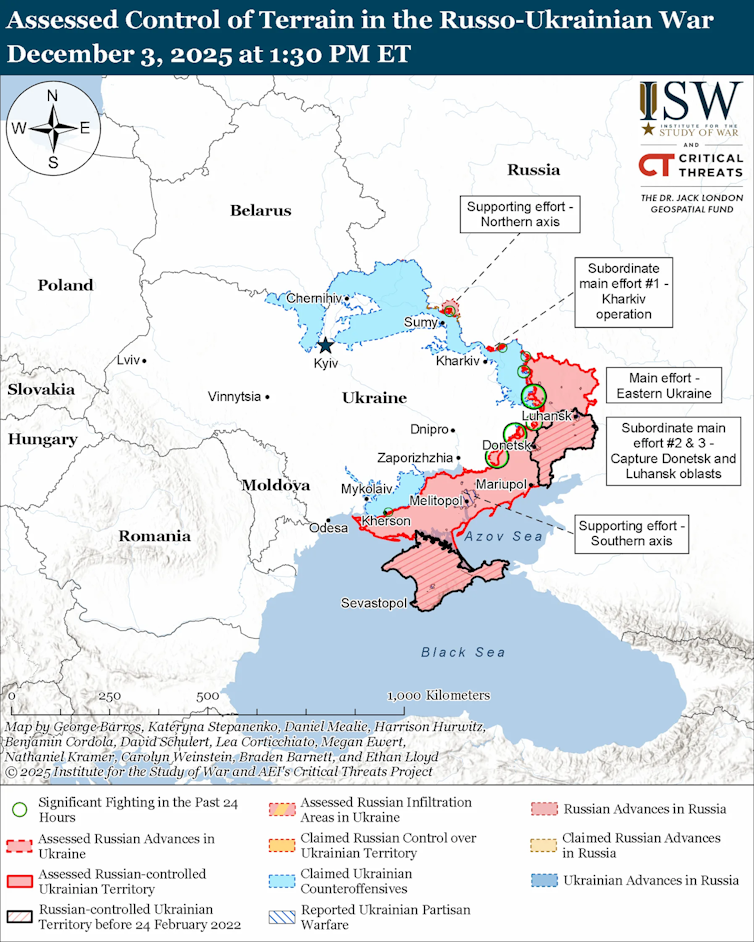
The state of the conflict in Ukraine, December 3 2025.
Institute for the Study of War
In fact the reality is far more complex and lies somewhere in between. Russia’s advance in eastern Ukraine is real, but it is painfully slow and extraordinarily costly in terms of casualties.
Some estimates suggest it could take Russia months and possibly years to occupy all of Donetsk and Luhansk.