


Russia recently held one of the largest “war games” since the Cold War, on its Western borders. The drill exercised combat scenarios recently used in Ukraine and tested the compatibility of the Belarusian army with Russian forces.
Politicians from Poland, Ukraine and Baltic states viewed the exercise as aggressive as they mistrust the Kremlin and fear possible security threats in the region. They used the drill to justify the ongoing “social militarisation” of their respective countries.
This is essentially a rise of state support or enthusiasm for voluntary defence organisations which are sometimes armed, committed to “national causes” and often have roots in right-wing political organisations.
Yet is the “Russian threat” the sole reason why right-wing politicians in the region want to militarise their societies?
Training for war
With the post-1989 transition to liberal democracy and NATO accession, Central Europe began a gradual process of social demilitarisation towards a Western model of civilian states. Slowly but steadily armies were reduced in size and professionalised.
In recent years, however, this model of statehood and citizenship has been seriously challenged in Central Europe.
The region has experienced a significant rise in the number and visibility of grassroots paramilitary actors ranging from anti-refugee vigilantes in Bulgaria and Hungary through pro-Kremlin militias in Slovakia and Czech Republic to a civilian component cooperating with the armed forces in the Baltics and Poland. By 2019, Poland expects to have trained 53,000 people for its Territorial Defence Forces, a new volunteer segment of the army built entirely of local citizens – many of them members of already existing paramilitary groups.
Military picnics
Normalisation of the paramilitary sector goes hand in hand with a diffusion of military values and practices to everyday life. For example, in Poland the teaching of history is increasingly centred around military events. WW2-themed clothing and accessories are growing popular too and families can be seen attending military-themed picnics featuring shooting ranges and weapons displays. The visibility of military uniforms in the public sphere has grown too. In Estonia, meanwhile, people are signing up for weekend training sessions with volunteer paramilitary groups.
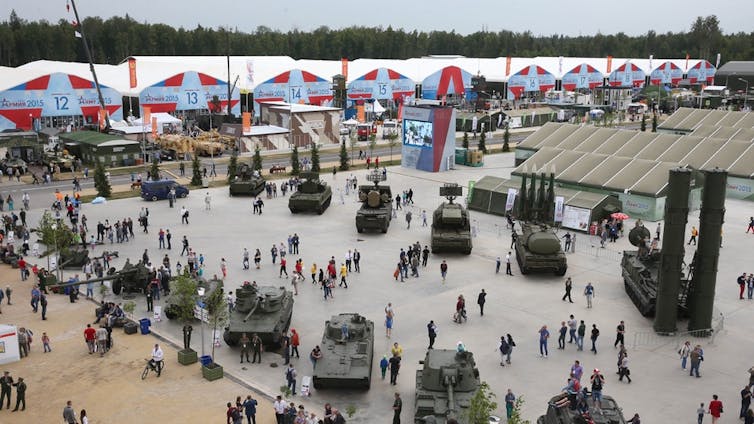
Army-themed amusement park in Russia. Military style is all the rage in neighbouring European countries too.
Government.ru/Wikimedia, CC BY-ND
This ideological shift became very clear when the Polish minister of defence Antoni Macierewicz made an appearance on a morning television programme for children. Sitting among a group of youngsters over bowls of army-style pea stew, he talked to the children about the importance of fighting for sovereignty.
Children are also being courted by the Hungarian governing party FIDESZ. Its officials are currently implementing a broad patriotic and national defence programme beginning in kindergarten. They are contemplating including shooting classes and military training in schools. Following the path of his Estonian and Polish counterparts, the Hungarian minister of defence, István Simicskó, has praised volunteer territorial defence forces. He is also endorsing the idea to build state-owned shooting ranges in each county to popularise military skills.