

Main
Among current genome editing systems that function in both dividing and nondividing mammalian cells in vitro and in vivo, prime editing1 offers unusual versatility by enabling the replacement of a target DNA sequence with virtually any other specified sequence containing up to several hundred inserted, deleted or substituted base pairs2,3,4,5,6,7,8,9,10,11. This versatility makes PE systems particularly promising for the treatment of a broad range of genetic diseases in humans. A prime editor (PE) is an engineered protein consisting of a catalytically impaired programmable nickase domain (such as a Cas9 nickase) fused to an engineered reverse transcriptase (RT) domain. The prime editing guide RNA (pegRNA) specifies the target protospacer sequence and simultaneously encodes the desired edits in the reverse transcription template in the 3′ extension of the pegRNA. The mechanism of prime editing requires three independent nucleic acid hybridization events before editing can take place and does not rely on double-strand DNA breaks or donor DNA templates. As a result of this mechanism, prime editing is inherently resistant to off-target editing or bystander editing, and can proceed with few indel byproducts or other undesired consequences of double-strand DNA breaks1,12,13,14,15,16,17,18,19,20,21.
Fully realizing the potential of prime editing for research or therapeutic applications in mammals requires safe and efficient methods capable of delivering PEs into tissues in vivo. So far, several groups have reported the in vivo delivery of PE via viral delivery methods, including adenoviruses8 and adeno-associated viruses (AAV)8,9,10,11,12,22,23,24,25. Viral delivery methods, however, require that the transgene be encoded directly in the viral gene expression cassette, limiting transgene size. The AAV genome has a cargo gene size limitation of ~4.7 kb (not including inverted terminal repeats)26, requiring large cargoes such as PEs (6.4 kb in gene size for a first-generation PE) to be split into multiple AAVs25, limiting editing efficiency especially at moderate or low vector doses27. Viral delivery methods also pose potential safety risks including increased off-target editing from sustained transgene expression28 and the possibility of unwanted cargo DNA integration into host cell genomes29. Nonviral delivery methods, such as lipid nanoparticles, avoid some of these issues by packaging editors as transiently expressing messenger RNAs (mRNAs). In vivo nonviral targeting of tissues beyond the liver for efficient therapeutic gene editing remains a challenge30,31, however, despite recent advances targeting hematopoietic stem cells32.
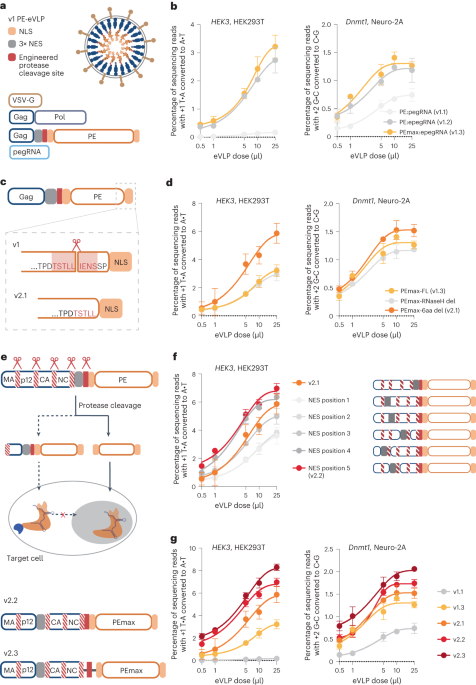
Virus-like particles (VLPs) are potentially promising delivery vehicles that in principle offer key benefits of both viral and nonviral delivery methods33. VLPs are formed by spontaneous assembly and budding of retroviral polyproteins that encapsulate cargo molecules from producer cells. VLPs lack a packaged genome but retain the ability to transduce mammalian cells and release cargo34,35. Previous studies explored VLPs for delivering Cas9 nuclease36,37,38,39,40,41,42,43. We recently reported efficient in vivo delivery of adenine base editor (ABE):single guide RNA (sgRNA) ribonucleoproteins (RNPs) with iteratively engineered virus-like particles (eVLPs)44 that overcame specific molecular bottlenecks in cargo packaging, release and localization.
Engineered VLPs offer several advantages over other delivery methods as a candidate for in vivo PE delivery. Read More