


The Mystery Behind the Universe’s Expansion
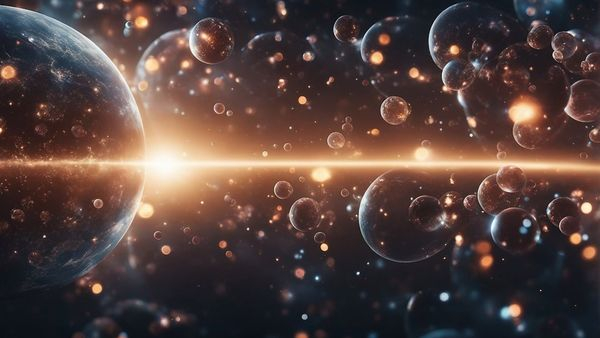
It is widely accepted in cosmology that our universe is continuously expanding, yet the exact cause of this phenomenon remains a mystery. Recent theoretical research suggests a fascinating explanation: our universe may be growing by colliding with and absorbing smaller parallel universes.
While the Standard Cosmological Model attributes the accelerated expansion of the universe to dark energy, a substance that is not observable in any other way, many scientists question its existence and seek alternative explanations.
A study published in December 12, 2023 in the Journal of Cosmology and Astroparticle Physics proposes a new idea – that the universe’s expansion is driven by interacting with other universes, rather than dark energy.
Embracing ‘Baby’ Universes
Although the concept of multiple universes coexisting is not novel, this study introduces a mathematical model to explore how this interaction could impact our universe’s evolution. According to their calculations, merging with other universes results in an increase in our universe’s volume, which could be interpreted as expansion.
The researchers also determined the rate of the universe’s expansion using their model, which aligns more closely with observational data compared to the traditional Standard Cosmological Model.
A Theory for the Ages
The authors’ theory also offers insight into cosmological inflation, the rapid expansion that occurred in the early stages of the universe. While previous theories attributed this inflation to the inflaton field, the new study proposes an alternative explanation – that the early expansion was a result of our young universe merging with a larger one.
Overall, this study presents a thought-provoking perspective on the expansion of our universe, suggesting that interactions with other universes may hold the key to understanding this cosmic phenomenon.