


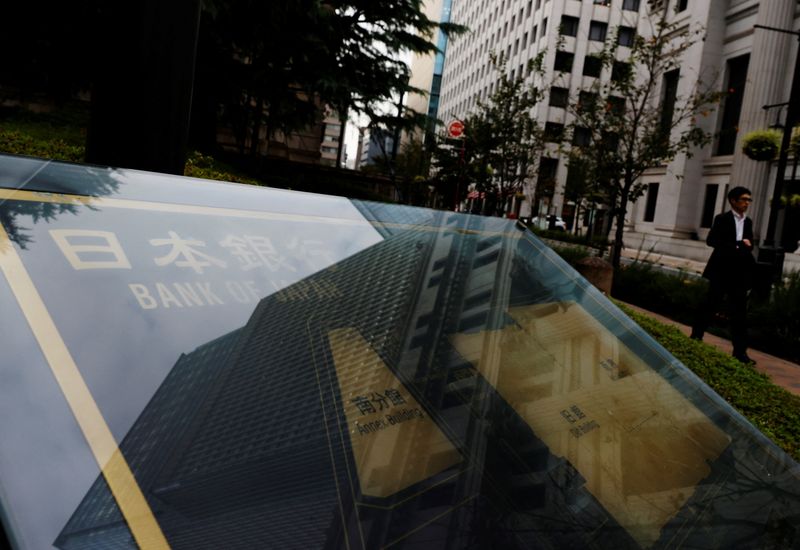
© Reuters. A man walks past a sign of Bank of Japan outside its headquarters in Tokyo, Japan, October 31, 2023. REUTERS/Kim Kyung-Hoon/File Photo
By Satoshi Sugiyama
TOKYO (Reuters) – Japan’s economy took a faster hit than anticipated in the third quarter, according to revised data released on Friday. Household spending faced increasing challenges, which adds complexity to the central bank’s push to phase out its accommodative monetary policy.
Both consumer and business spending declined, leading to a decrease in third-quarter gross domestic product (GDP). Other data revealed that real wages and household spending continued to decline in October due to prolonged inflation, which discouraged shoppers.
“Weakness in personal consumption is likely to continue for the foreseeable future, as real disposable income is likely to extend its decline, which is seen as a factor in sluggish consumption,” said Kota Suzuki, an economist at Daiwa Securities.
The revised Cabinet Office data showed that the economy contracted by an annualized 2.9% in July-September, which is more severe than the previously estimated 2.1% contraction and market forecasts for a revised 2.0% decline.
Capital expenditure fell 0.4%, compared to a preliminary 0.6% decrease and a median market forecast for a 0.5% fall.
Private consumption, which accounts for more than half of the economy, declined by 0.2% in July-September, versus a mostly flat performance in the initial estimate.
External demand shaved 0.1 percentage point off real GDP in line with the preliminary reading, as service imports outgrew auto exports.
Separate data showed that inflation-adjusted real wages dropped 2.3% year-on-year in October to mark a 19th straight month of decline, although slower than the 2.9% fall in September, according to the labor ministry.
Although nominal salaries rose 1.5%, inflation of more than 3% wiped off the wage growth in real terms, which is seen as a gauge of consumers’ purchasing power. With income stagnant, household spending decreased 2.5% in October from a year earlier, falling for eight months in a row, according to internal affairs ministry data.
The Bank of Japan has emphasized the need to maintain ultra-low interest rates until sustainable inflation of 2% along with wage hikes comes into view. Governor Kazuo Ueda said next year’s wage outlook would be crucial for determining whether prices were on the right track.