

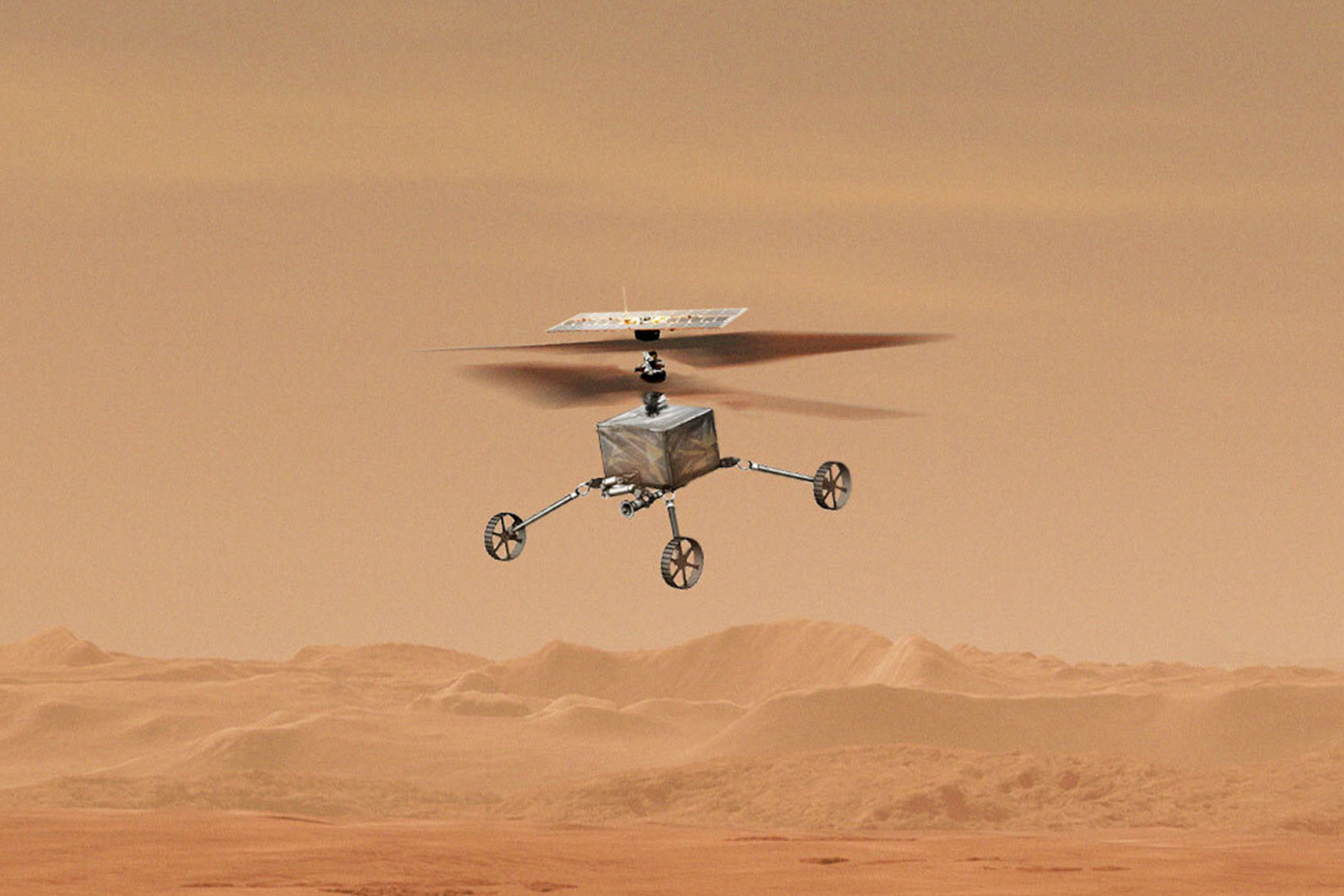

Last week, one of the most innovative missions in space exploration came to a bitter end. NASA’s famously successful Ingenuity rotorcraft — the 3.5-pound helicopter-like robot collecting samples on Mars — finally came to a crashing end. But already NASA and the European Space Agency are looking ahead to the next generation of space helicopters.
More robust than its predecessor, with at least 66 test flights under its belt and a new dual-rotor system, and carbon-fiber blades that can nearly reach Mach 1 speeds — the heir to Ingenuity has been preparing to take over its predecessor’s mission inside the agency’s 25-foot space simulator at the Jet Propulsion Lab in Pasadena, California.
Ingenuity was the first aircraft to make a powered, controlled flight on another planet. And though it was originally planned for only five flights, the helicopter made it 14 times farther in distance than NASA thought it would, logging more than two hours of airtime in its 72 successful flights on Mars.
“It is bittersweet that I must announce that Ingenuity, the little helicopter that could — and it kept saying ‘I think I can, I think I can!’ — well, it has now taken its last flight on Mars,” said NASA Administrator Bill Nelson in a Friday appearance”, who compared the craft’s historical flight achievements to those of the Wright brothers in 1903.
“What Ingenuity accomplished far exceeds what we thought was possible,” Nelson said. “And helped NASA do what we do best – make the impossible, possible. Through missions like Ingenuity, NASA is paving the way for future flight in our solar system and smarter, safer human exploration to Mars and beyond.”
Nelson said the fatal blow to Ingenuity came when the craft’s carbon fiber wings — fighting for lift through the planet’s exceedingly thin atmosphere, which is just 1% as dense as Earth’s — sustained damage during a landing. Nelson said the agency is investigating the possibility that the rotor blade struck the ground.
Now, hopes are high for the next generation of helicopters on the red planet. Called Sample Recovery Helicopters (SRH), NASA’s new craft are about the size of Ingenuity but have new dual, carbon-fiber rotors with wingspan about four inches longer than Ingenuity’s. They’re stronger too, and designed with higher speeds in mind, having already undergone at least 66 test flights with the benefit of Ingenuity’s off-world data.
“Over three weeks, the carbon-fiber blades were spun up at ever-higher speeds and greater pitch angles to see if they would remain intact as their tips approached supersonic speeds. Longer and stronger than those used on NASA’s Ingenuity Mars Helicopter, the blades reached Mach 0.95 during the test,” NASA said in November.
Want more health and science stories in your inbox? Subscribe to Salon’s weekly newsletter Lab Notes.
Tyler Del Sesto is NASA’s deputy test conductor for the SRH at the Jet Propulsion Lab. … Read More