


Activism
/
September 22, 2025
The country’s Gen Z uprising illustrates both the promise and limitations of online-brokered protest
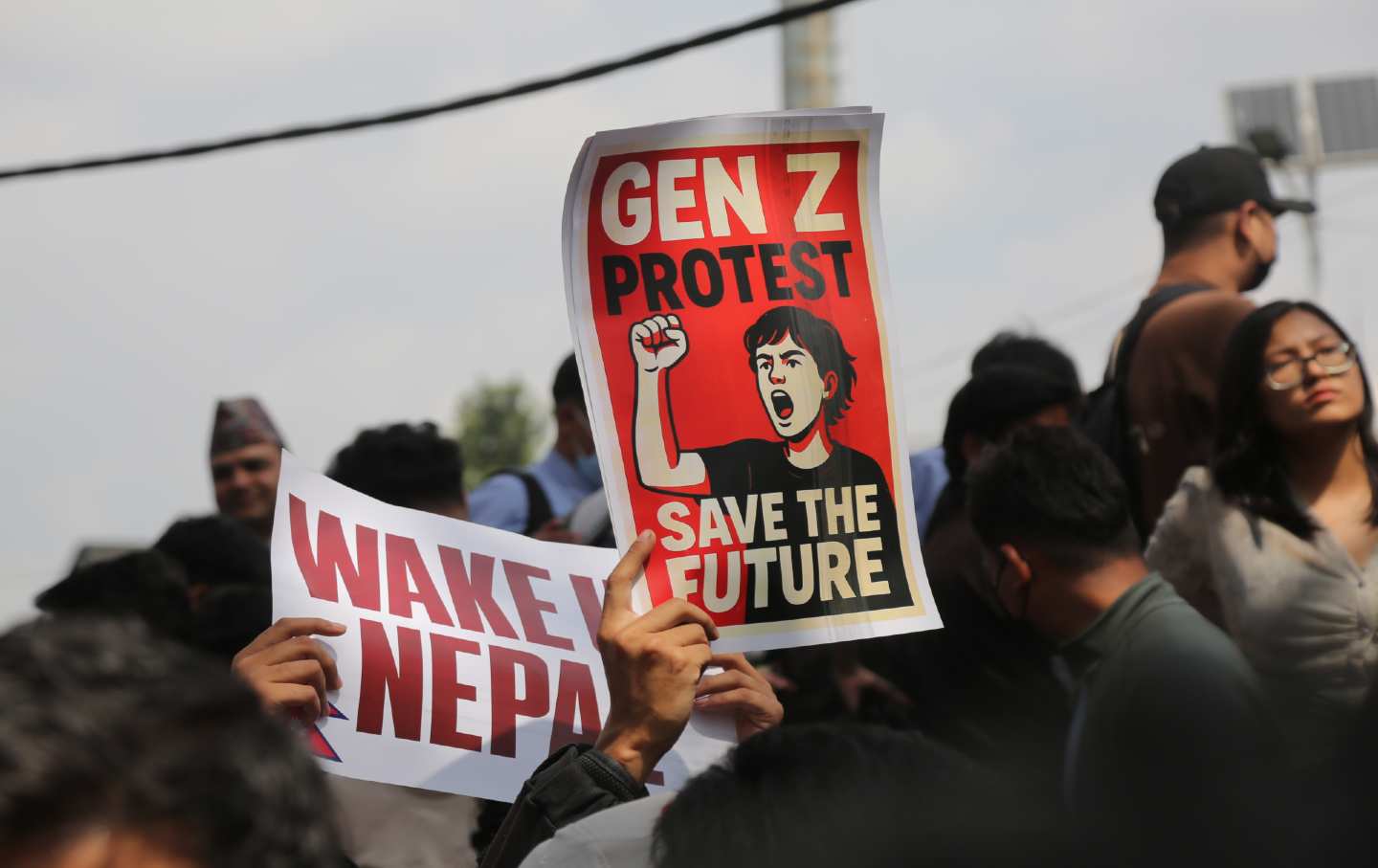
Anti-government protestors in Kathmandu, Nepal, on September 8
(Sunil Pradhan / Anadolu via Getty Images)
Something big is happening in remote Nepal—the first revolution not only powered by network technology but also in many respects about it. In a weeklong blaze of fury, young protesters belonging to a movement dubbed simply “Gen Z” burned the parliament, the Supreme Court building, international business headquarters, and the homes of disfavored politicians, some of whom were chased down and beaten by mobs. The Brahmin Communist prime minister, KP Sharma Oli, resigned, and protest leaders entered into discussions with the army, which historically answered to the monarchy, to form a new government. On September 15, one week after the start of riots that claimed at least 72 lives, mostly protesters killed by police, the dead were honored as “Gen Z martyrs.” The new regime is headed, for now, by the country’s first woman prime minister, Sushila Karki, a septuagenarian former Supreme Court justice and anticorruption crusader not affiliated with any party.
“The Parliament of Nepal right now is Discord,” the chat app popular with young gamers, a 23-year-old online content creator from Kathmandu, Sid Ghimiri, told The New York Times. The comment was typical of the enthusiastic international press coverage. You may be forgiven if it triggers your Silicon Valley BS detector. Yet, amazingly, this wasn’t hyperbole—Karki defeated four other short-listed candidates in a vote held in a Discord chat room with 16,000 members, organized by a Nepali nongovernmental organization (NGO) involved in the negotiations with army leaders. Although Internet tech has played a key role in recent revolutions—memorably during the Arab Spring as well as the so-called color revolutions—the facsimile of direct democracy held in an online chat room is something rather new.
Initial reports framed the Gen Z uprising as a response to a draconian ban on social media and online messaging platforms. But beneath that spark lay the tinder of more traditional grievances about wealth inequality, corruption, and representation. “What this group is demanding is an end to corruption, with good governance, and economic equality,” Karki said after being sworn in. “We must work with the Gen Z mindset.” Exactly what that means, especially in the Nepali context, remains nebulous. Obviously, no generation has uniform politics. What the press has declined to ask is who this vague new mindset leaves behind.
Current Issue

Nepal’s latest, and rather remarkable, revolution underscores just how profoundly the Internet has become foundational to the structures of governance, not only in wealthy countries but also in some of the poorest. It’s also an instructive example of how wielding control of the internet can be a double-edged sword for the ruling class. In dominant economies such as the United States and China, public- and private-sector investors are pouring hundreds of billions of dollars into the promulgation of artificial intelligence,