


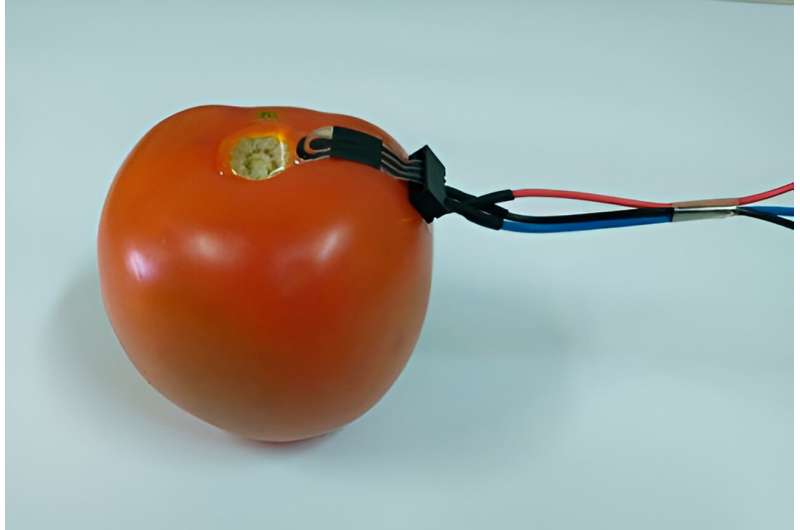
At the University of São Paulo (USP) and the Federal University of Viçosa (UFV) in Brazil, researchers have created a sustainable sensor that can be placed directly on the surface of fruits or vegetables to detect pesticides. Known as “plant-wearable,” this sensor is made of cellulose acetate, a material derived from wood pulp.
The device has the potential to ensure food safety in a world that increasingly faces a food shortage and environmental and health problems caused by excessive use of agrochemicals.
The study is published in the journal Biomaterials Advances.
Pesticides are widely used to raise crop yields and are typically applied by spraying, but only 50% reach their target. The rest ends up in soil, groundwater, surface water, raw drinking water, wastewater, and food products. Monitoring pesticide levels in water, soil, and food is essential to prevent contact between these toxic substances and the public.
The most common analytical tools used for this purpose are chromatographic techniques, which are effective but have drawbacks such as the need for pretreatment of samples, expensive equipment, and the long time taken to complete the analysis. Electrochemical sensors are an alternative that can combine affordability, rapid detection, and in situ pesticide detection.
“Our invention has all these features. The analysis is performed directly on the surface of fruit, vegetables, or leaves. Hence the term plant-wearable,” said Paulo Augusto Raymundo-Pereira, a researcher at the São Carlos Physics Institute (IFSC-USP).
“However, instead of the usual materials, which take a long time to degrade, we used cellulose acetate, a material derived from plants that has little impact on the environment and disintegrates completely in 340 days or less depending on local conditions.”
The researchers conducted laboratory tests in which a solution containing carbendazim, a fungicide, and paraquat, a herbicide, was sprayed on lettuce and tomatoes in a simulation of real-world use. The sensor was then directly attached to the lettuce and tomatoes. The sensor was able to successfully detect the presence of these pesticides directly from the surface of the produce.