


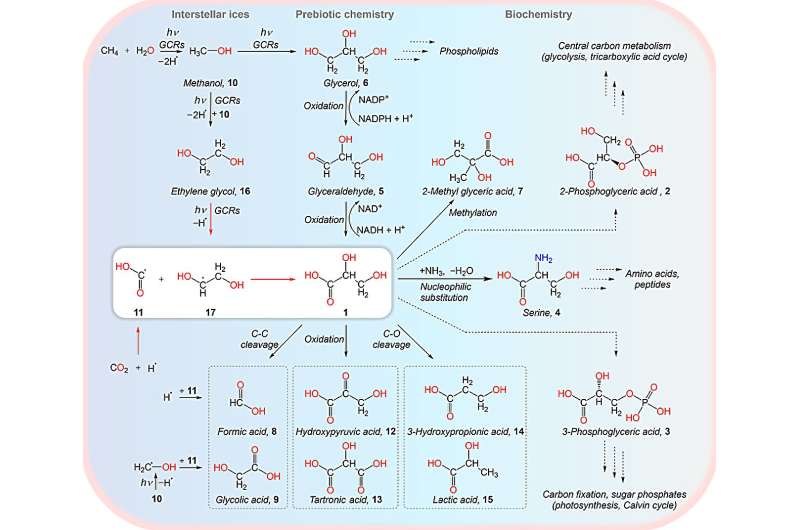
Exploration of Glyceric Acid Formation in Interstellar Environments
An essential compound crucial for the biological processes of living organisms has been successfully produced for the first time by researchers at the University of Hawaiʻi at Mānoa in extreme cold conditions (10 K) on nanoparticles coated with ice, replicating deep space conditions. This development represents a significant advancement in our comprehension of the origins of life.
The findings have been documented in the journal Science Advances.
A team from the UH Mānoa Department of Chemistry, led by Professor Ralf I. Kaiser, alongside postdoctoral researchers Jia Wang and Joshua H. Marks, collaborated with computational chemist Professor Ryan C. Fortenberry from the University of Mississippi to investigate the formation of glyceric acid in ultra-cold, carbon dioxide-rich icy surroundings of outer space. Glyceric acid, the simplest sugar acid, plays a vital role in glycolysis, which is a metabolic pathway that facilitates the conversion of food into energy for bodily functions.
Through experiments utilizing interstellar model ices and Galactic Cosmic Ray proxies at UH Mānoa’s W. M. Keck Research Laboratory in Astrochemistry, racemic glyceric acid was synthesized and identified with the assistance of photoionization lasers in the gaseous state. These molecules may contribute to the emergence of life on planets such as Earth. Scientists are now aiming to detect these compounds in space using telescopes like ALMA.
“The research indicates that compounds like glyceric acid could have been generated in molecular clouds and potentially in star-forming regions before being transported to Earth via comets or meteorites, thereby playing a role in the formation of life’s building blocks,” said Kaiser. “Understanding the mechanisms of these molecules’ creation in space is vital for unveiling the enigmas surrounding the origins of life.”
“The possible existence of such molecules in space underscores the interconnectedness of the chemistry within our bodies and the chemistry of the cosmos,” Fortenberry emphasized. “Moreover, the synergy between experimentation and computational models highlights how diverse scientific perspectives collaborate to expand our knowledge base.”
For further details, the study titled “Interstellar formation of glyceric acid [HOCH2CH(OH)COOH]—The simplest sugar acid” can be accessed in Science Advances (2024). DOI: 10.1126/sciadv.adl3236.
Citation: Uncover the roots of life: Researchers unveil the formation of ‘cool’ sugar acid in space (2024, March 13) retrieved 14 March 2024 from https://phys.org/news/2024-03-unraveling-life-scientists-cool-sugar.html
This document is protected by copyright.
» …
rnr