

Home Fossil Energy Oil & gas flows from ‘win-win’ subsea tie-back offshore Norway
December 4, 2024,
by
Melisa Cavcic
Norwegian state-owned energy giant Equinor has brought online a development project in the Norwegian Sea, which has been tied back to existing infrastructure at a field off the coast of Norway.
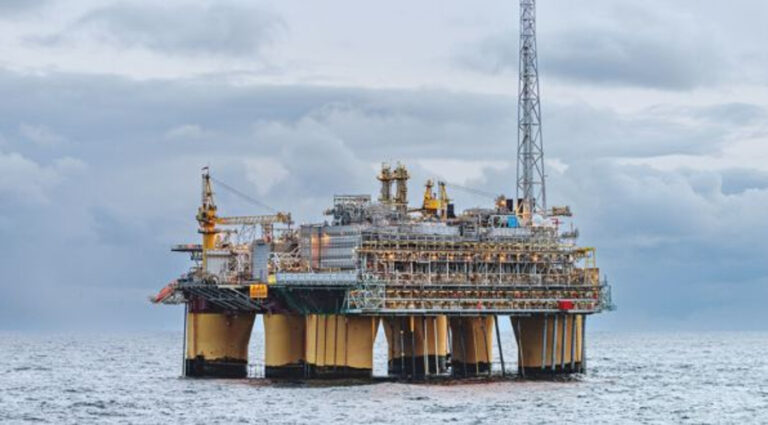 Åsgard B platform; Source: Equinor
While announcing the start of oil and gas production at Smørbukk North, a satellite development to the Åsgard field in the Norwegian Sea, Equinor highlighted that the utilization of existing infrastructure was “a win-win situation.”
The Norwegian energy giant elaborated on this description by explaining that the tie-back option enables Smørbukk North to have low development costs and profitable production with reduced CO2 emissions while providing Åsgard with an extended lifespan.
“Now that Smørbukk North is in production, Åsgard’s future looks even brighter, characterized by high activity and viable development. The Åsgard field consists of several installations in the Norwegian Sea and the Åsgard Transport gas pipeline that exports gas to European customers,” underscored Equinor.
The Norwegian player is the operator of the Smørbukk North license, while its partners are Petoro, Vår Energi, and TotalEnergies. The ripple effects from the Åsgard field in Norway are notable, according to Equinor, which claims that field purchases create a value of NOK 3-5 billion (around $271.7-$452.8 million) a year, with over 95% coming from Norwegian suppliers.
The company secured the green light last year for a “major” modification in connection with the development of Halten East and Smørbukk North at Åsgard B, which is a semi-submersible floating platform on the Åsgard field with processing facilities for gas treatment and stabilization of oil and condensates. It came on stream on 1 October 2000.
The platform was developed by Kværner and the hull was built by Daewoo Heavy Industries in Korea. The topside modules came from Poland, Russia, the Netherlands, Sweden, and Egersund, and were mated with the hull in Stavanger. This platform was the largest semi-submersible platform ever built for production in 2000, with a topside weighing 33,700 tonnes.
Located in the central part of the Norwegian Sea, in a water depth of 240-300 meters, the Åsgard field was discovered in 1981 and the development concept includes the Åsgard A production vessel, the Åsgard B semi-submersible platform and the Åsgard C storage vessel. The field has been producing oil since May 1999 and gas since October 2000.
The Åsgard facilities also receive oil and gas from seven different fields: Midgard, Smørbukk, Smørbukk South, Mikkel, Morvin, Smørbukk Northeast and Trestakk. Morvin – four wells and two subsea templates – and Mikkel – three wells and two subsea templates – are also tied into the infrastructure at Åsgard B.
The gas from the Åsgard field is routed by pipeline to Kårstø in Northern Rogaland County, where heavier components such as ethane, propane, butane and naphtha are separated, and the dry gas is transported onward via the Europipe II pipeline to customers on the continent.