

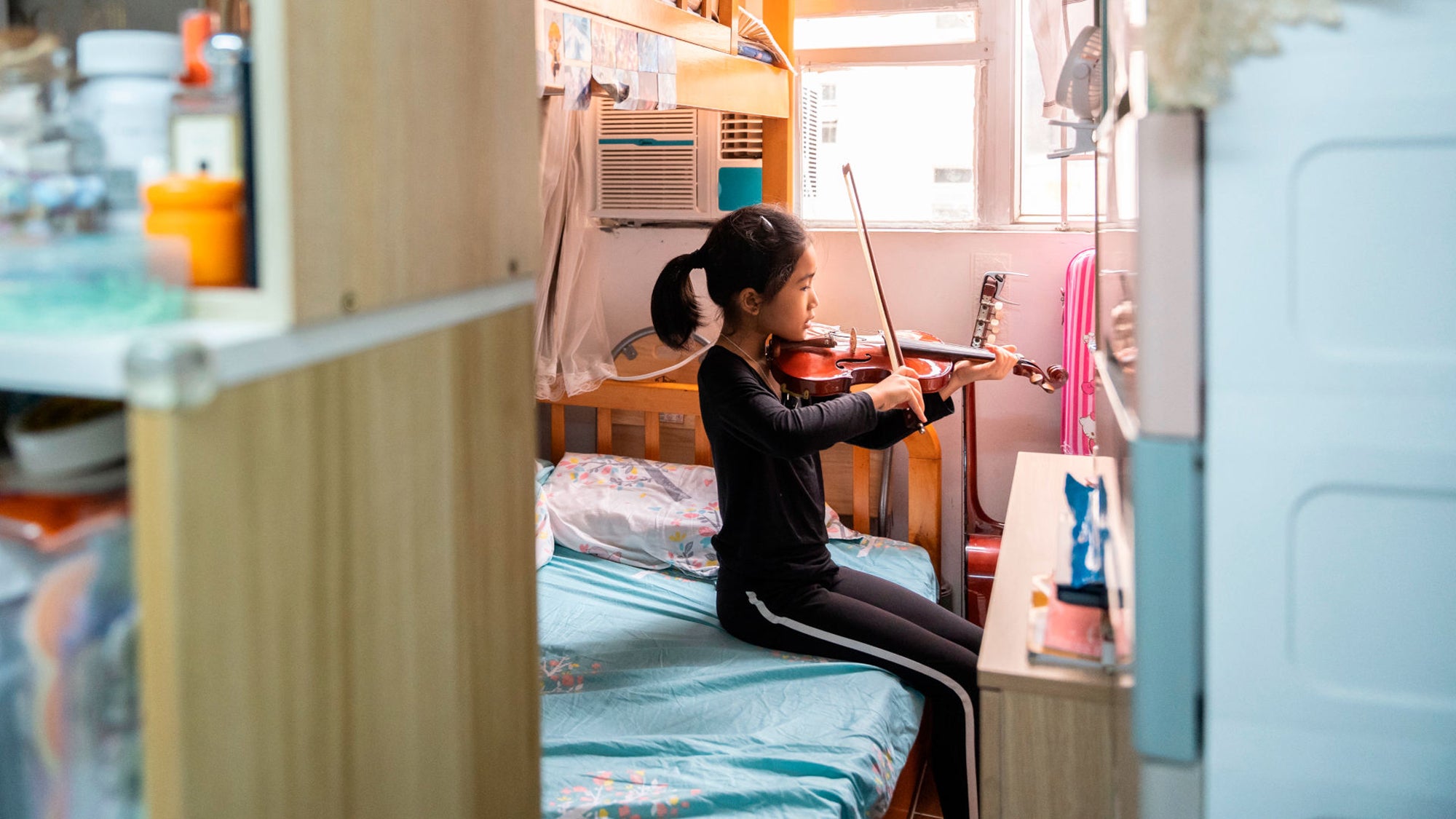

Check out how a community health care model might help low-income families stuck in the city’s notorious subdivided apartments.
By
Crystal Chow / Undark
|
Published Dec 4, 2023 7:00 AM EST
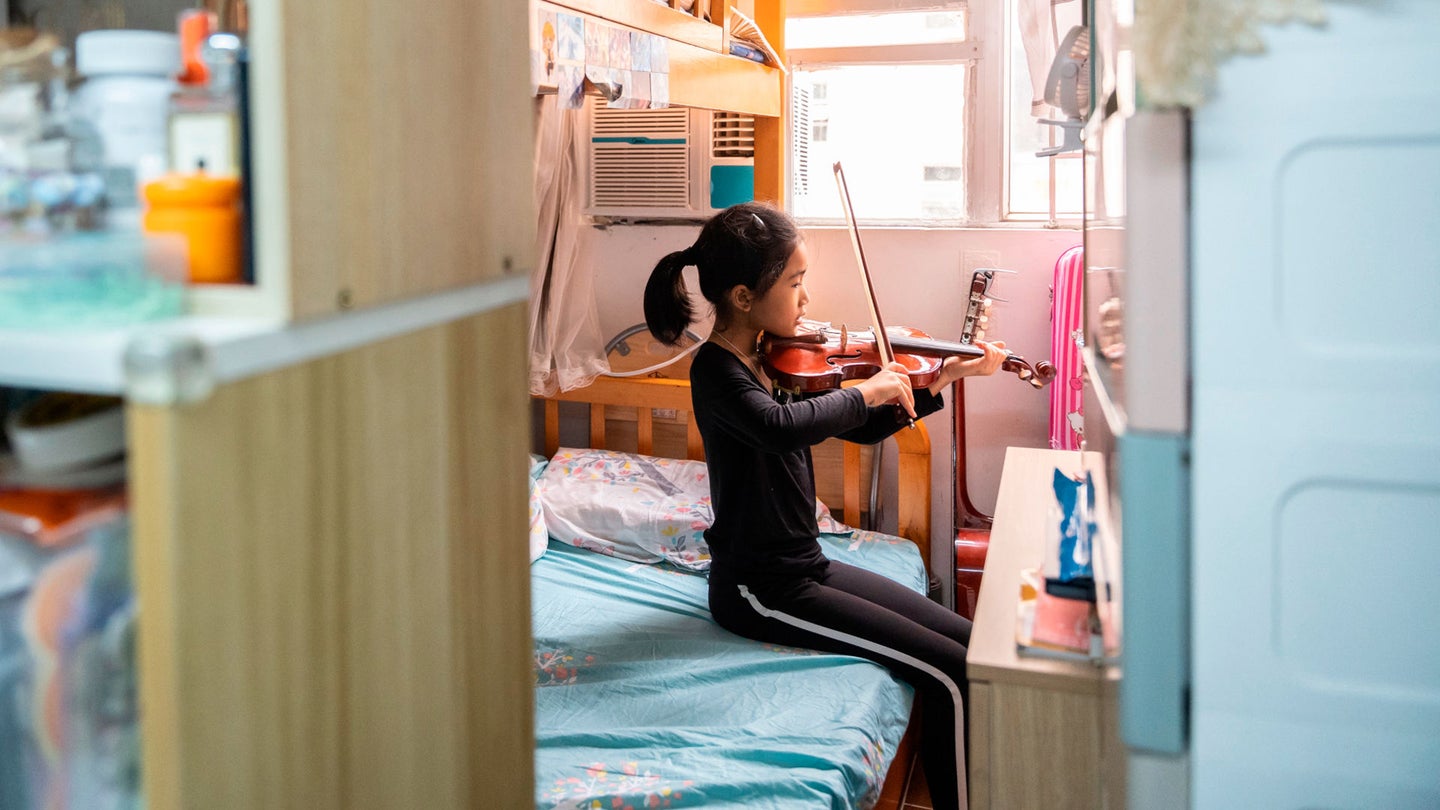
Morning Wan’s daughter, now 8 years old, plays violin in the family’s small subdivided flat in the Sham Shui Po area of Hong Kong. A lack of proper kitchen facilities in the apartment makes it difficult to cook, affecting the family’s diet. Chan Long Hei for Undark
SHARE
This article was originally featured on Undark.
Sham Shui Po is only a 15-minute subway ride from Hong Kong’s Central District, yet it’s one of the city’s poorest and most densely populated areas. The neighborhood, marked by its tightly packed aged apartment buildings, bustling street markets, and discount stores, is home to tens of thousands of low-income families unable to get subsidized housing.
Many of those residents live in so-called shoebox flats—subdivided apartments that have sprung up in response to a widespread housing shortage. What was once a single standard-sized unit gets divvied up into two or three or even four or more to accommodate multiple families. These informal dwellings tend to be squalid, poorly ventilated, lacking basic facilities, and — with a median floor area of just 100 square feet—very small.
As the pandemic laid bare the disparities faced by poverty-stricken families, Crystal Ying Chan, a research assistant professor at Chinese University of Hong Kong, was interested in how those disparities manifested in people’s diet and nutrition. With rent taking up as much as 40 percent of their monthly income, many households struggle to put food—healthy or otherwise—on the table.
So, in the spring of 2020, which marked the city’s second wave of Covid-19 outbreaks, Chan collaborated with a mobile team of nurses, social workers, and dieticians to deliver food and provide care services to subdivided flat residents. She then secured a research grant to explore factors contributing to food insecurity risks among those low-income families.
“It began as a small three-month study to look at how Covid heightened food insecurity in these communities,” said Chan, “but we quickly realized that it goes beyond the pandemic.”
Now, Chan is exploring how to use lay health workers—members of the community who have been trained in providing health services—to address gaps in public care, from food insecurity to diabetes management to mental health care.
An emerging body of research has explored similar interventions for community health services globally. In Uganda, for instance, care delivered by community health workers has helped manage infectious diseases such as malaria, tuberculosis, and HIV, and one ongoing study is exploring its effectiveness to control hypertension among the country’s rural communities.
These informal dwellings tend to be squalid,