


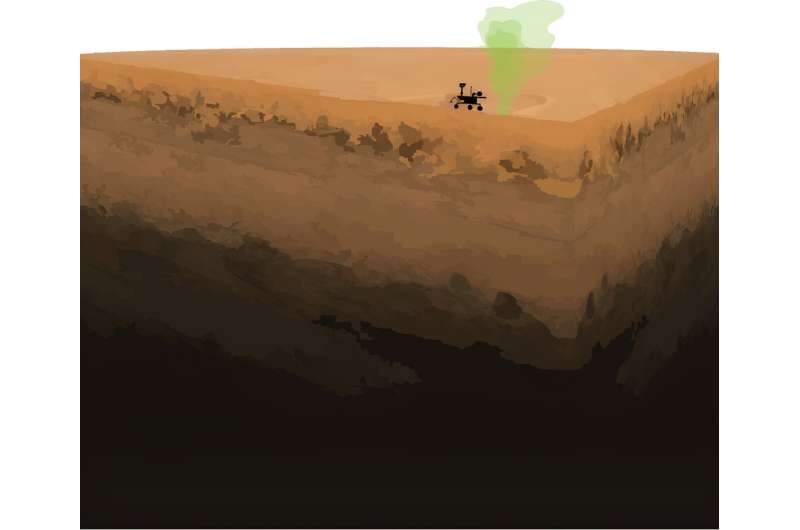
Conceptual diagram of NASA’s Curiosity rover measuring methane on the surface of Mars. Credit: John P. Ortiz 2022.
Ever since methane was first detected in Mars’ atmosphere 20 years ago, scientists have been trying to understand how it got there and how it behaves on the Red Planet. With these new measurements, they are hoping to uncover the reasons behind these fluctuations and get an insight into potential life on Mars. The task, however, is to figure out the best time to collect these samples, given Curiosity’s constraints on resources.
Recent findings led by John Ortiz, an environmental engineering doctoral candidate at Johns Hopkins University, shows interesting evidence of how varying atmospheric pressure might be behind these irregular but expected fluctuations. The research could vastly influence the current mission of the Curiosity rover, which has been operational on Mars for over a decade.
“Barometric pumping, as we call it, is likely causing these fluctuations. It’s a process where changes in atmospheric pressure move gases from underground up to the surface,” explained Ortiz, of the Department of Environmental Health and Engineering. “Just like on Earth, daily atmospheric pressure changes on Mars occur due to heating from the sun— cooler air at night leads to higher pressure, while warmer air during the day results in lower pressure. This movement of gases from below the surface becomes pronounced during low pressures and minimalizes when pressures get high.”
The results from this study have now been published in the Journal of Geophysical Research: Planets. The team comprised of researchers from several institutions, including Johns Hopkins, Los Alamos National Laboratory, Purdue University, and the Freshwater Trust.
For their study, the researchers developed computer models to simulate methane transport below the Martian surface as well as the mixing of methane within its atmosphere. The team was able to make predictions for methane concentration over time due to less chaotic weather and atmospheric pressures on Mars compared to Earth.
Their computer models also indicated the existence of a “puff” of methane prior to sunrise—information that the Curiosity rover can utilize in its atmospheric sampling experiments during the current campaign at Gale crater.
“Our research reveals key windows for collecting data which has the potential to provide immense insights into the timing of methane fluctuations and eventually help us understand its origins on Mars,” said Harihar Rajaram, a professor of environmental health and engineering at Johns Hopkins and Ortiz’s doctoral adviser.
Co-authors: Kevin Lewis,