


Armed Conflicts, Civil Society, Democracy, Development & Aid, Global, Headlines, Human Rights, Humanitarian Emergencies, TerraViva United Nations
Opinion
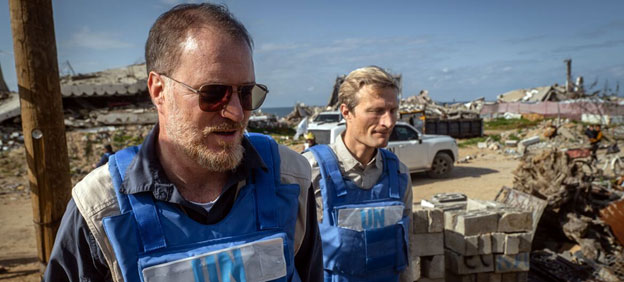
Shaun Hughes (left), WFP Country Director for Palestine, walks amid massive destruction in Gaza. Credit: WFP/Maxime Le Lijour
Excerpts from a statement by Tom Fletcher, Under-Secretary-General for Humanitarian Affairs and Emergency Relief Coordinator, to the Security Council, pursuant to resolution 2730 (2024) on the safety and security of humanitarian personnel and the protection of United Nations and associated personnel.
UNITED NATIONS, Apr 9 2026 (IPS) – In 2025, at least 326 humanitarians were recorded as killed across 21 countries, bringing the total number of humanitarians killed in three years to over 1,010. We recognise, grieve and honour each of our 326 colleagues, and commit the work ahead to their memory.
Of those over 1,000 deaths, more than 560 were in Gaza and the West Bank, 130 in Sudan, 60 in South Sudan, 25 in Ukraine and 25 in [the Democratic Republic of the Congo].
That number – over 1,000 – compares to 377 recorded as killed globally over the previous three years – so that’s almost tripling the death count. This is not an accidental escalation – it is the collapse of protection.
These humanitarians were killed while distributing food, water, medicine, shelter. They died in clearly marked convoys and on missions coordinated directly with authorities. And, too often, they were killed by Member States of the United Nations.

Credit: WFP/Sayed Asif Mahmud / Source: UN News
Humanitarians know we face risks. It is the nature of our work, the places in which we operate.
These deaths are not because we are reckless with our lives. They are because parties to the conflict are reckless with our lives.
So, on behalf of over a thousand dead humanitarians and their families, we ask: why?
Is it because the world no longer believes in Security Council resolution 2730, in which you spoke with such moral urgency about ending violence against humanitarians?
Is it because international humanitarian law, forged by a generation of wiser political leaders for just such a time as this, is no longer convenient?
Is it because it is more important to protect those designing, selling, supplying and firing lethal weapons – including drones, cyber tools, artificial intelligence – than protecting us?
Is it because those killing us feel no cost for their actions? How many were prosecuted? How many of their leaders resigned? On how many investigations did the UN Security Council insist? Were you ever selective in your outrage?
Or is it because Member States see these numbers as collateral damage, part of the fog of war? Or worse, are we now seen as legitimate targets?
And perhaps the most chilling question: if these deaths were ‘preventable,’ why then were they not prevented?