


NEW YORK (RNS) — Around 20 parishioners gathered at the Jesuit Community Chapel in Brooklyn on Thursday evening (July 3). The chairs were arranged in a circle, and the mood was purposeful but warm. Two community members acted as translators in Creole and in Spanish as organizers took turns standing to speak.
The group, part of a growing resistance to the planned closure of St. Teresa of Avila Church in Crown Heights, has held weekly meetings since early June, when the church’s rector, Fr. Christopher Heanue, read aloud a letter from their bishop announcing the closing of the church. The ad hoc committee, made up largely of longtime Brooklyn residents within this Caribbean-American community, is determined to fight for a church many members have called home for decades.
“God’s house must always prevail, particularly in these times when people have nothing,” said Denise Caldwell, a longtime parishioner and a co-chair of the group formed to reverse the Bishop’s decision. They have been meeting in the Jesuit Community Chapel, about a half mile away from St. Teresa of Avila, because, Caldwell said, “we were locked out of the church.”
On the first Sunday of June, Pentecost Sunday, Bishop Robert J. Brennan wrote a letter to the church “to share the difficult news that we have determined that the church building must close at the end of this calendar year.” His letter announced that Masses would be scaled back starting July 1 and added, “While I know that these decisions will be hard for you to accept, I want to explain the reasons behind it and to commend the faithful, effective work that has been done at this church for decades.”
Over the past decade, Crown Heights has undergone significant demographic shifts amid rapid growth in New York City’s housing market. Between 2010 and 2020, North Crown Heights lost nearly 19,000 Black residents while gaining approximately 15,000 white residents, according to 2020 Census data released in 2021. During that time, many neighborhoods in Brooklyn, including Crown Heights, saw home prices double.
Mike Delouis, 39, was the cantor at St. Teresa of Avila and had been baptized there after his parents immigrated to Brooklyn from Haiti in the 1970s. “I really liked to see the new faces that were coming in, even through the process of gentrification,” Delouis said. He first heard the news of the church’s closure from the choir loft on Pentecost morning. “We only had the closing hymn left to sing, and it was hard to do it,” he said. “It’s devastating.”
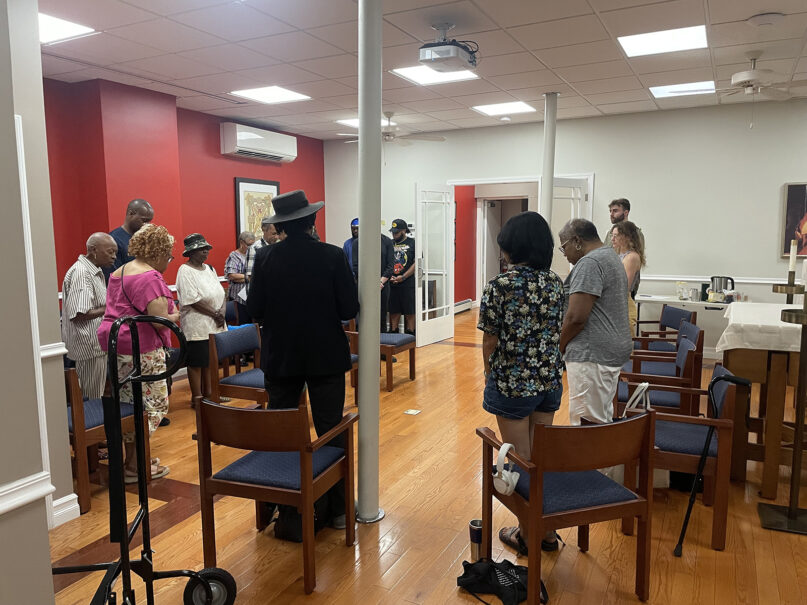
Parishioners gather to strategize protesting the planned closure of St. Teresa of Avila Catholic Church at the Jesuit Community Center on Carroll Street in Brooklyn, Thursday, July 3, 2025. (RNS photo/Fiona Murphy)
The Bishop’s letter cited mounting financial challenges, dwindling participation and a deferred repair bill estimated at $5.5 million. But participants in the group are not convinced and have circulated fliers in the surrounding neighborhood since the announcement,