


- Exciting Features
- Legendary Guitarist
“I’ve had all of the great guitarists in the world say to me, ‘Pete, you’re not in the top 10 for virtuosity, but you’re certainly No. 1 as an acoustic rhythm player’”: Pete Townshend on Who’s Next, Lifehouse, and fun times with Superstrats
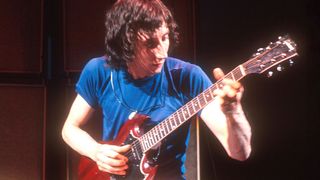
(Image credit: Jeffrey Mayer/WireImage)
During the golden age of rock ’n’ roll, Pete Townshend helped define and redefine both the electric and acoustic guitar several times over. As the Who’s guitarist, he pioneered an aggressive, almost punky approach to the guitar in the mid-1960s, at least a decade before punk was a genre.
And his rampant destruction of his instrument on stage – which he later attributed to his studies at Ealing Art College of Gustav Metzger, the pioneer of auto-destructive art – became not just an expression of youthful angst but also a means of conveying ideas through musical performance.
“We advanced a new concept,” Townshend wrote in his memoir. “Destruction is art when set to music.”
It also set the Who apart from just about every one of their contemporaries, but most especially guitarists like Jimmy Page, Peter Green, and, of course, Townshend’s friend Eric Clapton, who were peddling an English version of American blues back to the country of its origin.
“No-one who saw the Who at that time could deny that they were the best live band going,” Richard Barnes, the Who’s biographer and Townshend’s flatmate at the time, recalled in 2021.
“Even the biggest Kinks fan, if the Kinks and the Who were both playing in town, would go see the Who over the Kinks. They were a real show when no-one else was putting on a show. And that catapulted them into that rarified company.”
Townshend’s aggressive but melodic approach to the guitar, in a style that combined both lead and rhythm guitar, was hugely influential on guitarists from the Sex Pistols’ Steve Jones to Guns N’ Roses’ Slash, and many others.
Recently ranked No 37 on Rolling Stone’s 2023 list of 250 greatest guitarists of all time, he was also one of the first musicians to use large stacks of amplifiers and feedback as a musical tool, often ramming his guitar against the deafeningly loud speakers.
“Our managers signed Jimi Hendrix to their label and had me take him down to Jim Marshall’s,” Townshend told this writer in 1993, recalling a trip to the legendary amplifier designer’s shop. “At the time I had two cabinets of four speakers each. Jimi bought four cabinets. He didn’t do my act. He stole my act.”
“Pete Townshend is one of my greatest influences,” Rush’s Alex Lifeson, a guitar virtuoso in his own right, said of Townshend’s often underrated talent on the guitar. “More than any other guitarist, he taught me how to play rhythm guitar and demonstrated its importance, particularly in a three-piece band.”
And as an enthusiastic acoustic guitarist,