



The nature of time has plagued thinkers for as long as we’ve tried to understand the world we live in. Intuitively, we know what time is, but try to explain it, and we end up tying our minds in knots.
St. Augustine of Hippo, a theologian whose writings influenced western philosophy, captured a paradoxical challenge in trying to articulate time more than 1,600 years ago:
“What then is time? If no one asks me, I know; if I want to explain it to a questioner, I do not know.”
Nearly a thousand years earlier, Heraclitus of Ephesus offered a penetrating insight. According to classical Greek philosopher Plato’s Cratylus:
“Heraclitus is supposed to say that all things are in motion and nothing at rest; he compares them to the stream of a river, and says that you cannot go into the same water twice.”
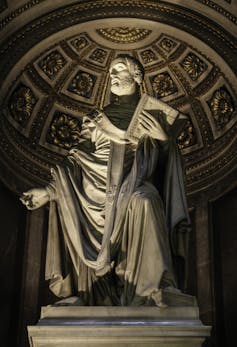
A 19th-century statue of St. Augustine by Antoine Etex in the church of La Madeleine, Paris.
(Fr Lawrence Lew, Flickr)
Superficially, this can sound like another paradox — how can something be the same river and yet not the same? But Heraclitus adds clarity, not confusion: the river — a thing that exists — continuously changes. While it is the same river, different waters flow by moment to moment.
While the river’s continuous flux makes this plain, the same is true of anything that exists — including the person stepping into the river. They remain the same person, but each moment they set foot in the river is distinct.
How can time feel so obvious, so woven into the fabric of our experience, and yet remain the bane of every thinker who has tried to explain it?
An issue of articulation
The key issue isn’t one most physicists would even consider relevant. Nor is it a challenge that philosophers have managed to resolve.
Time itself isn’t difficult to grasp: we all understand it, despite our persistent struggle to describe it. As Augustine sensed, the problem is one of articulation: a failure to precisely draw the right boundaries around the nature of time both conceptually and linguistically.
Specifically, physicists and philosophers tend to conflate what it means for something to exist and what it means for something to happen — treating occurrences as if they exist. Once that distinction is recognized, the fog clears and Augustine’s paradox dissolves.
The source of the issue
In basic logic, there are no true paradoxes, only deductions that rest on subtly mishandled premises.
Not long after Heraclitus tried to clarify time, Parmenides of Elea did the opposite. His deduction begins with a seemingly valid premise — “what is, is; and what is not, is not” — and then quietly smuggles in a crucial assumption. He claims the past is part of reality because it has been experienced, and the future must also belong to reality because we anticipate it.