

Repurposing Poland’s Bełchatów mine and power plant for renewables not recreation could create more jobs, tax revenue and electricity, transition experts say
In a cosy cinema room at the Bełchatów coal-fired power station in central Poland, a promotional video played to curious visitors boasts that the open-pit mine which feeds the power station is one of the largest holes ever dug in the ground.
The caverns of the Bełchatów coal mine are wide enough to fit around 5,000 full-sized football pitches and are rich in lignite – a soft, brown and wet type of coal which looks and feels like tree bark but is particularly damaging to human health when burned.
After more than 40 years of mining, the lignite is running out and plans are being made to wind down operations at the site.
PGE, the Polish state-owned utility which runs the mine and adjacent power plant – the largest and dirtiest in Europe – has a 45-year plan to turn the mining pits into the country’s deepest lake and the coal heaps into a series of hills for recreational use.
In 2070, PGE envisions visitors will be able to ski in the winter, golf, cycle, kayak, quad-bike, horse ride, climb and even scuba dive down to see the soon-to-be-underwater old mining machines.
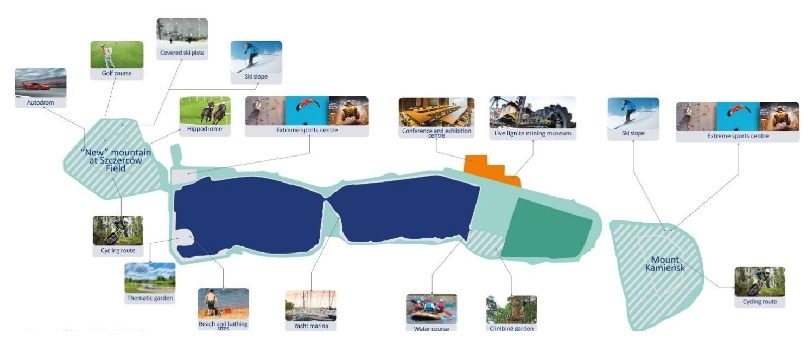
PGE’s visualisation of what the redeveloped Bełchatów site will look like (Photos: PGE)
But local governments officials and researchers warn that the plans risk failing to deliver the green and economically fair transition deserved by Bełchatów communities whose livelihoods have depended on coal. They argue the plans could waste the site’s huge renewable energy potential while the tourist attraction fails to replace the at least 7,500 jobs that will be lost when the mine and power plant close, potentially driving away the region’s young people.
As deputy director of the Just Transition Fund Department of Łódź province where Bełchatów is located, Malgorzata Misiak’s job is to cushion the blow of the region’s transition away from coal and make sure the benefits of what replaces it are shared as equally as possible.
She told Climate Home PGE’s plan to let the mine gradually fill over decades overlooks the many more jobs that could be created in a much shorter time-frame with renewable energy investment.
Anabella Rosemberg, a senior adviser on just transition at Climate Action Network International, said: “PGE is pledging an investment on a timeline by which time all its executives will be retired, so won’t be held accountable if it fails. By then, the communities dependent on Bełchatów would have already joined the thousands considering that the transition is paid by poor people.”
Forum Energii analyst Aleksandra Gawlikowska-Fyk warned that PGE’s plan would also overlook the region’s need for clean energy.
PGE did not respond to a request from Climate Home for comment for this article, while a spokesperson for the white-collar Kadra trade union declined to comment by the time of publication.