

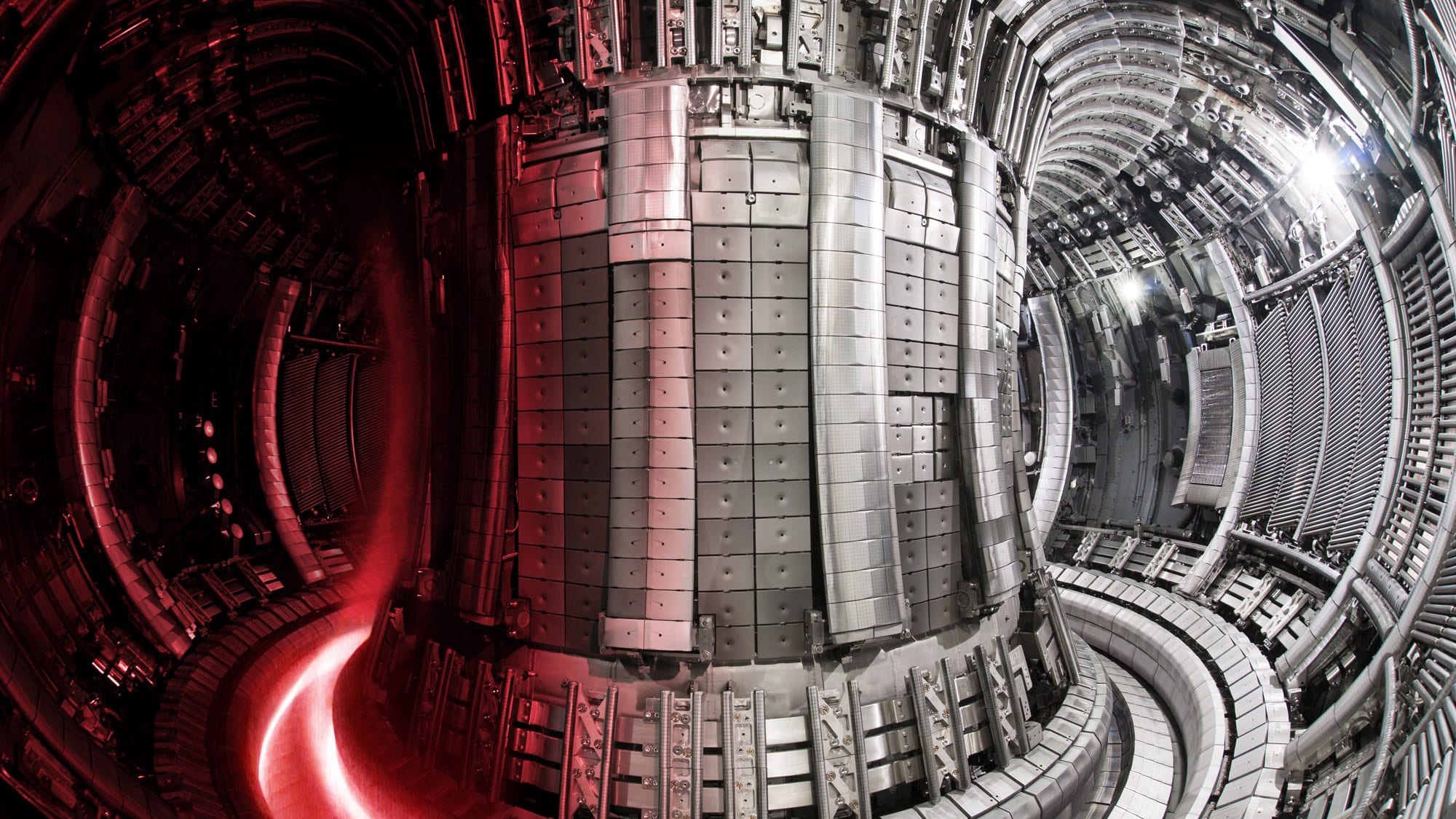

After 40 years of groundbreaking advancements in nuclear fusion, the Joint European Torus (JET) facility concluded its operations in December 2023, leaving behind a final achievement that broke records. The tokamak reactor’s last experiment resulted in the production of 69.26 megajoules of energy in just five seconds, surpassing its previous record by over 10 megajoules. This remarkable feat marked a significant milestone for JET, which initially reached a peak power level of 22 megajoules in 1997.
The JET facility, situated in Oxfordshire, UK, commenced operations in 1983 with the goal of propelling the world closer to sustainable and economically viable fusion energy production. Unlike nuclear fission, which releases energy by splitting atoms, fusion involves the fusion of atoms like tritium and deuterium at extreme temperatures to generate helium plasma, a neutron, and substantial energy. By emulating the fusion processes observed in stars like the sun, scientists aim to revolutionize the global energy sector.
The concept of tokamak reactors, derived from the term “toroidal chamber with magnetic coils,” originated in the USSR in 1958. These reactors resemble a large, sophisticated tire filled with hydrogen gas fuel that undergoes rapid rotation through magnetic coiling to ionize atoms and form helium plasma.
Despite the existence of multiple fusion facilities worldwide capable of initiating fusion reactions, the high costs associated with nuclear fusion remain a significant barrier. For instance, JET’s record-breaking experiment in December yielded 69 megajoules of energy in just five seconds, yet this output was only adequate to heat a few bathtubs’ worth of water.
While some experts predict that affordable fusion energy may become viable in the next two decades, others argue that financially feasible fusion reactors may never materialize. The current expenses involved in operating and sustaining fusion reactors pose significant challenges, compounded by the urgency of addressing the ongoing climate crisis. However, if humanity successfully develops sustainable fusion energy solutions, it will owe much to the groundbreaking achievements of the JET facility throughout its four-decade history.
In a recent interview with the BBC, UK Minister for Nuclear and Networks Andrew Bowie hailed JET’s final experiment as a significant step towards achieving fusion energy on a global scale. With JET now offline, Japan’s JT-60SA tokamak, towering six stories high north of Tokyo, has become the world’s largest fusion reactor. Although inaugurated in December 2023, the JT-60SA’s title may soon be surpassed by its European counterpart, the International Thermonuclear Experimental Reactor (ITER), scheduled to become operational in 2025 after facing various challenges and delays.