

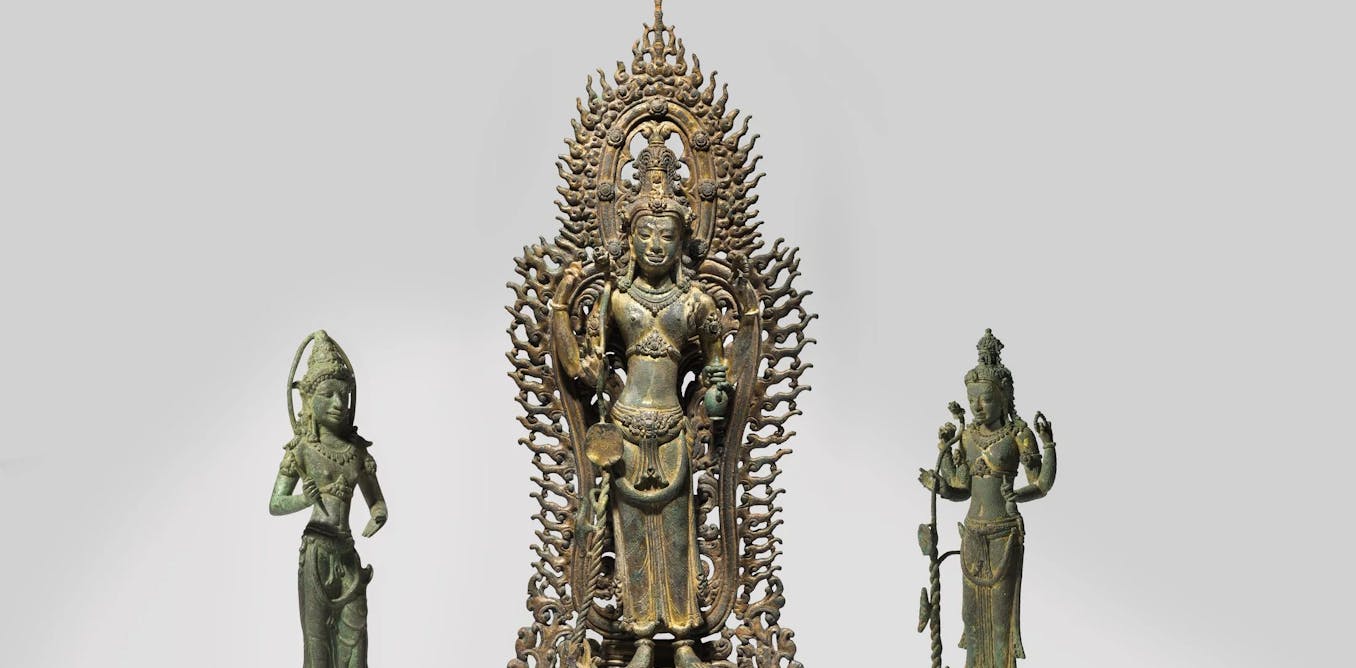

In late July, during a visit to the National Gallery of Australia, three Buddhist bodhisattva statues caught my attention.
All three were created in the ancient Champa Kingdom that flourished from the 2nd to 19th centuries across present-day Vietnam, Cambodia and Laos. They were purchased by the National Gallery (NGA) in 2011, before being “repatriated” to the Kingdom of Cambodia in 2023 (and displayed in the NGA on loan).
But the Champa Kingdom bore little resemblance to Cambodia’s current borders. What does repatriation mean when the political geography of a place has entirely transformed?
As my research has shown, museums, schools and state institutions can help sanction certain versions of history, while marginalising others. The quiet presence of the bodhisattvas in a museum case embodies much larger questions about cultural heritage, political legitimacy, and who gets to define historical “truth”.

The
three sculptures were made between 9th-11th centuries in the Champa Kingdom.
Author provided
Decades of marginalisation
The decision to return the Cham artefacts to Cambodia, and to exclude Vietnam and Laos, highlights how contemporary politics shape our understanding of cultural heritage.
The Cham people are an ethnic minority in Cambodia, Vietnam, and Laos. In Cambodia, they have been marginalised by the ruling government’s Khmer ethno-nationalist vision of the country.
Although most Cham people today are Muslim, the statues were made between the 9th and 11th centuries during a pre-Islamic era. This period was marked by strong Hindu and Buddhist influence, and a lack of nation-state borders.
After receiving the repatriated statues in 2023, Cambodian Ambassador to Australia, Cheunboran Chanborey, said:
Indeed, putting looted artefacts to their countries of origin can have significant and positive impacts on local communities and their involvement in preserving their cultural heritage. It can foster a sense of pride, national identity and cultural continuity as artefacts hold immense value for the communities to which they belong.
But the very cultural tradition that created the bodhisattvas now finds itself sidelined in a modern nation-state claiming ownership of them.
Lootings by the Khmer Rouge
The historical context of how the Cham poeple’s artefacts were looted is crucial and disturbing.
Journalist Anne Davies’ account in the NGA’s documentation notes organised looting networks were “often headed by members of the military or the Khmer Rouge”. The Khmer Rouge was the political party that ruled Cambodia from 1975–79 under the notorious Pol Pot, carrying out a genocide of the Cham people (as well as other ethnic groups).
However, this looting actually took place in the 1990s, after the Khmer Rouge was overthrown by the precursors to the present-day Cambodian People’s Party.
In other words, the looting happened on the current government’s watch. Davies writes “members of the military” of the Royal Cambodian Armed Forces worked with former Khmer Rouge soldiers who continued to occupy parts of northern Cambodia, especially areas protected by thick forest.