


Researchers have used guanidinium thiocyanate as a chaotropic agent to modulate the crystal growth rate during perovskite crystallization. They compared different concentrations of the guanidinium thiocyanate. Champion device efficiency was 22.34%.
August 29, 2025
Lior Kahana
Image: University College London, Journal of the American Chemical Society, CC BY 4.0
A research team led by scientists from the University College London in the United Kingdom has utilized simple salt to enhance the performance of tin-lead (Sn−Pb) perovskite solar cells. The salt, guanidinium thiocyanate (GASCN), was used as a chaotropic agent that modulated the crystal growth rate during perovskite crystallization.
“Our approach provides a straightforward, effective way to enhance perovskite quality during manufacturing, delivering solar cells that are both higher performing and more stable, key requirements for commercial success,” said corresponding author Tom Macdonald in a statement issued by the university. Co-author Chieh-Ting Lin added that “it opens the door to fine-tuning the structure of perovskites for high-performance tandem solar cells, with the potential to significantly push the limits of efficiency.”
Chaotropic agents such as GASCN, the team explained, disrupt the structure of secondary bonds such as Lewis acid−base interactions in the precursor solution. Different GASCN concentrations were tested in this research, namely 5%, 10% and 20%. They were applied to Sn−Pb perovskite, typically the bottom layer of a tandem cell. In addition, a reference cell, with 0% of GASCN, was also tested, along with two other additives, namely guanidinium Iodide (GAI) and sodium thiocyanate (NaSCN).
“We used a one-step antisolvent technique to deposit a narrow-bandgap mixed Sn–Pb perovskite, Cs₀.₀₂₅FA₀.₄₇₅MA₀.₅Sn₀.₅Pb₀.₅I₂.₉₂₅Br₀.₀₇₅. We prepared the precursor solution by adding a stoichiometric blend of the chemicals in a solvent mixture of dimethylformamide and dimethyl sulfoxide (DMF/ DMSO),” the academic explained. “To modify these perovskite films, we introduced GASCN at different molar ratios with respect to the perovskite molar concentration.”
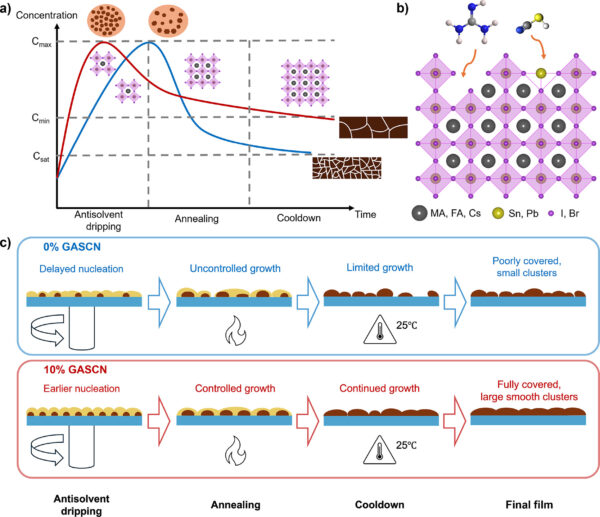 The crystallization pathway
Image: University College London, Journal of the American Chemical Society, CC BY 4.0
The total device active area of the single-junction cell was 0.18 cm2, and the mask aperture area was 0.1 cm2. Its structure consisted of glass as substrate, indium tin oxide (ITO) as transparent conducting electrode, poly (3,4-ethylenedioxythiophene)−poly (styrenesulfonate) (PEDOT:PSS) as the hole transport layer (HTL), Sn–Pb perovskite as light absorber, fullerene (C₆₀) as electron transport layer (ETL), bathocuproine (BCP) as a buffer layer an silver (Ag) as tp electrode. That resulted in a structure of glass/ITO/PEDOT:PSS/perovskite/C60/BCP/Ag.
“The champion control devices achieved a power conversion efficiency (PCE) of 19.12%, short-circuit current density (Jsc) of 30.92 mA cm−2, open-circuit voltage (Voc) of 0.81 V, and a fill factor (FF) of 76.29%. In contrast, devices with 10% GASCN showed a PCE of 22.34%, a Jsc of 31.84 mA cm−2, a Voc of 0.87 V, and an FF of 80.02%,” the results showed. “All PV parameters systematically improved as the GASCN concentration increased from 0% to 10% but declined when the concentration went further to 20%.”
While the champion device treated with GASCN achieved the highest PCE of 22.34%,