

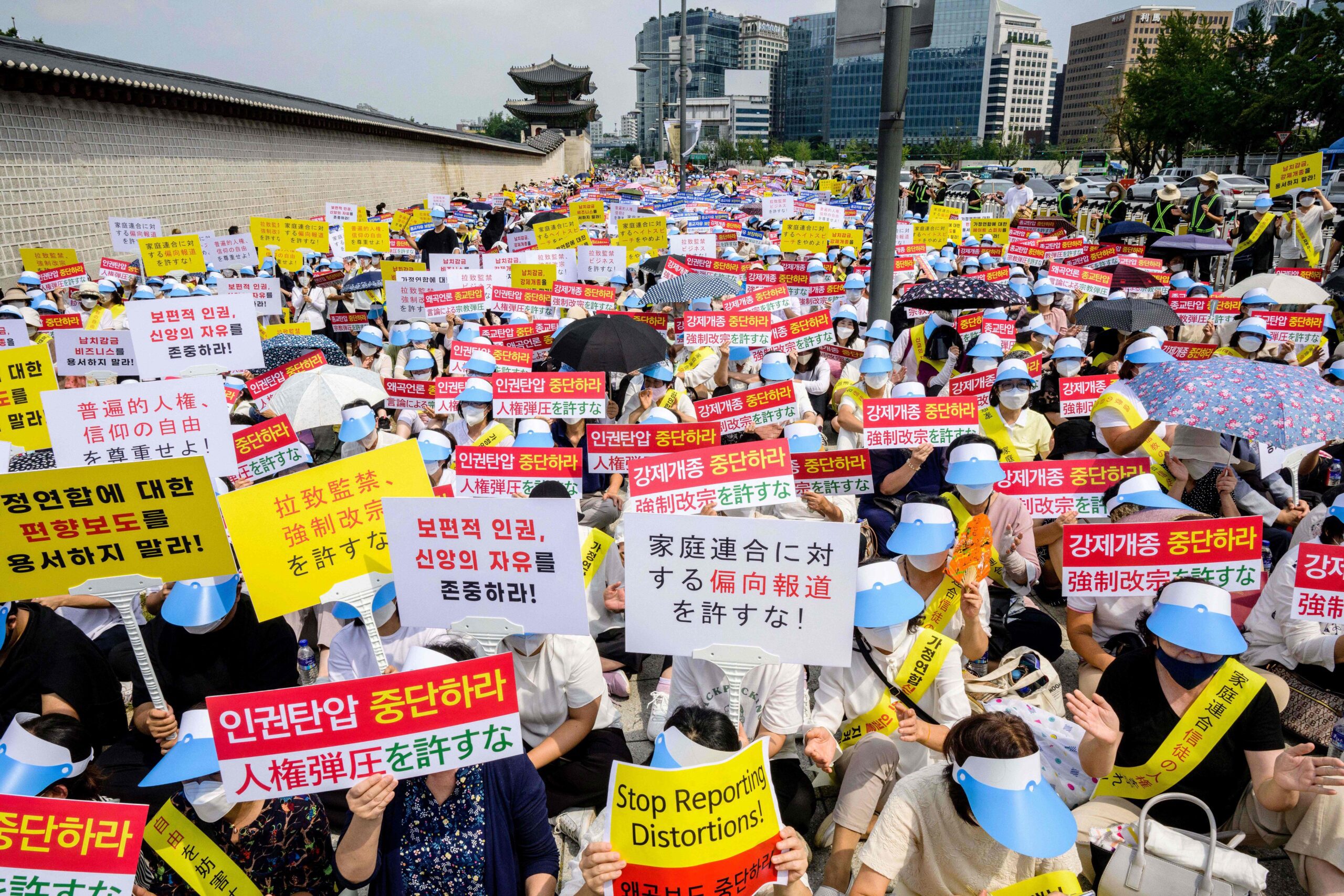


Unification Church members rally in Seoul on Aug. 18, 2022, to protest against the media coverage the group received in Japan following the assassination in early July of former Japanese Prime Minister Shinzo Abe. Photo: Anthony Wallace/AFP via Getty Images

Elle Hardy is a journalist and author of “Beyond Belief: How Pentecostal Christianity Is Taking Over the World.”
He has a stan culture to rival K-pop idols, a fund bankrolled by sympathizers, and has been labeled one of the “most successful assassins” in history. Beginning on Tuesday, Tetsuya Yamagami, the man who shot Japan’s longest-serving prime minister with a homemade gun, is standing trial. But in the eyes of many of his countrymen, the real defendant in the dock is Japan’s political system itself.
When Yamagami pulled the trigger in July 2022, killing Shinzo Abe in a puff of white smoke at a suburban political rally, it seemed incomprehensible. Modern Japan doesn’t have a gun culture, much less one of assassination. Photos soon emerged of Yamagami being wrestled to the ground by security, his crude blunderbuss — held together with gaffer tape — smoldering while Abe lay dying.
“I had no choice,” Yamagami told police, “but to choose Mr. Abe as a murder target.” The 45-year-old saw Abe — the third-generation godfather of Japan’s most powerful political dynasty — as the embodiment of a system that had destroyed his family. Yamagami described Abe as “one of the Unification Church’s sympathizers who wields the most influence in the real world.” To the defendant, Abe was the figure who could be held responsible for the decadeslong relationship between Abe’s right-wing Liberal Democratic Party, or LDP, and the Unification Church, a quasi-Christian movement founded by Korean preacher Sun Myung Moon more than 70 years ago.
To understand what brought him to that fateful moment, we first need to understand the bizarre Korean religious movement that served as the bridge between the two men — despite neither being members.
Moon was born in North Korea in 1920, at a time when the country was under repressive Japanese occupation and Christianity was flourishing as both a faith and a source of resistance. According to the church’s founding beliefs, Moon claimed Jesus visited him as a teenager and begged him to complete his mission to create God’s kingdom on Earth, with Korea as its chosen nation.
 police station to head to the prosecutor’s office in Nara. A man accused of killing Japan’s former prime minister Shinzo Abe pled guilty on October 28, 2025, three years after the assassination in broad daylight shocked the world. (Photo by JIJI Press / AFP) / Japan OUT (Photo by STR/JIJI Press/AFP via Getty Images)” width=”2507″ height=”3000″ loading=”lazy”/>
Tetsuya Yamagami, the man accused of murdering former Japanese Prime Minister Shinzo Abe, leaves the police station to head to the prosecutor’s office in Nara, Japan, on July 10, 2022. Photo: STR/JIJI Press/AFP/Japan OUT via Getty Images
In 1954, after building a small but devoted following, Moon founded the Holy Spirit Association for the Unification of World Christianity, better known as the Unification Church. In the United States, where it rose to prominence two decades later, the group became infamously known as the “Moonies,” noted for its mass weddings at venues like Madison Square Garden,