

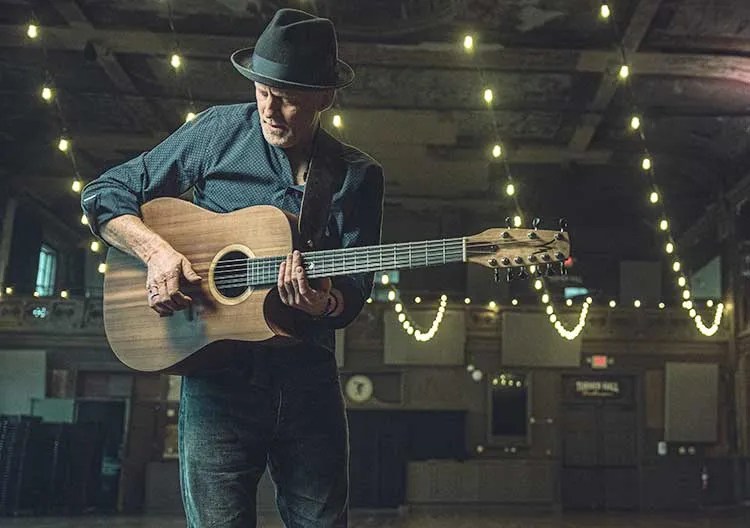

The sun had just set on a perfect, gumdrop-colored leaf peeping day in late October when Willy Porter took the stage at the Fruitlands Museum in Harvard, Massachusetts. Porter silently nodded and smiled, greeting his eager audience, and began to play fast arpeggio harmonics up the neck on his custom Jason Kostal guitar set up with a low open tuning and partial capo. Perfectly rendered and hypnotic, drawing in and centering the audience, the harmonic pattern soon opened up like a clear stretch of road into an infectious groove with a thumping bass note felt deep in the belly as Porter sang, “Put down your weapons, let the music change your mind.”
For over 30 years, the Milwaukee-based singer-songwriter has made his mark on the acoustic music scene for his exceptional, inventive guitar playing, his heartfelt and soulful lyricism, his improvisational live shows, and his side-splitting humor. But above all else, Porter may be best known for his kindness as he searches for and celebrates the best of what humans are capable of. On his most recent album, The Ravine—his 13th full-length release—Porter once again invites listeners to embark on a musical journey that traverses a grand spectrum of emotions. From the sublime to the mundane, this new record is an unwavering quest for new musical, spiritual, and personal horizons.
 Photo: Cory Zimmerman/Z2
I first met Porter in 2005, when I opened for him at Sam Bond’s Garage in Eugene, Oregon. In the early days of my own touring career, I had made the rookie mistake of miscalculating how long it would take to get to the venue and had missed his soundcheck. Also, on the way to the gig, when I opened the jewel box to the album (Dog Eared Dream) that Porter’s agency had sent me, the CD was missing. So I hadn’t heard one note of his music, but after I quickly sound checked, we decided to take a walk around the neighborhood. I was enchanted by Porter’s way with words (what I’ve come to describe as “diamonds falling out of his mouth”), and we were fast friends. Then I heard him play. Like everyone I’ve ever known experiencing Porter’s music for the first time, I was blown away. I ended up opening several tours for him, and he produced two of my albums on his Weasel Records label.
I have been lucky enough to be the proud owner of Porter’s now-discontinued signature model Guild guitar and joined him onstage for a few tunes at the Fruitlands gig. We caught up after the show so I could ask him some questions about his newest record, his process, and his practice.
Blending Technique and Groove
Porter’s approach to the guitar is a dance between skill and emotional expression. He uses complex combinations of alternate tunings (including lowered standard tuning) and partial capos, and a highly sophisticated approach to fingerstyle.