

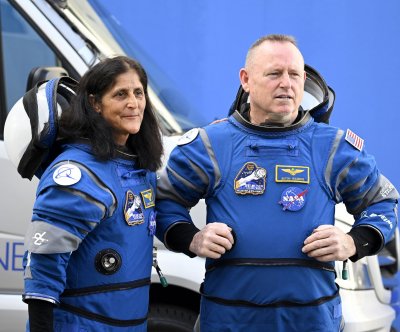

1 of 4 | NASA test pilots Suni Williams, left, and Butch Wilmore speak to NASA managers after walking out from the Operations and Checkout Building on Saturday at the Kennedy Space Center in Florida. Photo by Joe Marino/UPI | License Photo
June 1 (UPI) — NASA is still unsure of when it will attempt the first Boeing Starliner crewed mission launch, but it for sure won’t be Sunday.
The mission was called off once again Saturday, just four minutes before launch due to a computer data problem.
NASA had a backup launch date at 12:03 p.m. EDT Sunday, but it announced Saturday evening that it will not attempt liftoff at that time.
The next launch window is 10:52 a.m. EDT on Wednesday. Another window is Thursday.
United Launch Alliance, a joint venture between between Boeing and Lockheed Martin, wants to “give the team additional time to assess a ground support equipment issue” and is planning an update Sunday.
.@NASA, @BoeingSpace, and @ulalaunch are forgoing a Crew Flight Test launch attempt on June 2 to give the team additional time to assess a ground support equipment issue.
ULA will assess the ground support equipment overnight, and NASA will provide an update June 2 on next steps… pic.twitter.com/BlBddwk63o— NASA Commercial Crew (@Commercial_Crew) June 1, 2024
“We got really close today, and the team did a phenomenal job,” Steve Stich, NASA manager for the commercial crew program, told reporters during a post-launch attempt news conference.
“This is kind of the way that spaceflight is,” he added. “Every time you go to the pad for a crew flight or any flight, you’ve got a chance for scrubbing.”
A computer launch sequencer problem with the Atlas V rocket triggered a hold less than four minutes before the first crewed launch of the Boeing Starliner spacecraft was to occur.
NASA test pilots Sunita “Suni” Williams and Barry “Butch” Wilmore are attempting the first crewed mission of the Boeing Starliner spacecraft .
The Atlas V rocket was set to launch the Starliner into space from the Space Launch Complex 41 at the Cape Canaveral Space Force Station in Florida at 12:25 p.m. EDT Saturday.
Prospects for Saturday’s launch initially looked good despite a minor setback.
Around 10 a.m., teams found a loss of data from ground valves responsible for replenishing the liquid oxygen and hydrogen to the second, or upper stage, of the Atlas V rocket.
A redundant system worked as intended, which didn’t halt or slow the launch.
At 3 minutes and 50 seconds before launch, the computer launch sequencer triggered an automatic launch hold, which scrubbed the day’s launch.
The Atlas V rocket uses three large computers to monitor launch conditions and provide triple redundancy if something fails, ULA CEO Tory Bruno told reporters during news conference.
Triple redundancy means there are three ways to do the same task in case one or two other systems fail.