

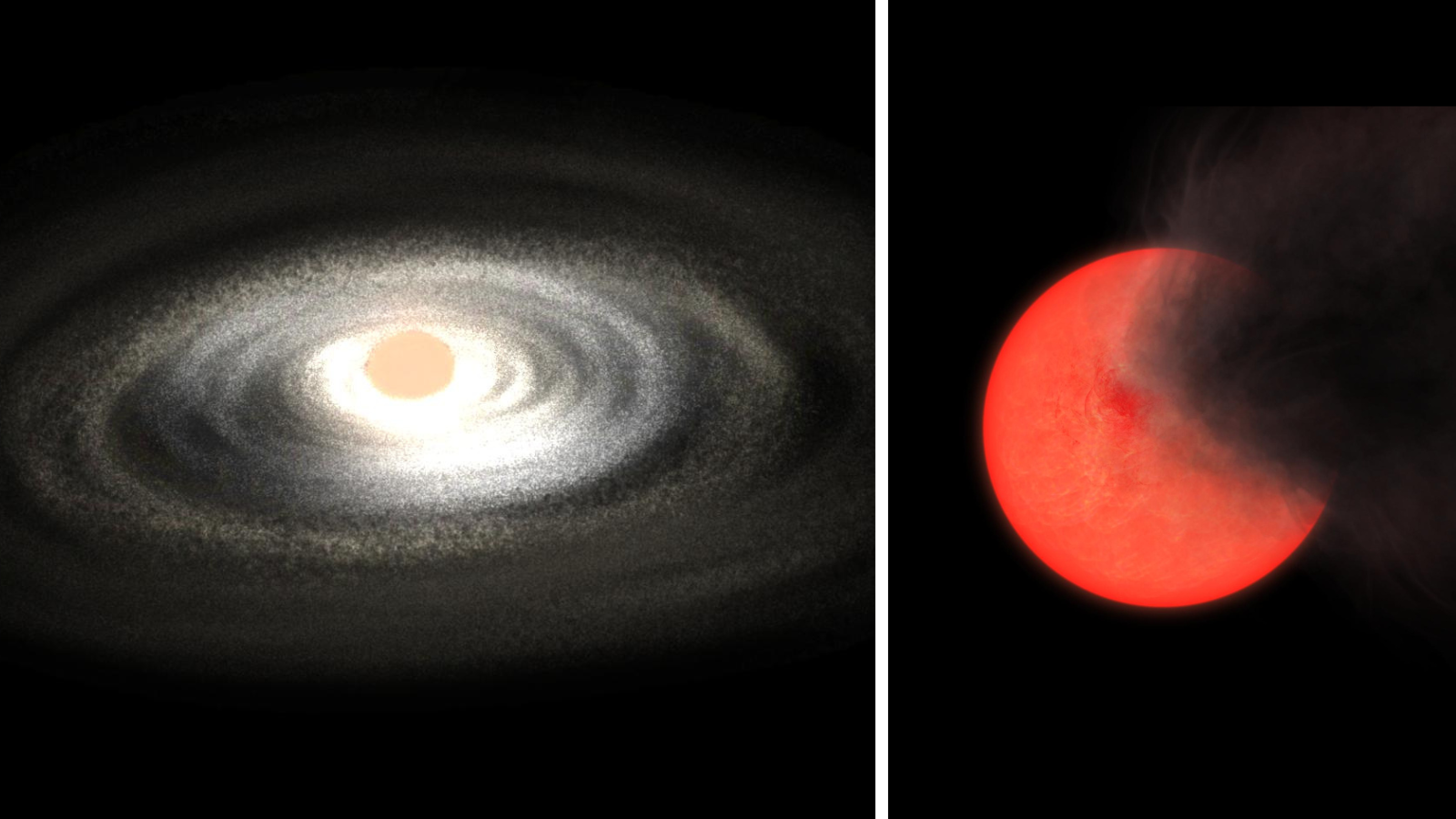

 newborn star (right) an artist’s interptation of a anceint ‘old smoker’ star” onerror=”if(this.src && this.src.indexOf(‘missing-image.svg’) !== -1){return true;};this.parentNode.replaceChild(window.missingImage(),this)” data-original-mos=”https://cdn.mos.cms.futurecdn.net/86fhnYLMCkmrrCUKfgdYuZ.png” data-pin-media=”https://cdn.mos.cms.futurecdn.net/86fhnYLMCkmrrCUKfgdYuZ.png”/>
(left) an illustration of a screaming newborn star (right) an artist’s interptation of a anceint ‘old smoker’ star
(Image credit: Royal Astronomical Society)
Astronomers have uncovered a huge haul of hidden stars, including some violently erupting newborn protostars as well as others that fall under an unexpected new category of ancient giant red stars. They dub the latter bodies “old smokers.”
These old smokers lurk at the heart of the Milky Way, the team says, sitting quietly for decades and fading away until they eventually puff out vast clouds of smoke. The stars were discovered through a 10-year survey of the sky conducted with the Visible and Infrared Survey Telescope (VISTA), located high in the Chilean Andes at the Cerro Paranal Observatory. This effort managed to track almost 1 billion stars.
The same investigation, known as the VISTA Variables in the Via Lactea (VVV), also uncovered dozens of erupting protostars as the international team behind the study looked closely at 222 stars.
“About two-thirds of the stars were easy to classify as well-understood events of various types,” Phillip Lucas, team leader and a professor at the University of Hertfordshire, said in a statement. “The rest were a bit more difficult, so we used the Very Large Telescope (VLT) to get spectra of many of them individually. A spectrum shows us how much light we can see at a spread of different wavelengths, giving a much clearer idea of what we are looking at.”
Related: An ‘extragalactic’ intruder may lurk among stars orbiting the Milky Way’s black hole
The stars spotted by the team had remained hidden due to the vast amounts of gas and dust that block our view of the Milky Way’s heart.
This material is very effective at absorbing visible light — but less adept at absorbing and blocking infrared wavelengths of electromagnetic radiation. What that means is VISTA, with its infrared eye on the cosmos, was in fact able to peer through those clouds of gas and dust to uncover unseen stars close to the center of the Milky Way.
“Our main aim was to find rarely-seen newborn stars, also called protostars, while they are undergoing a great outburst that can last for months, years, or even decades,” Zhen Guo, team member and a scientist at the University of Valparaiso, said in the statement.
Protostars in young star systems undergo these extreme outbursts as they gather enough mass from their natal envelopes of gas to trigger the fusion of hydrogen to helium and become fully-fledged stars, a process that the team hoped to learn more about.
“These outbursts happen in the slowly spinning disc of matter that is forming a new solar system. They help the newborn star in the middle to grow, but make it harder for planets to form,” Guo said. “We don’t yet understand why the discs become unstable like this.”
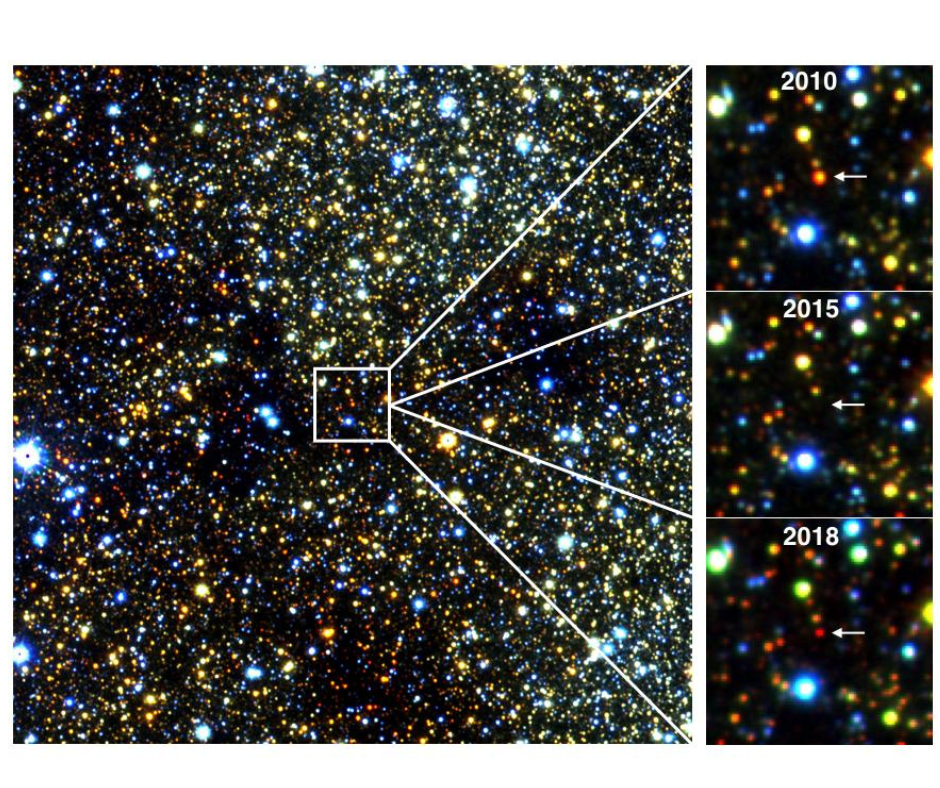
A new born star erupts in a cloud of gas and dust brightening over 2 years until 2015 and remianing bright until at least 2018 (Image credit: Royal Astronomical Society)
The astronomers say they spotted 32 “screaming” stellar infants,