


December 8, 2023
6 min read
Scientists Witness Newborn Star Feeding on Cosmic Dust in Another Galaxy for the First Time
By Phil Plait
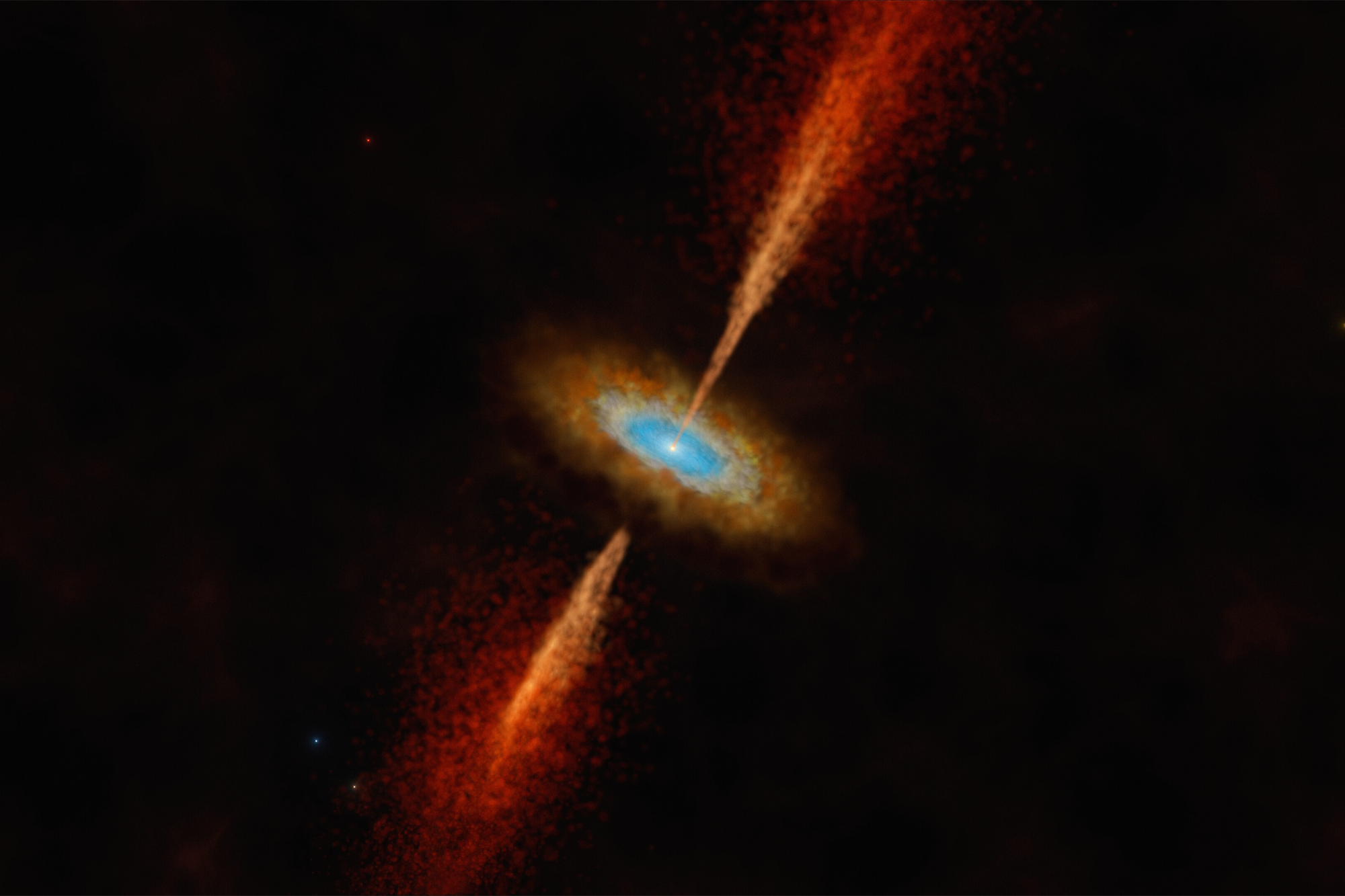
An artist’s concept of the HH 1177 system, a dusty disk around a newborn massive star in the Large Magellanic Cloud, a neighboring galaxy of the Milky Way. The glowing star in the center is feeding on material from the disk, while also ejecting matter in powerful jets.
Making stars is a messy business. Although the process takes far longer than any human life span, we’ve sufficiently studied its various stages in stellar nurseries scattered around our galaxy to gain a decent overall grasp of how it works. It starts, in general, with a huge swirling cloud of gas and cosmic dust—like the Orion nebula that currently graces our winter skies. Motions in the cloud can give rise to tenuous clumps of material If such a clump grows large enough, it can gain the necessary gravitational pull to collapse and become denser still, drawing in more matter from the surrounding cloud all the while.
As this collapsing clump coalesces, infalling matter amplifies any rotational motion in the gas, causing the clump to spin up and flatten out into a disk with a glowing nascent star at the very center. This protostar becomes hotter and more massive as it feeds off the gas flowing in from that disk. Eventually it gains sufficient mass to squeeze hydrogen atoms together in its high-pressure core so tightly that they fuse, transmogrifying into helium and releasing huge amounts of energy. At this point a star is literally born.
Although the central sun is, well, the “star” of this show, the disk that feeds it material plays a crucial supporting role—both for stellar birth and the emergence of accompanying planets. We had seen such disks around many still-forming stars in our own Milky Way galaxy but never outside it—until now.
Astronomers have, for the very first time, detected the rotating disk of material around a very young star in another galaxy, and the discovery is already offering fresh insights about how stars form under different cosmic conditions. The results were published in the journal Nature.
The galaxy in question is the Large Magellanic Cloud (LMC), a smallish satellite of the Milky Way that is roughly 160,000 light-years from Earth. This nearby galactic companion is visible to unaided eyes in the Southern Hemisphere yet never crests above the night sky’s horizon at most northern latitudes. A few years ago astronomers took a peek at the gaseous nebula LH 117 (aka NGC 2122), a spectacular stellar factory in the LMC filled with hundreds of stars, and found that one of these stars stood out because of two long jets of material blasting away from it. Such jets are common around newborn stars.