


Armed Conflicts, Crime & Justice, Energy, Europe, Headlines, Health, Human Rights, Humanitarian Emergencies, Migration & Refugees, TerraViva United Nations

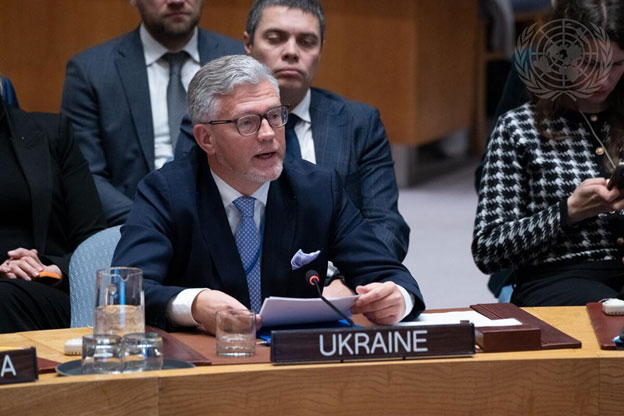
Andrii Melnyk, Permanent Representative of Ukraine to the UN, briefs the United Nations Security Council meeting on the maintenance of peace and security of Ukraine. Credit: UN Photo/Evan Schneider
UNITED NATIONS, Jan 23 2026 (IPS) – Nearly four years into Russia’s full-scale invasion, Ukraine faces another winter marked by widespread humanitarian suffering and continued indiscriminate attacks. The final months of 2025 were particularly volatile, characterized by routine bombardment of densely populated areas and repeated strikes on residential neighborhoods, critical civilian infrastructure, and humanitarian facilities. As hostilities expanded into new territories over the past year, humanitarian needs grew sharply, with many war-torn communities residing in uninhabitable areas.
According to figures from the Office of the United Nations High Commissioner for Human Rights (OHCHR), at least 55,600 civilians have been killed or injured since the wake of the full-scale invasion, with 157 civilians killed and 888 injured across Ukraine and Russian Federation-occupied areas in the final months of 2025 alone. Additionally, The United Nations High Commissioner for Refugees (UNHCR) reports that over 3.7 million people have been internally displaced since the invasion.
Additional figures from OHCHR indicate that 2025 marked the deadliest year for civilians since the start of the full-scale invasion, with the United Nations Human Rights Monitoring Mission in Ukraine (HRMMU) reporting that 2,514 civilians were killed and 12,142 were injured as a direct result of conflict-related violence. This marks a 31 percent increase from 2024.
“The 31 per cent increase in civilian casualties compared with 2024 represents a marked deterioration in the protection of civilians,” said Danielle Bell, head of HRMMU. “Our monitoring shows that this rise was driven not only by intensified hostilities along the frontline, but also by the expanded use of long-range weapons, which exposed civilians across the country to heightened risk.”
The Office for the Coordination of Humanitarian Affairs (OCHA) reports that roughly 10.8 million people across Ukraine are in urgent need of humanitarian assistance, with 3.6 million identified as particularly vulnerable and prioritized in relief operations. OCHA underscores the exacerbation of humanitarian conditions over the past few months, noting that front-line areas and northern border regions face higher rates of military shelling, destruction of civilian infrastructure, mass civilian displacement, and repeated disruptions to essential services.
Civilians residing in Russian Federation-occupied zones remain largely cut off from essential services and protection measures, facing heightened risks of serious human rights violations.
According to Matthias Schmale, The UN Human Coordinator for Ukraine, the nation is currently in the midst of a severe protection crisis, marked by rapid shrinking of humanitarian resources, consistent escalations of insecurity, and no signs that 2026 will be safer for civilians or humanitarian aid personnel. “The nature of warfare is evolving: more drone attacks and long-range strikes increase risks for civilians and humanitarians, while causing systematic damage to energy,