

Culture
/
StudentNation
/
September 18, 2024
There has been an effort to negate Fanon’s ideas and sever them from the people of Palestine. But in his work, I find the beginning of a credible path towards liberation.
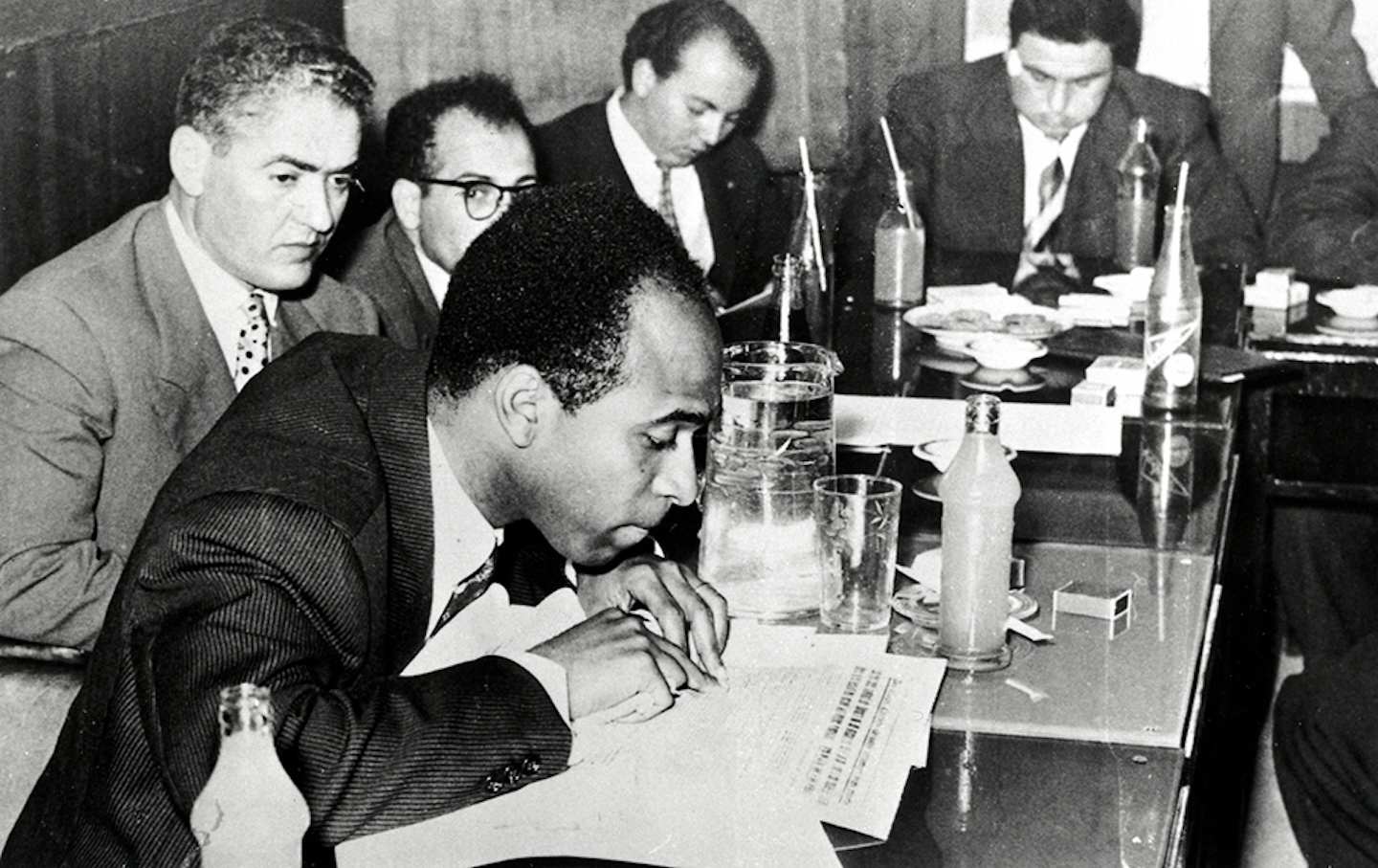
Frantz Fanon at a press conference in 1959.
(Wikimedia)
On a biting day last March, I sought shelter in a basement lecture hall where I hoped, finally, we would stop beating around the bush. My social theory survey class had discussed the communist revolution with Karl Marx, “the revolution that never happened” with Simone de Beauvoir, and was now turning to the national revolution, convening for our lecture on Frantz Fanon. By that time, Israel had killed more than 32,000 Palestinians in Gaza in its brazen campaign of genocidal bombing and starvation.
We were assigned readings from Black Skin, White Masks and The Wretched of the Earth. I anticipated our discussion to center the latter, but Fanon’s anti-colonial treatise, written against the backdrop of the Algerians’ struggle for independence from France, was squeezed into the tail end of the two-hour lecture. Our professor closed with a frantic footnote: “I just want to caution you against thinking of Fanon as the bloodthirsty celebrator of violence he’s often made out to be.”
I was disturbed. That same sentiment seems to have made its way to center stage in the months since October 2023, crowding out an honest, intellectual reappraisal of Fanon’s work. Most notably, in “Vengeful Pathologies,” the widely circulated essay by Adam Shatz—who recently published a new biography on Fanon—the argument has been advanced: All that is inflammatory in “On Violence,” the first chapter of The Wretched of the Earth, is to be qualified, viewed in a larger context, and, ultimately, negated. Fanon must not be taken at his word.
The argument goes that Jean-Paul Sartre’s infamous, incendiary preface to The Wretched of the Earth ran away with the book, and served to associate Fanon chiefly with the glorification of violence. Indeed, in the context of Algeria, it was Sartre and not Fanon who wrote: “In the first phase of the revolt, killing is a necessity: killing a European is killing two birds with one stone, eliminating in one go oppressor and oppressed: leaving one man dead and the other man free.”
Outside of the militant left, Sartre’s words were hardly ever popular: not to Hannah Arendt—who scorned the preface in “On Violence” (1970)—and not to a sizable crowd who, in the decades since, have snuffed out even the mere mention of Fanon in reference to the contemporary world, lest it falsely rile up the left-leaning youth.
In recent months, though, this crowd has gotten louder, and more forceful. If Sartre fanned the flame, then in these past few months writers and academics have tried their hardest to extinguish it.
Current Issue

This turn doesn’t come out of nowhere.