

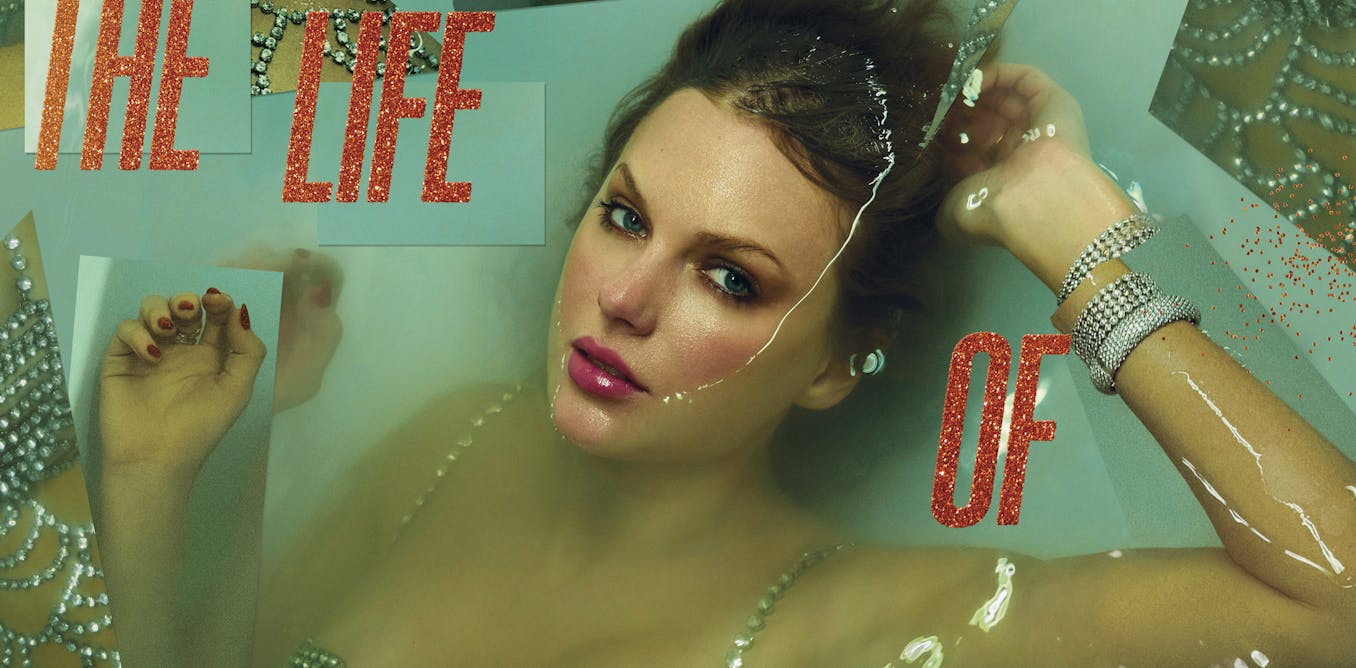

On Taylor Swift’s highly-anticipated new album The Life of a Showgirl, track four, Father Figure, includes the late George Michael as one of the credited songwriters.
But Swift’s song is not a cover of Michael’s 1987 hit of the same name. Rather, it is an “interpolation”. What does this mean, and how is it different from a cover, or a song that uses sampling?
Cover, sample, remix and interpolation
The vocabulary of popular music can be slippery. Terms such as cover, sample, remix and interpolation all describe ways artists reuse existing material, but they are not interchangeable.
A cover is a new performance of an existing song. From jazz standards, to pub rock tribute bands, the cover reproduces a song recognisably intact, albeit with varying degrees of interpretation.
In his book A Philosophy of Cover Songs, philosopher P. D. Magnus argues a cover is best understood as a re-performance of the same song, albeit open to stylistic variation. Although, he also highlights how chronology and authorship problematise this definition.
For example, although Paul McCartney wrote The Beatles’ Let It Be, the first official released version of the song was sung by Aretha Franklin. Yet no one describes the Beatles as having “covered” Franklin.
A sample involves lifting a fragment of an original sound recording, such as a guitar riff, drum loop, or vocal hook, and inserting it into a new track. The sound itself is borrowed – not just the musical idea.
A remix manipulates the audio of an existing track, often altering tempo, instrumentation or structure, while remaining tethered to the original recording. This practice originated with DJs but has since become a standard part of studio production.
An interpolation sits somewhere between covering and sampling. As Magnus and industry sources note, it means re-performing part of a song, such as a melody, lyric, or riff, within a new composition. The material is recognisable, but newly recorded – not lifted from an existing recording.
In Swift’s case, Father Figure does not re-use George Michael’s recording, but it does quote from his song. That could be why Michael is credited as a writer.
Specifically, Swift interpolates Michael’s original track by echoing the lyrics of his chorus (“I’ll be your father figure”) and uses a melody that resembles – but doesn’t copy – the melody in the original track.
These are more subtle references than substantive quotation. So while the track pays tribute to the past, it still asserts itself as a definitive new work.
Creative practice and copyright
These distinctions matter because United States copyright law separates rights in the song composition (melody, harmony, lyrics) from rights in the sound recording (the particular performance captured on a recording).
To cover a song, an artist must license the underlying composition. This is usually straightforward through mechanical licensing schemes.
To sample a recording,