

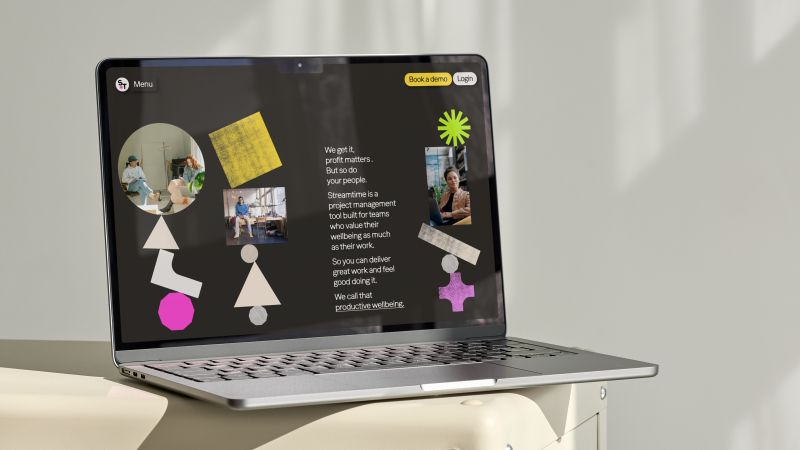

We’re facing yet another challenging time. The creative industries are once again fighting tight budgets, ghosting clients, and unsettling quiet periods. Despite these difficulties, we’ve never been as organised as we are now, thanks to project management software, Streamtime.
This isn’t your average solution to managing our day-to-day workload, though. It’s been rethinking timesheets since 2002. Would you believe it? They’ve turned the old way of doing things into intuitive to-do lists and holistic features that actually support how creatives work.
But its new internal strategy, ‘Productive Wellbeing’ – which, to you and I, means “feeling good while doing great work” – called for a shift in how Streamline presents itself. Cue the need for a brand overhaul. And enter NB Studio.
It was Streamline’s CEO, Andy Wright, who approached the London agency about the project, bringing with him a refreshing social contract that set the tone for their collaboration. It included commitments like never using work they hadn’t paid for, respecting NB’s time by only contacting them during reasonable hours, and acknowledging their expertise in branding and creativity. How’s that for mirroring what they promise via the app? But honestly, shouldn’t that be the case with every partnership?
One could say that Streamline differs from its competitors. In that, it approaches productivity and wellbeing like no one else: at its core rather than a “nice-to-have”. But here’s the interesting thing: this whole ‘Productive Wellbeing’ was never about perfection. It’s about the real, messy tension between head and heart. The daily balancing act of creative work and the commercial realities of running a business. That’s something we can relate to.
So, how do you translate this noble sentiment to its new brand? Inspired by empathy for the creative community, NB Studio’s guiding idea, ‘Business Balance for Creative Chaos’, was the spark behind Streamtime’s digital transformation across multiple touchpoints.
The new identity system is centred around a dynamic set of abstract shapes based on the product’s current interface, but now more joyful, tactile, and slightly off-kilter. Influenced by the Kiki/Bouba effect, the forms mirror the emotional highs and lows of the messy creative process. There are seven core shapes, nodding to the days of the week.
“Our core shapes transform into expressive icons that capture a wide range of human emotion, explains NB. “These shape-based emojis reflect our different moods throughout the day with a sense of humour.”
Typography, meanwhile, is expressive by combining structure with personality. Layouts intentionally break grid rules by stacking paragraphs as if they could topple over. “We reject Newton’s laws of motion and replace them with our own rules of imperfect balance,” NB explains. “Never still and always doing the opposite.”
Then there are micro-interactions – subtle yet full of personality – that breathe life into the brand identity and reinforce the core idea throughout the website design. Working in collaboration with Webflow designer Koysor Abdul, hover, buttons,