

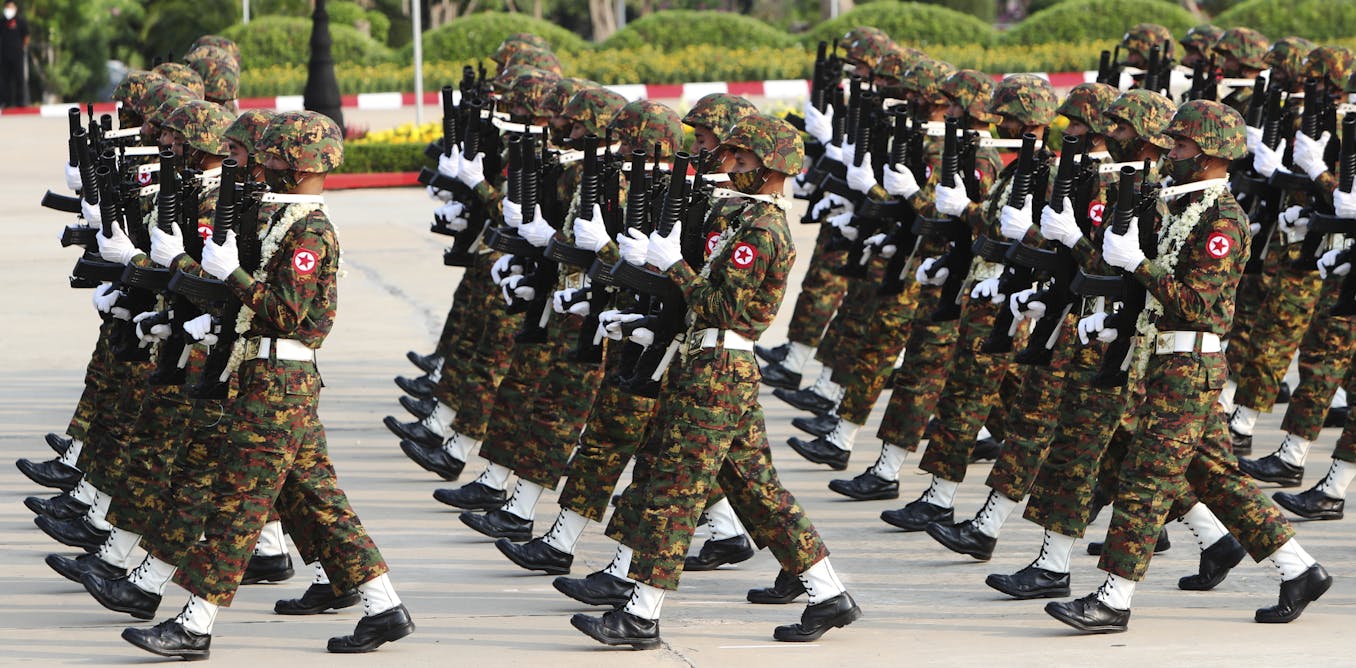

Among the cruel ironies of the Myanmar civil war, now in its sixth year, is that for an army that is struggling to conscript soldiers, the Myanmar junta has repeatedly bombed its own troops held as prisoners of war.
In this garrison state, it appears everything may be sacrificed to keep the military and its civilian front government – recently installed following widely discredited elections – in power.
There has been some impressive progress by the National Unity Government’s People’s Defence Force and allied ethnic armies against the military’s front organisation, the Union Solidarity and Development Party.
But after so many years, the Myanmar civil war is now at stalemate.
How did we get here?
The civil war began in February 2021 when the armed forces staged a coup against the elected civilian government headed by Nobel laureate Aung San Suu Kyi.
The civilian-led government had been elected in 2015, following more than five decades of military rule.
The army claimed (without evidence) there were irregularities in the 2020 elections and staged a coup months later.
For the army, allowing competitive elections in 2020 was intended as window dressing while it pursued business as usual.
It didn’t expect a genuine challenge to its deeply embedded role in the state. It had constitutionally reserved to itself the right to remove the civilian government at any time.
Since the coup, more than 90,000 people have been killed and more than three million displaced.
The army now only controls a little over a fifth of the country, but still holds most of the larger towns.
The civil war is, in many respects, a continuation of civil conflict dating back to the 1950s. Then, the government of the newly independent Burma was beset by an ethnic and communist insurgency. It soon lost control of almost all of its territory, except the Irrawaddy Valley.
In the face of political instability, the civilian government invited the army to rule the country for a year in 1960. Two years later, the army staged a coup. It stayed in power until 2015, before its recent return.
Two key factors hindering anti-junta forces
Over recent years, the successes of the anti-junta forces indicate they are in the ascendancy. Victory over the junta may just be a question of time.
However, two crucial factors may hinder their success.
The first is that when they take a strategic town or city, they’re often forced to relinquish it after being attacked by the junta’s Chinese- and Russian-supplied aircraft and drones.
Both sides use drones. However, the junta’s aircraft, as well as the sophistication of their drones, mean this is an unequal war.
Russia’s close support for the junta, and its military cooperation agreement signed in February, mean the Myanmar civil war also has an element of the Russia-Ukraine war about it.